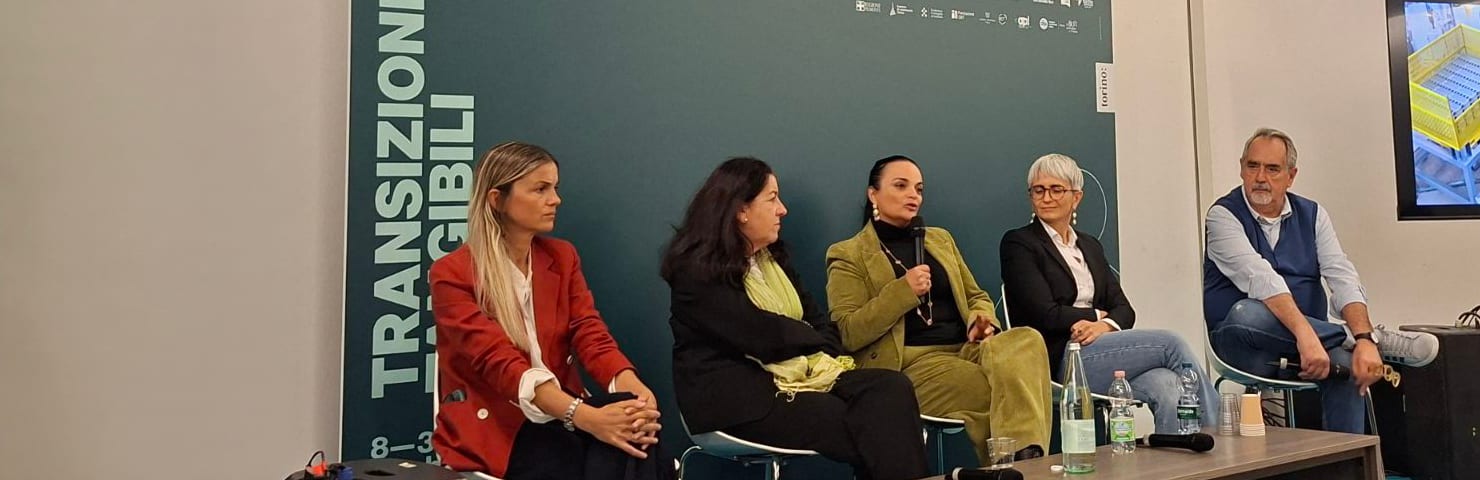
Stefania Ferrero, Chief Marketing and Products Portfolio Officer at Comau, described the company's plan to build human-centric robotics around artificial intelligence at a roundtable in Turin on Thursday, October 29. The talk, titled "Il design che avanza," took place at the Green Pavilion of MAcA. Ferrero presented Comau's change as a transformation journey rather than a single product launch.
The event and who organised it
"Il design che avanza" was part of the programme of Torino Design City – Transizioni Tangibili, a festival promoted by the Polytechnic University of Turin. The university organised it together with the Circolo del Design and the Unione Industriali Torino. The festival's title points to tangible transitions, and the Comau session was framed around how technology and people's skills drive that kind of change.
The format was a roundtable, not a product presentation. Ferrero shared the stage with three other speakers, each representing a different organisation. That mix suggests the session was meant to compare how companies in different sectors handle transformation, not to showcase one firm's hardware.
What Ferrero said about Comau's direction
Ferrero focused on Comau's transformation journey. She named two drivers: a business diversification strategy into new market sectors, and technological evolution. Diversification means the company is moving beyond its existing markets, though the talk, as described, did not list which new sectors it is targeting.
She said Comau's role in this transition is to lead a responsible transformation. The method she described is integrating artificial intelligence into human-centric technologies. She gave a range for those technologies, running from collaborative robotics to mobile robotics. Collaborative robots are built to work in shared space with people. Mobile robots move through a facility rather than staying fixed at a station. Placing both under the human-centric label indicates that the company sees people as part of the production system, not as something to be removed from it.
The second half of her argument concerned sustainability. Ferrero said the same transformation opens the way to sustainable production processes. She gave two examples: the refurbishing of used technologies and battery disassembly. Both deal with what happens to equipment and components at the end of their first working life. Refurbishing extends the use of existing technology. Battery disassembly takes apart a product so that its parts can be handled separately.
The other voices on the panel
Three other speakers joined Ferrero. Maria Antonietta Perino is Director Space Economy Exploration and International Network at Thales Alenia Space. Alice Mariotti is Global Communications Director at Newcleo. Giovanna Matrone is Sustainability Team Leader at Dumarey. The account of the session does not report what these three said, so their positions are not covered here. Their job titles show a panel that mixed communications, sustainability and international exploration roles with Ferrero's marketing and product portfolio remit.

Analysis: what the talk shows and what it leaves open
The most useful detail is the pairing of AI with collaborative and mobile robotics under a single responsibility claim. Comau is saying that the next phase of its business rests on intelligence added to robots that work near people or move around a site, not on faster fixed machines alone. That is a statement of direction. It is not evidence of a shipped capability.
The sustainability examples are the most concrete part. Refurbishing used technologies and disassembling batteries are specific process areas, and they tie the human-centric message to a practical use. They also link two themes that are often treated separately: how robots are built and deployed, and what happens to products and equipment afterwards. Battery disassembly in particular is a task where handling variation between units matters, which is a plausible reason to connect it with AI. That reasoning is ours. The talk, as described, does not make the connection explicit.
Several things remain unproven. No product names, customer deployments, timelines or performance figures were given, so there is nothing to measure the claims against. The new market sectors behind the diversification strategy were not named. The meaning of "responsible" was not defined in measurable terms, such as safety outcomes, material recovery or worker retraining. The phrase "people's skills" in the event title suggests that workforce capability is part of the plan, but the description of Ferrero's remarks does not say how Comau would support it.
Comparison with other robot makers is also hard to draw from this material. Collaborative and mobile robotics are not unique to Comau, and a stated range from one to the other does not by itself separate its approach from anyone else's. What would separate it is evidence: working refurbishing or disassembly lines, defined uses of AI in those lines, and results that an outside party could check.
For the field, the talk is a signal about positioning. An established industrial automation company is presenting AI, human-centric design and circular production as one story, and doing so at a design festival rather than at a trade show. That choice of venue implies an effort to reach audiences beyond automation buyers. Whether the story becomes a product line depends on details the company has not yet given in this setting. Readers tracking human-centric robotics should watch for named sectors, named applications and deployment data, and treat the October 29 remarks as a statement of intent until those appear.