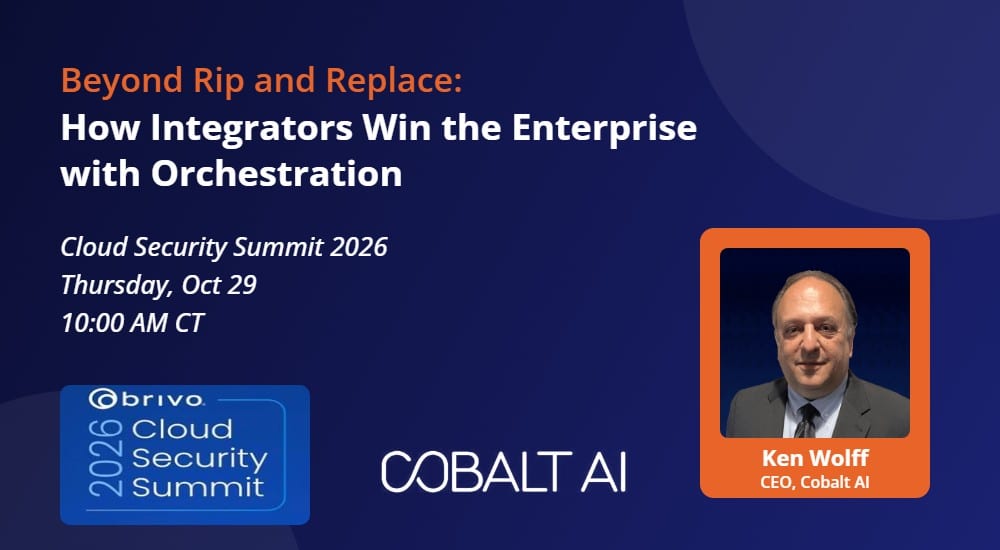
Cobalt AI says its software delivers verified security events to operators in under 75 seconds, and its chief executive was scheduled to make that case to integrators in a 15-minute session on Thursday, October 29, 2026. Ken Wolff was due to speak from 10:00 to 10:15 AM CT at the Loews Arlington Hotel & Convention Center in Arlington, Texas, as part of the 2026 Cloud Security Summit. His subject was security alarm orchestration: connecting the cameras, readers and sensors a customer already owns instead of replacing them.
The problem Wolff set out to address
Wolff's argument starts with the operations side of enterprise security. Customers keep adding cameras, readers and sensors, and their operations teams get slower as a result. A single alarm can take minutes to work. Operators sift through low-value signal before they reach the events that matter. Headcount grows with every new site, and different shifts apply different judgment under pressure.
From that, he draws a conclusion aimed at integrators: the next product an integrator sells should make the installed base work better, not add to it. The session was framed around four issues he says decide enterprise deals now. They are orchestration, connected systems that carry identity and site context, no rip-and-replace, and return on investment the customer can see in numbers.
Three alarms, three outcomes
The session centered on three everyday alarms that each end differently. In the first, a tailgate clears because context shows nothing is wrong. In the second, a door forced open is traced to its root cause and fixed, rather than dismissed again and again. In the third, a real tailgate escalates to a person with video attached.
Wolff also planned to argue that security is not a binary choice between clearing an alarm and escalating it. A middle path, such as opening a ticket for a faulty sensor or sending a nudge to a repeat tailgater, is what keeps the noise from returning. The company describes the direction of the industry as judgment applied against company policy, root-cause fixes instead of dismissals, an overlay on existing equipment, and outcomes that can be measured.
What Cobalt claims and how it is deployed
Cobalt Monitoring Intelligence connects to existing access control, video and alarm systems. It can do so in the cloud, at the edge or in a hybrid setup, so customers can modernize at their own pace. The company says people keep the final call. Cobalt resolves routine events and routes recurring causes to be fixed. Events that need a decision reach a person with video, a timeline and the root cause attached. Customers choose who applies that final judgment, either Cobalt's Command Center or their own staff.
The company listed four results as proof. It cites up to 90% less unwanted alarm noise and verified events reaching operators in under 75 seconds. It reports a 42% reduction in operator staffing costs at a Fortune 100 customer. It also says tailgating accounted for 3.2% of door traversals on one corporate campus, a figure it offers as evidence that the behavior can be measured.
Robert Mirakaj, Senior Director of Physical Security at Salesforce, is quoted on the deployment. He says that connecting Cobalt Monitoring Intelligence with Agentforce and Slack eliminated false alarms, reduced manual effort by thousands of hours and gave the company global visibility in real time.
The company behind the pitch
Wolff joined Cobalt as a consultant in 2022 and was appointed CEO by the board in February 2024. He has been CEO of four companies, three of which had successful exits. At Cobalt, he repositioned the business from a robot-centric company to the judgment-based software platform it is now. That shift is the notable detail for a robotics audience. A company once defined by its machines now sells a software layer that works with equipment other vendors installed.
Analysis: what this means and what is unproven
The pitch reflects a pattern in physical security. Sites already hold more sensors than their operators can watch, so the scarce resource is attention, not hardware. An overlay that decides which events deserve a person addresses that directly. It also lowers the barrier to purchase, because a customer does not have to retire working cameras or readers. That is a real contrast with approaches that depend on new hardware or a platform migration, and it explains why the message is aimed at integrators who own the existing installations.
The company's own history sharpens the point. Moving from robots to software suggests the value in this market sits in the decision layer more than in any one device. Still, the evidence offered here is thin. The figures are vendor-reported and framed with "up to" on the noise reduction. The source gives no baseline for the alarm-noise claim and no definition of what counts as a verified event. It does not say how many sites or customers sit behind the 75-second figure. The 42% staffing reduction comes from one unnamed Fortune 100 customer, and the 3.2% tailgating rate comes from one campus. The Salesforce statement is a customer testimonial, not an independent evaluation.
Several questions remain open. The most important is the miss rate: a system that clears more alarms also risks clearing one that should have escalated, and no figure for that appears. It is also unclear how "judgment against company policy" is configured and audited, and how well results hold across mixed or older equipment. The human-in-the-loop design is a sensible safeguard, but it depends on how often events reach a person and how quickly. Until customers or third parties publish comparable numbers, security alarm orchestration of this kind is best read as a credible direction with unverified performance claims.