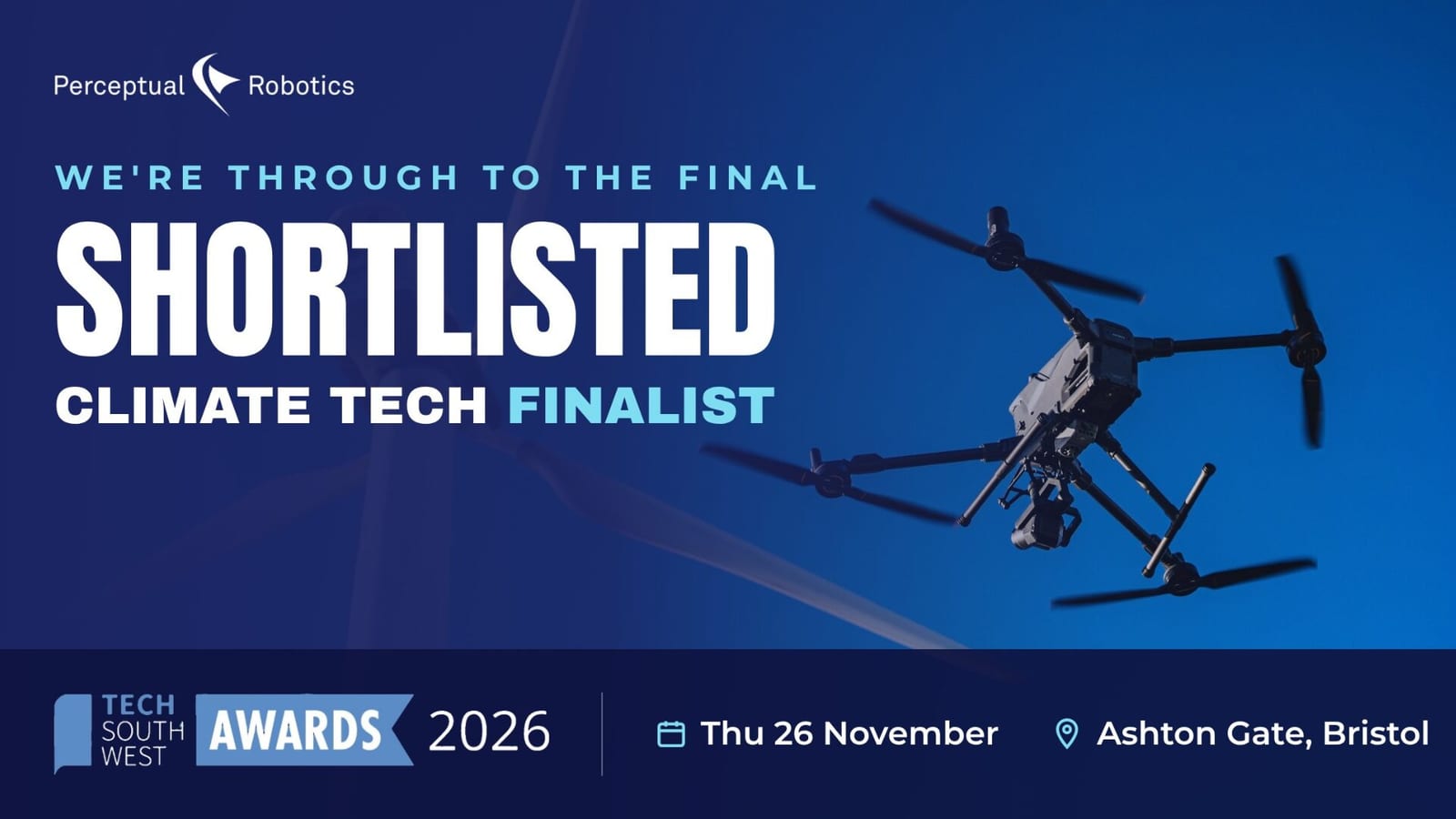
Perceptual Robotics, a Bristol company that carries out wind turbine blade inspection with AI-powered drones, has been named a finalist in the Climate Tech category at the Tech South West Awards 2026. The company announced the shortlisting on 25 October. Winners will be revealed at a ceremony in Bristol on Thursday 26 November.
What the shortlisting covers
The Climate Tech category sits within an awards programme that recognises businesses driving innovation across the South West of England. Perceptual Robotics is one of the finalists in that category. The company said it was proud to be recognised alongside what it described as many strong teams from the region.
The work being recognised is AI-powered drone inspection of wind turbine blades. The company's announcement did not describe the technology in further detail. It did not name a drone platform, a sensor payload or a specific software product, and it did not say how many turbines or blades it has inspected.
The announcement was written by Lucia Roca and filed under news. It carried a set of tags that point to the company's focus areas, including blade health, offshore wind energy, predictive maintenance, operational efficiency and unmanned aerial vehicles. Those tags indicate the markets the company sees itself in. They are not performance claims.
The ceremony and the local angle
The Tech South West Awards 2026 will take place on Thursday 26 November at Ashton Gate Stadium in Bristol. The event runs from 6pm to midnight. Winners in each category will be announced on the night.
Perceptual Robotics is based in Bristol, so the venue is in its home city. The company said this made the shortlisting feel close to home. It thanked its team, along with the customers and partners who help it keep improving how blade inspections get done. It did not name any of those customers or partners.
The announcement did not say how many finalists are in the Climate Tech category. It also did not say who the other finalists are, or what criteria the judges apply. Readers should treat the shortlisting as a recognition of the company's work by the awards programme, not as a ranking against named competitors.
What the company does
The company's description is brief. It works on inspecting wind turbine blades using drones and artificial intelligence. Its own wording frames the goal as improving how blade inspections get done. The tags attached to the announcement include offshore renewables, predictive maintenance and inspection, which suggests the work is aimed at finding blade condition issues and informing maintenance decisions.
The announcement gives no figures for inspection speed, defect detection accuracy, cost or fleet size. It does not state how the AI component is used, whether on images captured by the drones or in flight planning. It does not say whether inspections are carried out onshore, offshore or both, although the offshore wind tags suggest offshore turbines are part of the picture.
Because those details are absent, this report limits itself to what the company has stated: it builds AI-powered drone inspection for wind turbine blades, it is based in Bristol, and it is a Climate Tech finalist.
Analysis: what a shortlisting does and does not show
A regional awards shortlisting is a modest signal, and it is worth reading for what it is. It shows that a panel or process connected to the Tech South West Awards judged the company's work worthy of a place in the final. It does not show that the inspection method is more accurate, faster or cheaper than alternatives. The announcement offers no data that would allow that comparison.
The category matters more than the trophy. Wind turbine blade inspection is a maintenance task where robotics and machine learning have a clear job to do: collect images of large structures that are hard to reach, then sort real damage from noise. A company in this space being placed under Climate Tech reflects how inspection and maintenance technology is increasingly framed as part of keeping renewable generation running, not only as a service cost.
On comparison, the announcement is silent. Other companies also offer drone-based and robotic blade inspection, and buyers weighing them would want evidence the announcement does not provide. Useful measures would include detection rates against known defects, how often findings are confirmed on later inspection, how the system handles offshore conditions, and how inspection data feeds into repair planning. Without those, the shortlisting cannot be used to rank Perceptual Robotics against anyone.
Several things remain unproven from the public statement alone. The AI component is described but not specified. Customer results are referenced in general terms but not shown. The scale of deployment is not given. None of this suggests the technology falls short. It means the announcement is a recognition notice, not a technical disclosure.
The next concrete data point is the ceremony on 26 November. If Perceptual Robotics wins, the result will confirm the judges' preference within one category and one region. A more informative development for the field would be published inspection results or named customer case studies, which would let operators judge wind turbine blade inspection services on measured performance.