
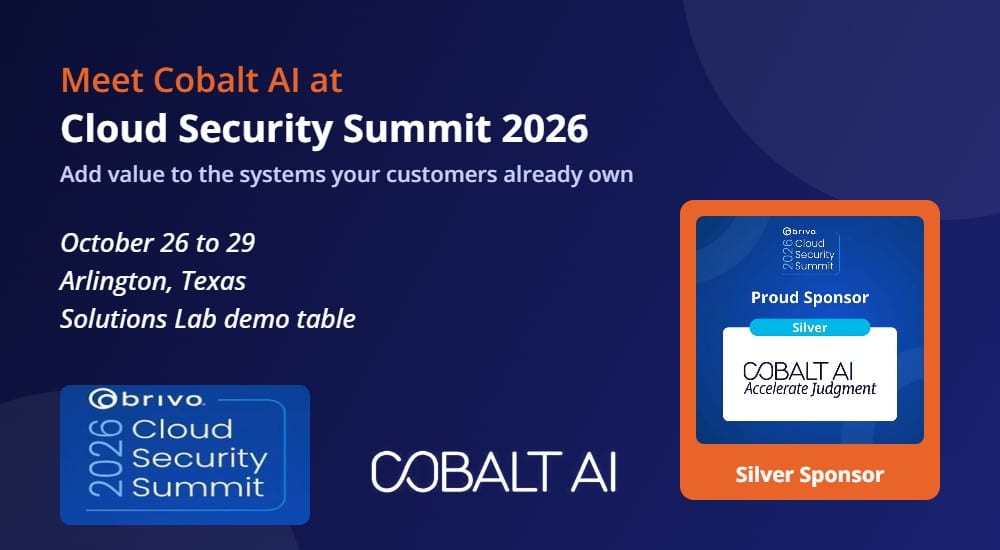
Up to 1,000,000 alarms a year can land on a single enterprise security team, and each one takes a person 2 to 7 minutes to work. Cobalt AI built its alarm monitoring software around that workload, and it took the pitch to integrators and channel partners at the 2026 Cloud Security Summit in Arlington, Texas, which ran October 26 to 29.
The workload Cobalt is targeting
Cobalt's argument starts with how enterprise security operations behave. Its customers review every alarm, not only emergencies. Most of those alarms are noise, yet each still needs a person to look at it. Cobalt says those customers also run many separate systems, and that replacing them happens slowly.
From that, the company draws a list of what enterprise buyers want. They want the root cause of recurring alarms fixed so the noise stops returning. They want routine responses automated and only the events that need a person escalated. They want value across all their systems without ripping any of them out.
How the software works
Cobalt Monitoring Intelligence is a software overlay on cameras and access control that are already installed. It compares camera data, access control data and company policy data in real time. It connects to existing equipment in the cloud, at the edge or in a hybrid setup, so customers do not have to replace hardware.
Cobalt says it judges events against each customer's own rules, around the clock. It describes a middle ground between clearing an alarm and escalating it. A faulty door gets a ticket. A repeat tailgater gets a nudge. The aim is that the underlying cause is addressed and the alarm stops recurring.
When an event does need a decision, the system hands a person the video, a timeline and the root cause. The customer picks who makes the final call. Under the managed option, that is Cobalt's Command Center. Under the SaaS option, it is the customer's own team.
The results Cobalt cites
Cobalt lists three measures. It claims up to 90% less unwanted alarm noise, verified events delivered in under 75 seconds, and a 42% cut in operator staffing costs at a Fortune 100 customer. The company does not name that customer in this material or describe how the figures were measured.
It also quotes Robert Mirakaj, Senior Director of Physical Security at Salesforce. He says that connecting Cobalt Monitoring Intelligence with Agentforce and Slack eliminated false alarms, cut manual effort by thousands of hours and gave global visibility in real time.
The channel pitch and the Summit program
The audience at the Summit was the channel. Cobalt framed the product as a way for integrators to move from the install to the operation, with outcomes to deliver on top of the hardware they already placed. It notes that enterprise deals take 12 to 18 months to close and offered a live demo that partners could take to their own accounts.
Cobalt was a Silver Sponsor and ran a demo table in the Solutions Lab at the Loews Arlington Hotel & Convention Center. Senior Sales Engineer Ellie Horita and Charlie Jannsen, Director of Security Strategy and Operations, staffed the table. CEO Ken Wolff was scheduled to speak on Thursday, October 29, from 10:00 to 10:15 AM CT. His session was titled "Beyond Rip and Replace: How Integrators Win the Enterprise with Orchestration." Cobalt also offered 20-minute demos built around a partner's own accounts and the systems those accounts run.
Why it matters and what is unproven
The pitch addresses a real structural problem in physical security. Cameras and door controllers generate events faster than staff can review them, and the hardware is bought in cycles that last years. A software layer that works across installed equipment avoids the replacement cost that slows enterprise change. It also gives integrators, whose revenue has traditionally come from installation, a route into recurring operational work.
The approach sits close to a wider trend in which software that interprets sensor data is separated from the sensors themselves. Cobalt's distinguishing claim is the focus on root causes. Many alarm systems stop at filtering or verifying an event. Cobalt says it sends the recurring cause to be fixed, which would reduce future volume instead of only handling it faster. That is a different promise from classifying alarms, and it depends on facility teams acting on the tickets the system raises.
Several points remain unproven in public. The 90% noise reduction is stated as an upper bound, and the baseline is not given. The 42% staffing cut comes from a single unnamed customer, and the material does not say whether that result applies to smaller deployments or to customers using the SaaS option. The 75-second delivery figure has no stated conditions, such as site size or the mix of equipment.
Compatibility is the other open question. The claim that Cobalt works with whatever cameras and access control are on the wall is the core of the integrator pitch. The material does not list supported vendors, and older or mixed estates are where overlay products tend to meet their limits. Independent testing, named customer references beyond the Salesforce quote, and a clear account of how policies are encoded and audited would let integrators judge the claims. Until those appear, the figures are vendor-reported, and partners should treat them as targets to verify in a pilot.