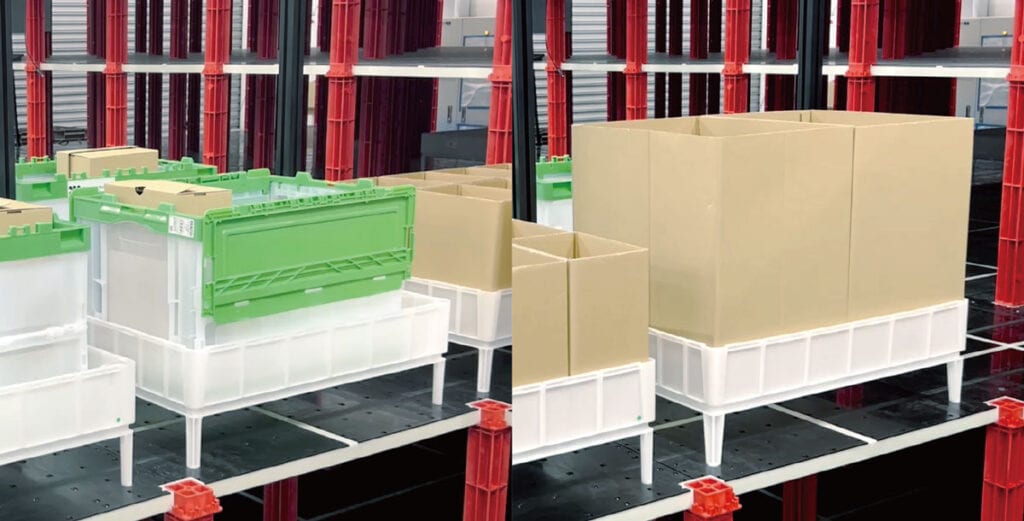
Rapyuta Robotics has detailed how its ASRS picking station is fed: bins travel from storage to the operator on autonomous robots and elevators, with no intermediate conveyors or hand-offs. The design treats the ASRS picking station as the end point of a system built from racks, robots, bins, picking stations and elevators.
The five parts of the system
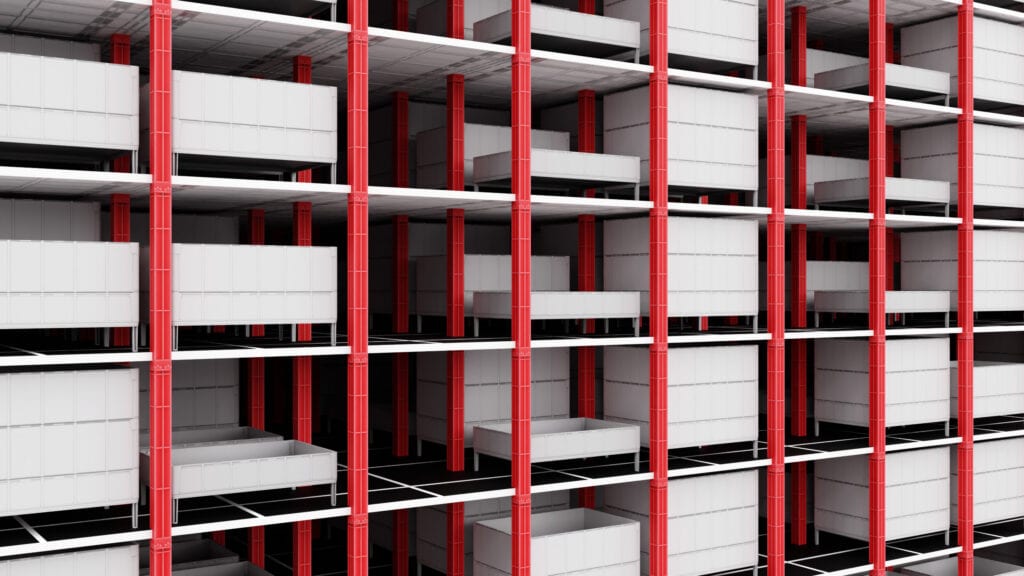
The rack is divided into sections sized for one bin or one robot each, with columns at the corners. Each floor has storage areas that face movement passages, and the robots travel along those passages.
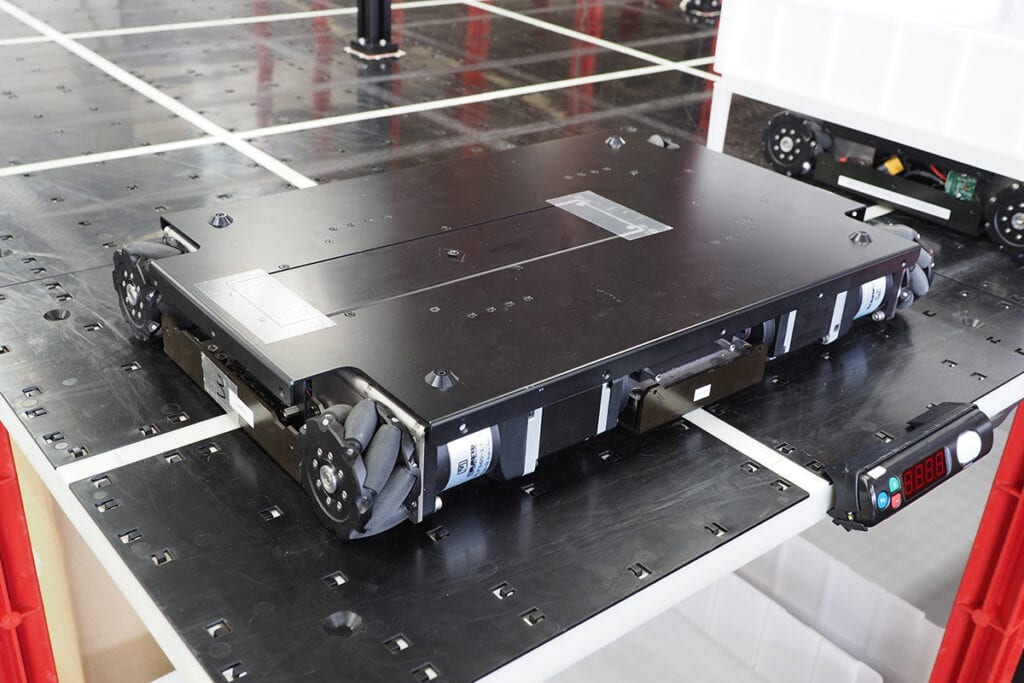
The transport robot is a compact, autonomous carrier with a low profile and adjustable height, which lets it handle bins of different sizes. It navigates with optical sensors and line tracing, and it is built to ride the elevators between floors. Integrated control modules handle safety.
Each bin is a cuboid on four legs, which leaves clearance for the robot to drive underneath. Every bin has a unique ID and can hold one SKU type or mixed SKUs.
Picking stations sit at the rack edges with direct robot lanes. Picking positions are in front of the operator, while loading positions are to the side or around the operator.
The elevators sit in the movement passages. Each has a drive unit at the top of the structure, a lifting box that carries the robot, and a control box on the rack beside it. If there is enough clearance below the ceiling, the control box goes on the top level next to the drive unit. Where clearance is tight, it moves one level down and can be placed in several positions around the elevator to suit robot paths. An intrusion sensor on the drive unit monitors the elevator area, the control box has an emergency stop, and sensors at the bottom of the shaft slow the lifting box and confirm its position.
How an order moves
Every order follows eight steps. The system locates the bin the order needs, assigns a robot, and directs it to the bin and then to the picking station. The robot retrieves the bin. After picking, the bin returns to storage, the items are marked ready for delivery, and the shipment bin goes to the shipping station. The order is then marked complete.
Several robots work at once, delivering bins to different picking stations in parallel. Operators can pick from several bins at the same time and load products directly into shipment bins. Shipment bins head to outbound docks, and the software tracks each step.
A management server routes bins based on demand, storage turnover and picking station availability. Popular SKUs are stored lower in the rack. Rapyuta says this helps operations meet carrier cut-off deadlines and balance peak loads.
Manual picking, robot arms and scaling
The architecture supports manual picking and robot arm picking. Most orders go to robot arm stations, which handle small-to-medium SKUs and can keep working overnight or during off-hours. If an order includes oversized SKUs or cannot be completed automatically, the system sends the order bin and SKU bin to a manual station during working hours.
Rapyuta describes a staged path for customers. A fully manual operation can reduce labor through the system's flow design alone, and robot arms can be added gradually or at scale later. Overnight, the arms can also merge partially filled bins without human help. In a system where bins average 50% fill, merging them frees roughly half the totes, which recovers storage capacity without new hardware.
Other routes bypass the main pick flow. Single-SKU or fast-moving items can be picked straight into external order bins, and items needed immediately can go directly to loading and unloading points.
On growth, picking stations can be placed along any rack edge and run in parallel. The system expands by adding floors, stations or robots, and the elevators allow vertical densification without costly retrofits. Rapyuta also says robot and bin footprints are proportioned so bins can sit closer together without blocking access.
What this means, and what is not yet shown
The design choice is clear. Many warehouse systems rely on sequential bin delivery and conveyor transfers, which the company names as sources of delay and operator idle time. Rapyuta removes those stages and presents several bins at one station at once. That makes the station less likely to wait on the next bin, particularly for orders with many SKUs.
The approach also shifts where the risk sits. Fewer mechanical stages means fewer conveyor parts to fail, which is the basis for the company's claim of higher uptime and simpler maintenance. But robots on multiple floors depend on elevators to change levels. The source does not say how many elevators a typical installation has or what happens to flow when one is out of service. That is a reasonable question for any buyer, because the elevator is a shared resource in a design that otherwise spreads work across many robots.
The staged automation path is a practical selling point. A site can start with human pickers and add robot arms later, and the stated geometry and software are intended to support that. This lowers the up-front commitment. It also means the ASRS picking station a customer buys on day one is not the one that delivers the full overnight bin-merging benefit.
The source offers no measured data. It gives no picks-per-hour figures, no uptime numbers, no storage density comparisons against conveyor-based systems, and no named customer results. The claims about reduced idle time, higher density and lower operational risk are design arguments, not test results. The 50% fill example is an illustration of the mechanism, not a measured outcome.
The company's own offer points the same way. It proposes a facility analysis using a customer's SKU velocity, peak-hour demand, cut-off requirements and labor model before commitment. For buyers, the useful test is whether that analysis produces site-specific throughput and station-count figures that can be checked against the parallel-handling and prioritization claims made here.