
WiBotic has added an IP65-rated version to its 1 kW wireless charger family, and its chief executive says fleets of just 20 to 40 mobile robots can already hit a charging bottleneck. Ben Waters, the company's CEO, described the shift in an interview about how wireless charging strategy changes as deployments scale.
The argument centres on opportunity charging, a method that Waters says has become practical now that fleets are large enough to need it. This article covers that strategy, the design questions Waters says companies should settle early, and the product changes at WiBotic. It closes with analysis of what the claims do and do not establish for wireless charging for robot fleets.
Why fleet charging becomes a bottleneck
The common approach is to place chargers at the edges of a facility and send a robot to them when its battery reaches a threshold such as 20%. Waters says this is easy to implement for a small fleet, because the rule is simple: when any robot hits 20%, it stops and drives to a charger.
The problem grows with fleet size. A robot on the far side of a factory may need to drive 10 minutes to reach a charger. During that trip it must navigate around other traffic, and fleet management may no longer assign it work, even if it is in an area where a task needs doing. Waters says this causes unwanted downtime and becomes a bottleneck even in fleets of 20 to 40 robots.
Opportunity charging with wireless
Opportunity charging places charging stations where robots naturally pause. If a robot finishes a task and sits for 10 seconds, a charger positioned at that spot can add energy during the pause. Waters says that repeated often enough, short top-ups add substantial energy across the fleet and let robots run around the clock without leaving their working loops.
He argues this only makes sense with wireless charging. Contact chargers would be engaged far more often under this approach, and even a very strong contact would eventually need maintenance, multiplied across every charger in the fleet. Waters says opportunity charging is the main reason companies are now asking WiBotic for wireless power.
Design questions to settle early
Waters named three issues companies should address during system design rather than after deployment. The first is power infrastructure: where the electrical outlets are, how many there are, and whether they are rated for the combined load of all the chargers planned. He says teams are often caught by this when they consider it too late.
The second is battery sizing. Waters says many companies ask whether they need a battery for an eight-hour runtime or one that supports very fast charging, and that in batteries these goals tend to trade off against each other. Some, he says, overdesign and add battery cost they do not need, especially when a charging strategy could cover the gap.
He also says customers frequently ask to charge as fast as possible. WiBotic generally assumes those choices were made for good reasons. With close customers, though, it sometimes asks whether they have checked the battery manufacturer's data sheet for the effect of a 3°C charge rate on lifetime, and whether that cost is worth it.
The third issue is maintenance. Waters says teams that finish a design and begin deploying without considering these points will likely run into every one of them within a couple of months, if not sooner.
Product direction and new markets
WiBotic has widened its focus beyond traditional robotics to floor care, medical carts, space and defense, which Waters says use the same wireless, autonomous charging product as its longstanding robotics customers. He says legacy robotics customers saw significant volume growth this year, with strong activity in automotive autonomous mobile robots and outdoor inspection at energy substations. He called humanoids a wild card, where wireless charging could reduce downtime.
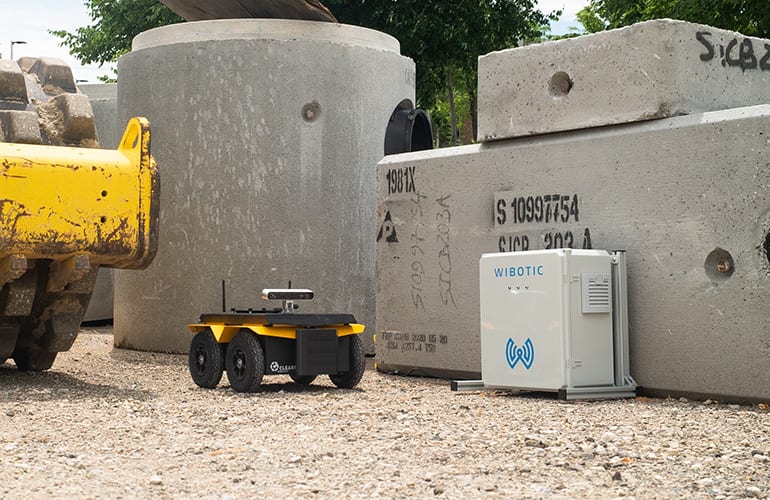
On products, Waters says WiBotic sells standard, certified systems rather than customizing each one. The 1 kW family originally shipped only in an IP20 form factor, and the company has now released an IP65 version. He says that rating is needed for outdoor robotics and is also desirable for indoor uses such as floor care, where water and dust are present.
Development is now focused on size and weight, and on power. WiBotic is building lightweight, high-power systems for drones, which Waters says also suit humanoids, since added mass forces a humanoid to spend more energy balancing. The company is also working to raise its current products to a 3 kW level.
What this means, and what is unproven
The central claim is that charging strategy, not only battery capacity, sets fleet uptime. That is a reasonable operational point. A threshold rule that sends robots on long trips to fixed chargers wastes travel time and removes robots from productive areas, and the cost rises as more robots share the same chargers. Moving chargers to where robots already stop addresses that directly.
The argument for wireless is internally consistent but comes from a wireless charger maker. Its case rests on contact wear: more frequent docking means more mechanical cycles and more maintenance. Waters did not provide failure rates, cost comparisons or efficiency figures against contact systems, so the size of the advantage is not established. Wireless transfer typically involves its own tradeoffs, and none were discussed.
The 20-to-40-robot threshold is likewise a statement of experience, not a measured result. Facility layout, task length and battery chemistry would all shift where the bottleneck appears.
The design advice is the most transferable part. Checking outlet ratings, avoiding oversized batteries and weighing fast-charge rates against battery life are low-cost steps that apply regardless of charger type. The humanoid and drone work is still at the development stage, and the 3 kW target has no stated timeline, so those markets remain unproven for WiBotic.