
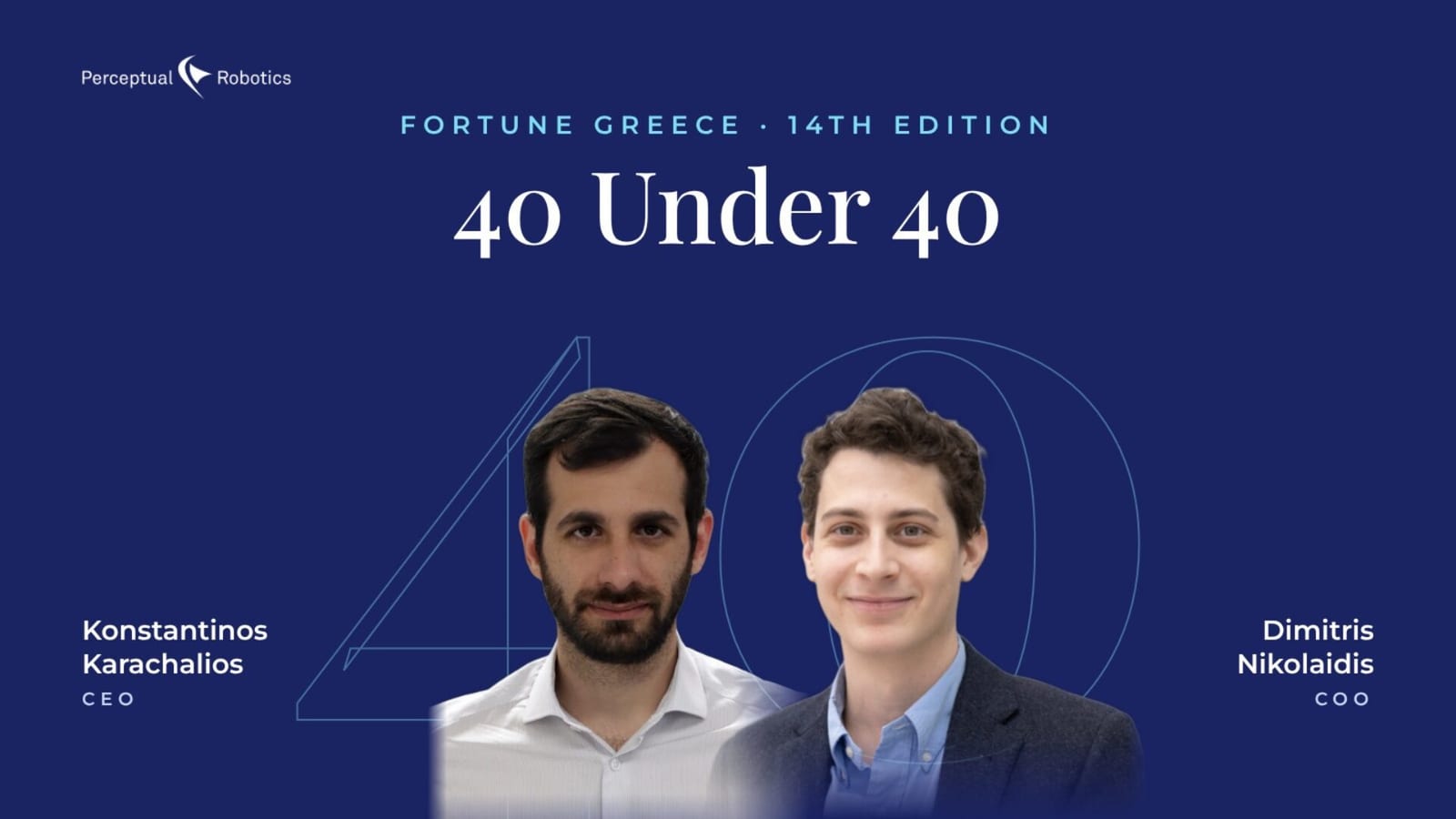
Konstantinos Karachalios and Dimitris Nikolaidis, the chief executive and chief operating officer of Perceptual Robotics, a wind turbine blade inspection company, have been included in the 14th edition of Fortune Greece's 40 Under 40 list. It is not their first appearance. The source describes the inclusion as a repeat, with the two founders returning to the ranking.
The listing was published in October 2026. Fortune Greece hosts the full ranking on its website under the 2026 business-list section.
What the list is and who is on it
The 40 Under 40 list is built around young entrepreneurs who turn ideas into real business results. That is the stated selection logic: the ranking looks at what founders have built commercially, not only at what they have proposed or prototyped.
This year, more than half of the entries come from technology. The category is broad. It covers software and artificial intelligence, and it also includes robotics. The exact count of technology entries was not given, so the only firm statement is that they make up a majority of the forty.
Karachalios and Nikolaidis are therefore part of a technology-heavy group. Within it, they represent a hardware-and-data business focused on energy infrastructure rather than a pure software product.
What the two founders run
Perceptual Robotics focuses on inspecting the blades of wind turbines. Its stated aim is to build a blade inspection company that operators come back to, and it reports working across more than 20 countries.
The company describes its output as blade data turned into decisions. The practical goal it names has two parts: keeping turbines running, and keeping maintenance teams focused on the blades that actually need attention. In other words, the product is a prioritisation of maintenance work, not just a set of inspection records.
The company's public tagging around the announcement points to offshore wind, drone inspection, unmanned aerial vehicles, predictive maintenance and blade health. The source does not detail the inspection hardware, the data pipeline, the number of turbines inspected or the customer list. None of those figures is available here, and none is assumed.
The company also thanked the operators who have trusted it with their blades and inspections. That line names operator retention as the measure it cares about, which matches its stated goal of being a provider that customers return to.
Why the recognition matters for the field
A founder ranking is not a technical validation. It says nothing about inspection accuracy, defect detection rates, inspection speed or cost per blade. Readers who want to judge Perceptual Robotics as a technology provider need those numbers, and the source does not supply them.
What the listing does show is narrower and still useful. Blade inspection is a maintenance niche that sits inside the wind sector, and a company working in it has been recognised for business results by a national business list for a repeat year. That points to commercial traction in a segment where robotics and drones are used for inspection work, though the size of that traction is not stated.
The claim of operation in more than 20 countries is the most concrete commercial indicator in the material. It suggests the service is not tied to a single national market. It does not say how many inspections are performed in each country, or whether the footprint comes from permanent teams, partners or one-off projects.
What remains unproven
Several questions stay open. The first is scale: the source gives no revenue, headcount, funding or inspection volume. Without those, the phrase about turning ideas into business results cannot be tested against Perceptual Robotics' own figures.
The second is the value of the data layer. The company says blade data becomes decisions that direct maintenance teams to the blades that need attention. That is a sensible framing for any inspection provider, since inspection only pays off if it changes what crews do. But the source offers no evidence of how often its recommendations alter maintenance plans, or whether they reduce downtime.
The third is comparison. Blade inspection is also served by other approaches, and the source does not set Perceptual Robotics against any of them. Rope-access crews, ground-based imaging and other drone services are examples of alternatives in the wider market. The material gives no basis to rank the company against them on cost, coverage or data quality, so any such ranking would be a guess.
The fourth is durability. The company's own stated target is repeat business from operators. Repeat customers are a stronger signal than a list placement, but the source reports the aspiration, not a retention rate.
For now, the fair reading is modest. Two founders in a robotics-adjacent energy niche have been recognised again by a business ranking dominated this year by technology firms. The recognition supports the view that inspection robotics and drones are becoming an accepted part of wind operations. Whether Perceptual Robotics is a leader in that space depends on performance data that has not yet been published in this material.