At Wistron in Taiwan, which manufactures baseboards for NVIDIA GPUs, retasking one robot for a new product takes a minimum of 8 hours. NVIDIA's Spencer Huang says agentic robotics cuts that to a minute or two. UC Berkeley and NVIDIA are presenting the approach jointly at the 2026 Conference on Robot Learning this week.
The method uses AI coding agents to write human-readable programs for robots. It requires no demonstration data and no human programmer for each task. The researchers describe it as a return to an older style of robotics, in which engineers first understand how a robot works and then write code to make it useful.
Code in place of demonstration data
For decades, robots were programmed with model-based methods. Engineers built a detailed model of the physics and mathematics of the robot and its environment, then wrote precise code from it. The resulting systems were fast and reliable, but they demanded human time and expertise. That cost pushed the field toward imitation learning, in which a machine-learning system is fed large amounts of human demonstration data.
Ken Goldberg, a robotics professor at UC Berkeley, says that paradigm has stalled for industrial work. His lab is presenting a paper on the approach at the conference. He is also a co-founder of Ambi Robotics and has worked with companies including Siemens and Bosch. He says data-trained systems perform well at first, then fail in new ways, and that adding data fixes some failures while exposing others. Industry's bet, he says, is that enough data will make robots reliable, as it did for ChatGPT, but that convergence point has not arrived.
Language models benefit from training data at the scale of the Internet. No robotics dataset approaches that scale, and generating one is slow and expensive. Goldberg and Huang, NVIDIA's Director of Product for Robotics, popularised the term agentic robotics for an alternative. It turns robot programming from a data problem into a coding problem that can draw on the scale of language models.
How the coding agents divide the work
Because the system is built on language models, a user can give instructions in natural language. In one Berkeley example, a robotic arm was asked to pack groceries into a bag. The task is split into sub-tasks, and each goes to a separate coding agent. One agent handles perception, identifying the groceries and the bag. A second handles manipulation with the gripper. A third handles moving objects with the arm once they are grasped.
Huang says the supporting tools already exist: object classifiers, pose estimation, task and motion planning, and trajectory generation. Previously a human had to write the code that connected them. The agents now generate that code themselves.
Simulation as the test bed
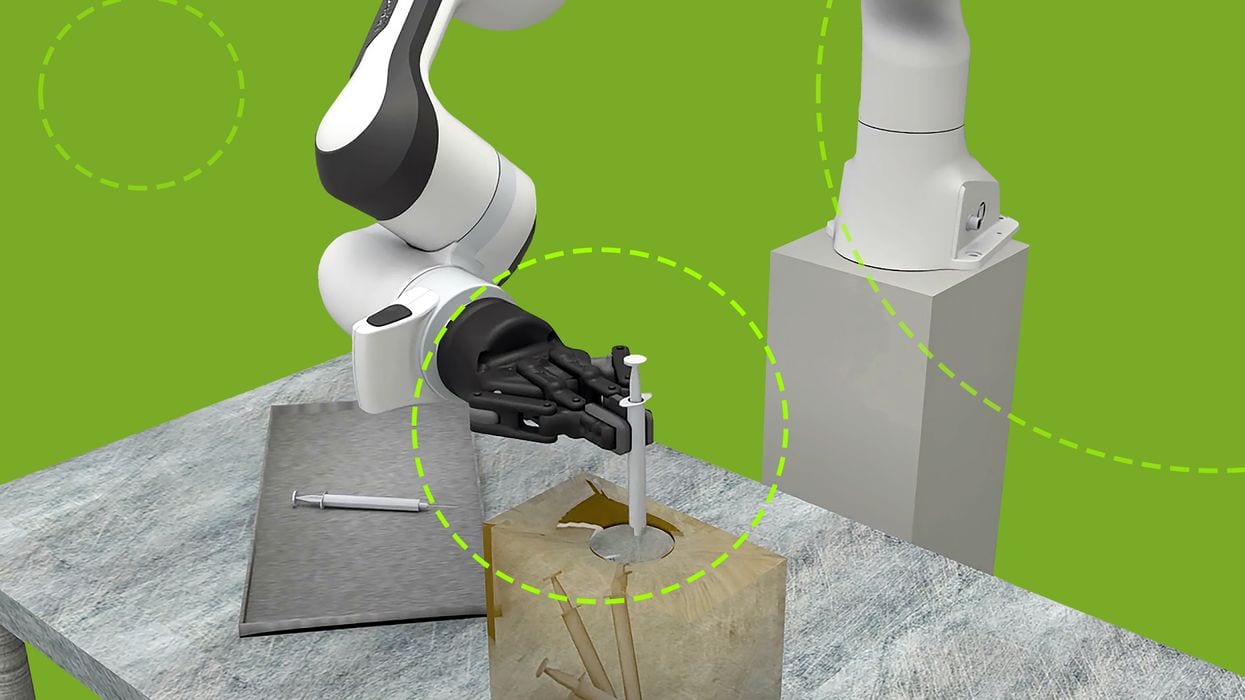
The agents run their code in simulation, change starting conditions, identify failures, and refine the program until it works. The limit is the simulation itself. Goldberg says simulations are hard to build, because greater accuracy means more parameters that a human typically has to configure for each task.
His team gave an agent direct access to those parameters and told it to match the simulation to a video of the real world. Goldberg says the agent reproduced the lighting, the background and the rest of the environment, and that the two were hard to tell apart side by side. Agents can also be fed video of a failed task and asked to update the simulation to match, while the coding agents iterate on a fix.
Torsten Kroeger, chief science officer at Alphabet's Intrinsic, is not involved in the research. He cautions that the gap between simulation and the real world remains unsolved. In his words, no physics engine can accurately model physical contact with the world.
To catch poor code, Huang says the team uses adversarial setups in which one agent designs a solution and another tries to find its flaws.
Results and early use cases
In Berkeley's testing, the approach reached success rates of up to 99 percent, matching human hand-engineered performance. On tasks where baseline imitation learning succeeded only 20 percent of the time, the agents still reached that top figure. Goldberg adds that the method uses an off-the-shelf coding agent, needs no data collection, and produces code a person can read and fix.
Huang sees the near-term fit in industrial manufacturing and manipulation that demands precision. He says some NVIDIA partners in semiconductors need components placed within 0.3 mm, which he says NVIDIA's GR00T humanoid development platform cannot do repeatably today. He also expects the generated code to serve as training data for later models. His thesis is that general intelligence in robotics will first appear as an agent orchestrating conventional technologies and specialised policies.
A set of benchmarks developed with NVIDIA Isaac Lab-Arena and the Newton physics engine is meant to let researchers evaluate agent performance. Goldberg is now working with real companies to put the approach into practice.
What the results show, and what they leave open
The main significance is where the approach puts human-readable structure back into robot control. A learned policy is a black box. Generated code can be inspected, tested and corrected by an engineer, which matters in commercial deployments that need reliability and safety. The Wistron figure points to a second benefit. If retasking drops from hours to minutes, the cost of changing products falls, and that is a cost imitation learning has not addressed.
The approach also differs from the current data-collection race in what it inherits. The agents compose existing perception, planning and trajectory tools rather than learning behaviour from scratch. Its ceiling is therefore set partly by those tools and by the fidelity of the simulation. That explains why the first targets are constrained industrial tasks and not open-ended home work, where Goldberg himself says imitation learning is more promising.
Several points remain unproven. The 99 percent figure is an upper bound, and the source does not say how many tasks were tested or how the results spread across them. The benchmarks come from the same groups promoting the method, and NVIDIA is a co-announcer, so independent replication will matter. Kroeger's contact-physics objection bears directly on the simulation-first workflow, and the source gives no evidence that the agents overcome it beyond iterating on failures. His second concern, whether agents can be trusted to behave correctly every time, is also open. Human review of generated code helps, but it becomes harder to rely on as agents take on more of the work.
Huang's claim that agentic robotics leads toward general-purpose capability is a thesis, not a result. Agentic robotics currently has support as a faster way to program precise, repeatable industrial tasks. Whether it extends further depends on testing outside the researchers' own benchmarks.