A line of simple electric motors, coupled through a shared mechanical backbone and pulling against a thick fluid, has reproduced several behaviours of muscle without any central controller. The tabletop device is an artificial muscle model built by a team at the University of Bristol. It shows coordinated, load-dependent force emerging from the physical layout of the motors rather than from software.
The results appear in Interface, a Royal Society journal. Hermes Bloomfield-Gadêlha, a mathematician at Bristol, describes the work as evidence that the coordination seen in real muscle may be a property of its setup. It does not have to be programmed and policed continuously.
From sarcomere to tabletop
The model starts from the sarcomere, the smallest force-producing unit of muscle. A sarcomere is built from actin protein filaments and myosin molecular motors, which together form the actomyosin system. Myosin motors repeatedly grab, pull and release actin cables, and thousands of them must work together to hold a steady force. How that coordination arises at the molecular level is not settled.
The team first wrote a mathematical model. It did not try to reproduce the chemical cycle that drives myosin. Each force-producing unit became a cycling rotor that contributes only while it is mechanically engaged with a physical backbone. When disengaged, the rotor drops out and acts alone.
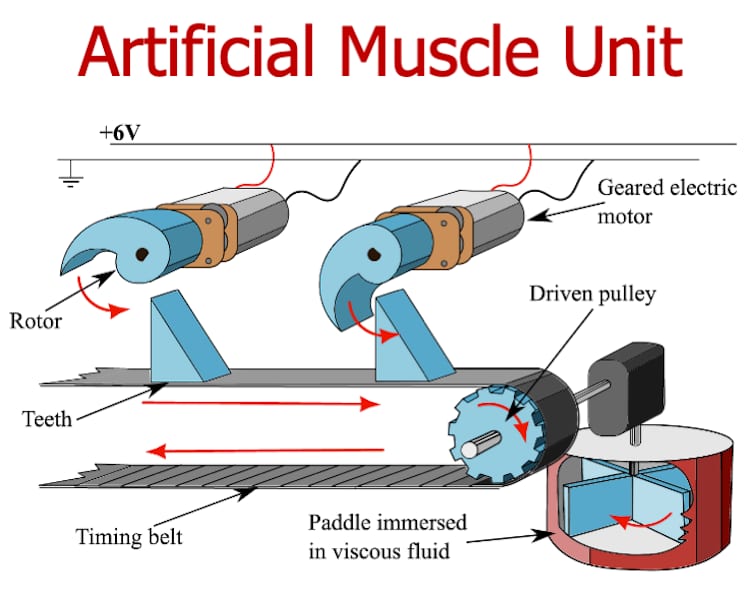
To test the idea in hardware, the researchers built a line of electric motors that interact through a shared backbone. The motors pulled against a viscous fluid, which gave a resistance similar to the viscous load that biological motors face inside muscle. The device produces force when supplied with current.
Coordination without communication
In both the mathematical model and the device, the motors do not stay connected. Each one briefly touches the moving backbone, pushes on it, then lets go. As the backbone moves, it carries the mechanical effect of one motor to the next. The motors coordinate without communicating directly.
Bloomfield-Gadêlha notes that this attach-and-detach design choice makes the network reorganise itself over time. Real motors in muscle also attach and detach as part of their biochemical cycles. The scaffold does much of the coordinating work, though that role is hidden. It lets units sense one another strongly enough for collective patterns to form.
What the system did
Several muscle-like behaviours appeared on their own, even in this stripped-down setup. As resistance increased, the motors collectively developed a load-speed relationship. More units contributed effectively as the load rose, so participation grew under heavier loads.
Under certain conditions the motion became jerky. Periods of coordinated pulling were interrupted by sudden slips, a pattern the researchers say echoes real actomyosin experiments. The system could also organise into travelling waves of coordination, in which the pattern moves along the array.
The team sees this as a loose scaling-up of the sarcomere idea: many force units embedded in a shared structure that passes forces from one unit to the next.
Flagella, cilia and the robotics angle
The researchers point to a similar problem in flagella and cilia. Flagella are tail-like appendages on the cells of some eukaryotes, including the tail of human sperm. Cilia are hair-like structures on many eukaryotic cells. Both are driven by large numbers of molecular motors spread along a slender scaffold, the axoneme, which turns local motor activity into bending waves. In sperm those waves underpin motility and fertility. In cilia they help move fluid in the airways and other tissues.
The authors call flagella muscle-like systems in disguise: drivers embedded in a coupling structure, with geometry determining how local activity adds up to a travelling wave. If structure does some of the organising, evolution may not need a central control system to build reliable, adaptive motor ensembles.
For robotics, the paper addresses a cost problem. Getting many actuators to cooperate usually means adding sensors, feedback loops, control algorithms and sometimes mechanical ratchets or complex gearing. That approach works but can be fragile and error-prone. The Bristol model suggests simpler actuators are possible, in line with long-running efforts on soft robots and artificial muscle.
Analysis: what this does and does not establish
The main value of the result is conceptual. It moves part of the coordination problem from the controller to the mechanism. In most robot arms and legs, stability under changing load comes from sensing and feedback. Here, a rising load recruited more working units and produced a load-speed relationship through mechanics alone. That is a different design philosophy from adding more computation, and it fits the aims of soft robotics, where the body is meant to share the work of control.
The comparison with existing artificial muscle approaches needs care. The source does not benchmark the device against any other actuator. It reports no force, speed, efficiency or lifetime figures, and the motors are ordinary electric motors in a bench-scale line. It is a physical demonstration of a principle. It is not a candidate component for a robot limb, and nothing in the work says it outperforms conventional actuators.
Several questions remain open. The jerky slip behaviour matches real actomyosin experiments, but in an engineered system it could be a drawback, and the authors do not say how to suppress it when smooth motion is wanted. Travelling waves are a feature in flagella and a possible hazard in a load-bearing actuator. The work also does not show whether the effect holds as the number of units grows large, or how a designer would tune the backbone for a specific task.
The biological claim is also modest. The model shows that coordination can emerge from this kind of coupling. It does not prove that muscle works this way. The authors present it as a way to test ideas about a question that is still unsettled.
What would make the robotics case stronger is concrete: measured performance against conventional actuators, operation at larger scale, and a demonstration inside a working soft robot. Until then, the study is best read as evidence that mechanical structure can carry coordination that engineers usually assign to control software.