PrecisionForm Inc., a producer of small custom metal parts, uses a Universal Robots UR5 cobot running the ActiNav system to pull parts out of deep bins and load them into CNC machines. The setup is one of four deployments that show how midmarket manufacturing robots are being applied to specific workflows rather than whole-factory rebuilds.
The other three cases involve Torneria Novoletto, Telesis and Northern Kentucky Machine (NKM). Each used a different robot supplier and solved a different problem. Labor shortages, machine utilization and quality demands run through all of them.
Bin picking on older CNC machines
PrecisionForm set out to automate bin picking for its CNC machines. The ActiNav system pairs the UR5 with vision and path-planning software. That combination lets the cobot pick reliably from deep bins, a task where part geometry often causes trouble. Universal Robots says users can deploy and calibrate the system easily.
The company reports that challenging geometries became less of an issue and that operators were freed up to manage multiple machines. The cobots also helped extend the useful life of older CNC equipment. PrecisionForm describes the robotic addition as relatively inexpensive, and says it improved daily production and raised the potential return on investment for a midmarket operation.
Unmanned operation in Italy and Kentucky
Torneria Novoletto is an Italian maker of components for the chemical, medical and pharmaceutical sectors. It struggled to reach high precision and process reliability on medium-sized batches. The company adopted SCHUNK's R-C2 automation concept, which combines clamping devices and grippers with robotic handling.
The R-C2 handles a continuous range of workpiece sizes and reclamps parts automatically. That cut setup and changeover times significantly and supported high operational flexibility. Torneria Novoletto says the system helps it pursue unmanned 24/7 operation, raise machine utilization and offset a shortage of skilled labor.
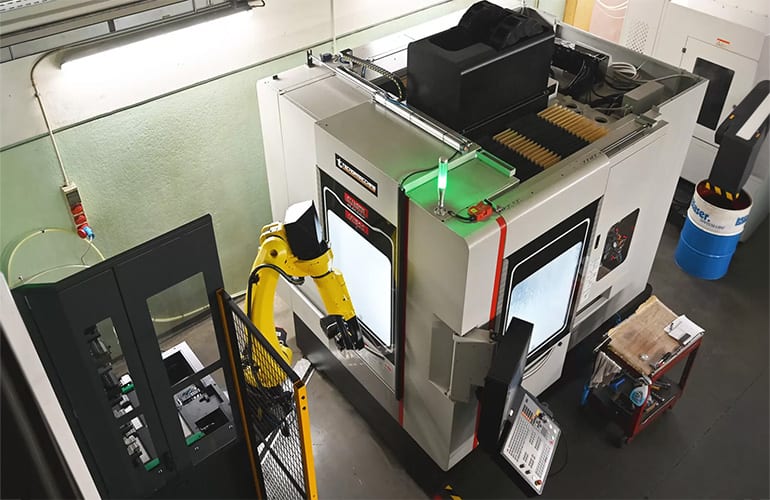
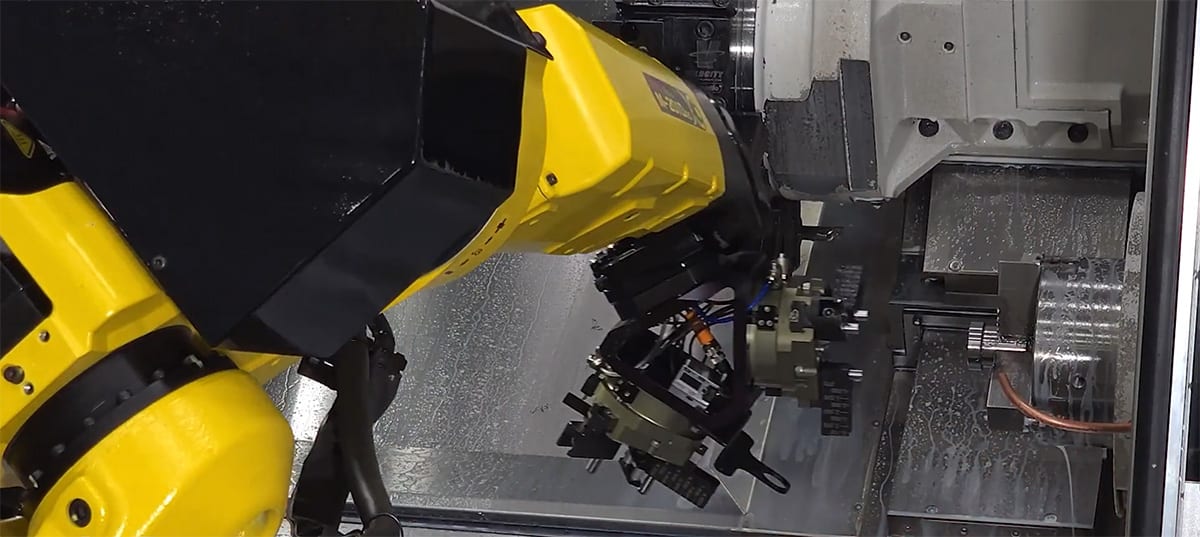
NKM, a flexible job shop, faced labor shortages and limited production capacity. It deployed FANUC M-20 Series industrial robots in a CNC machine-tending system called RC-2 from Automation Within Reach (AWR). Throughput and machine utilization rose as a result.
Operators learned to program and run the robotic cells quickly. That allowed lights-out manufacturing on longer runs and let NKM assign people to other work. The shop also says the cells gave it the scalability to take on larger projects, deliver consistent part quality and compete with other midsize manufacturers.
Part marking without safety cages
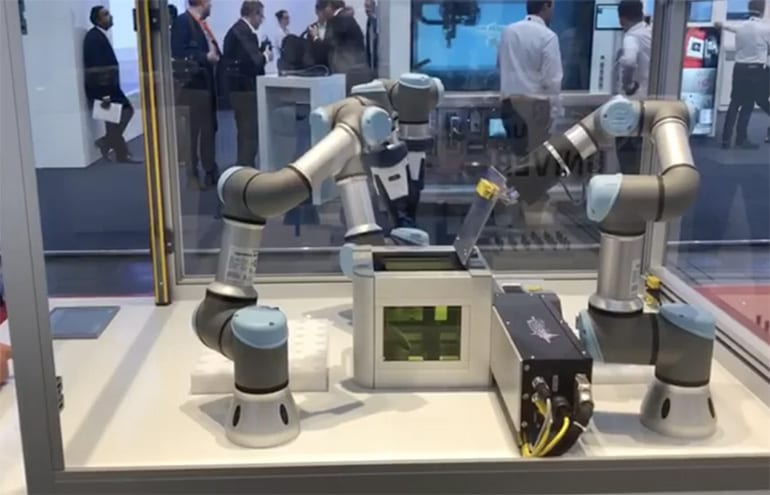
Telesis, which supplies industrial marking systems, integrated its laser and dot peen markers with Universal Robots arms. A Telesis laser marker mounted on a UR force- and power-limited arm gives manufacturers a flexible way to identify automated parts.
Because the arm limits its own force and power, the system can run next to people. Telesis reports a marking process that avoids complex safety enclosures, consistent marking across materials and part geometries, and added traceability and quality control.
What makes these cells viable for smaller shops
Across the four cases, several enabling features recur. Compact designs and lower investment costs make the systems easier to justify and fit into existing layouts. Lead-through teaching and intuitive interfaces shorten deployment and reconfiguration, and reduce the training needed by operators without robotics experience. Vision and force-torque sensors, combined with AI, let robots adapt to what they find. Collaborative arms can work near people without extensive guarding.
Together these features address the problems the manufacturers cite: skilled labor shortages, rising costs and quality requirements. In each case the robot takes on a bounded task, such as tending a machine, picking from a bin or marking a part, and leaves the rest of the operation alone.
Analysis: what the cases show and what they leave open
The pattern is consistent. The shops did not buy a new factory. They bought a cell that attaches to a machine they already owned. PrecisionForm's use of a cobot on older CNC equipment is the clearest example, because the robot raised the value of an existing asset instead of replacing it. That is a different proposition from the large-enterprise model, where automation is often designed into a line from the start. For midmarket manufacturing robots, retrofit-style cells appear to be the entry point.
The suppliers also differ in approach. SCHUNK sells a gripping-and-clamping concept built around changeover. FANUC and AWR offer industrial robots packaged as a machine-tending system. Universal Robots supplies force-limited cobots, one with vision-guided picking and one used as a marking platform. The range suggests that no single robot form factor is driving adoption. What the cases share is a packaged task, not a particular arm.
Much remains unproven. None of the cases gives figures for cost, payback period, cycle time, throughput gains or changeover savings. Words such as significantly, quickly and relatively inexpensive cannot be compared across sites. The accounts come from the deploying companies and their suppliers, so they describe benefits rather than failures. The cases also do not say how much integration effort or outside engineering each shop needed, which matters for smaller firms without in-house automation staff.
The claim of unmanned or lights-out running deserves similar caution. Torneria Novoletto says it is pursuing 24/7 unmanned operation, which is not the same as having achieved it. NKM reports lights-out running on longer jobs, but the scope of those runs is not quantified.
The test for the field is whether results like these repeat across many shops with published numbers. Until then, the four cases show that targeted cells are workable for midsize producers. They do not show how large the gain is or how reliably a typical midmarket manufacturer can reproduce it.