Orchard AI's system analyzes hundreds of images of each individual tree, vine or plant on a farm. John Deere has now acquired the San Francisco company behind it. The John Deere Orchard AI deal gives Deere a source of plant-level crop data to pair with the machines it already builds for high-value crop growers.
How Orchard AI collects its data
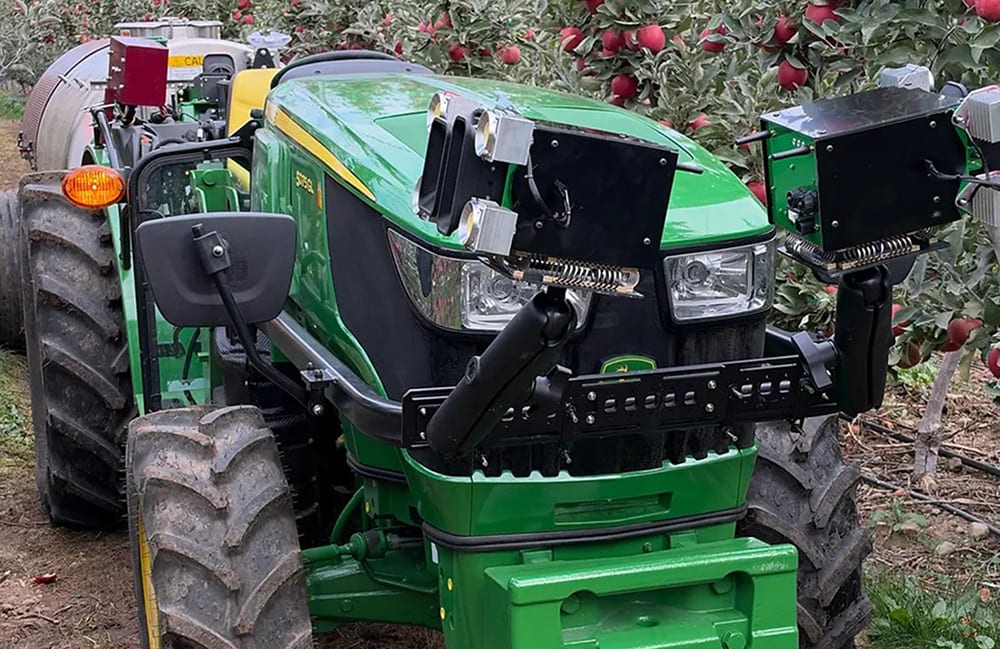
Orchard AI develops crop intelligence systems for growers of high-value crops. Its cameras are AI-powered and mounted on vehicles. As the vehicle moves through a field or orchard, the cameras capture data for every tree, vine or plant.
The system analyzes the images to give growers a detailed view of crop conditions. It produces yield estimates, fruit counts, fruit size and color data, and canopy measurements, among other outputs. The company describes the yield estimates and fruit counts as accurate.
Orchard AI also sells a software platform called FruitScope. Growers use it to visualize the data and apply it to farm management decisions.
What Deere says it will do with it
Deere said the acquisition strengthens its ability to help growers make informed decisions throughout the growing season. It plans to combine Orchard AI's plant-level crop insights with its expertise in precision agriculture, equipment and farm technology. The company said growers should be able to understand what their trees need and act at the right time.
Tim Marquis, director of Farm Systems Innovation at John Deere, framed the purchase as a link between information and action. “This acquisition connects crop-level intelligence with John Deere technology and equipment that can precisely execute the work in the field,” he said. He added that the combination should help growers get more value from technology they already rely on.
Charlie Wu, CEO of Orchard AI, said joining Deere lets the company accelerate its mission. “Together, we aim to bring the benefits of AI-powered crop intelligence to every grower across the globe,” he said.
A run of robotics and AI purchases
The Orchard AI purchase follows a series of acquisitions that began in 2017. That year Deere bought Blue River Technology for $305 million. Blue River developed computer vision and machine learning that lets agricultural sprayers identify weeds and apply herbicide selectively.
Deere later bought Bear Flag Robotics for $250 million. Bear Flag retrofitted autonomy systems onto existing tractors, using cameras, lidar and radar to give them redundant, 360-degree situational awareness.
In January 2022, Deere unveiled its first fully autonomous tractor, which used some of the technology it had acquired. The machine combined the 8R tractor, a TruSet-enabled chisel plow and GPS guidance with new technologies.
Acquisitions continued after that launch. In May 2022, Deere acquired intellectual property from Light, which works on depth sensing and camera-based perception for autonomous vehicles. In 2023 it bought SparkAI, a New York startup that built human-in-the-loop technology to help robots resolve edge cases in real time.
The most recent deal before Orchard AI was GUSS Automation in 2025. GUSS develops autonomous sprayers, and Deere had been its exclusive provider of those sprayers for years. The purchase pointed to Deere's interest in high-value crops such as orchards and vineyards, which are GUSS's focus.
Why the John Deere Orchard AI deal matters
Read in sequence, Deere's purchases cover most of the layers of a field robot. Blue River and Light brought perception. Bear Flag brought autonomy. SparkAI brought a way to handle cases a robot cannot resolve alone. GUSS brought a machine built for orchards and vineyards.
Orchard AI differs from those deals in what it measures. The earlier technologies mostly help a machine sense its surroundings or drive itself. Orchard AI describes the crop itself, one plant at a time. For specialty crops, where each tree or vine carries high value, that granularity is the point. The GUSS deal and the Orchard AI deal point at the same segment from two sides: one supplies a machine for orchards, the other supplies a record of what each tree looks like.
The stated rationale is a closed loop. Data identifies what a tree needs, and Deere equipment carries out the work. Marquis's wording about equipment that can “precisely execute the work in the field” describes that loop, and the reference to technology growers already use suggests Deere intends to build on its installed base.
Much remains unproven. Deere has not said how Orchard AI's data will connect to its machines, or when growers might see an integrated product. The announcement says nothing about pricing, or whether FruitScope will keep working for growers who run equipment from other makers. The accuracy of the yield and fruit-count figures is Orchard AI's own claim, and the announcement offers no independent validation.
It is also unclear whether per-plant data will change what machines do in practice. Seeing a tree's condition is different from acting on it automatically. Deere's sprayer technology already applies treatment based on what a camera identifies. Extending that approach from weeds to individual trees would be a logical next step, but Deere has not announced it.
For now, the John Deere Orchard AI acquisition is best read as a data purchase placed next to an existing machine strategy. Whether it becomes a working link between crop intelligence and autonomous equipment will depend on integration details Deere has yet to share.