
MassRobotics plans to open a marine robotics facility at the Boston Fish Pier in early 2028, with programming starting throughout 2027. Construction is underway through a partnership with the Massachusetts Port Authority, known as Massport. The site will give marine technology startups a place to build, launch and test robots directly on Boston Harbor.
What the facility will include
The pier is historic, and the project turns part of it into a working testbed. MassRobotics says the facility will be outfitted with testing equipment for marine robotics. That includes a water tank, a float alongside the pier for direct water testing, and lifting and launch equipment for getting vehicles in and out of the harbor.
The tank and the float cover two different stages of work. A tank allows controlled checks of a vehicle or sensor. The float puts the same hardware in open harbor water. The lifting and launch gear handles the practical task of moving a vehicle between the pier and the water. The source does not give the tank's dimensions, the float's size, or the weight limits of the launch equipment.
The pier sits close to MassRobotics headquarters. Tom Ryden, the executive director of MassRobotics, said founders can build in the organization's shop in the morning and test in the harbor by afternoon. He said marine startups tell the organization that finding a place to test is one of their biggest hurdles. He also thanked Massport for the partnership and said MassRobotics wants to help make Boston a global center for marine robotics.
The testing problem for marine startups
Access to water is often one of the biggest challenges for marine robotics startups. Testing an underwater vehicle or ocean sensor usually means renting boat time, borrowing a tank or traveling to a remote site. Each of those options adds scheduling effort, cost or travel.
MassRobotics says the Fish Pier facility removes that barrier. Companies can design and fabricate in the MassRobotics machine shop, walk a prototype to the pier and put it in the harbor the same day. The organization says this tight loop between building and testing means faster iteration and lower costs for early-stage teams.
Who the facility serves
MassRobotics currently supports more than 100 resident startups from across the globe. The Fish Pier adds a new dimension to what it offers them. It also opens the organization's doors wider to companies working in the blue economy.
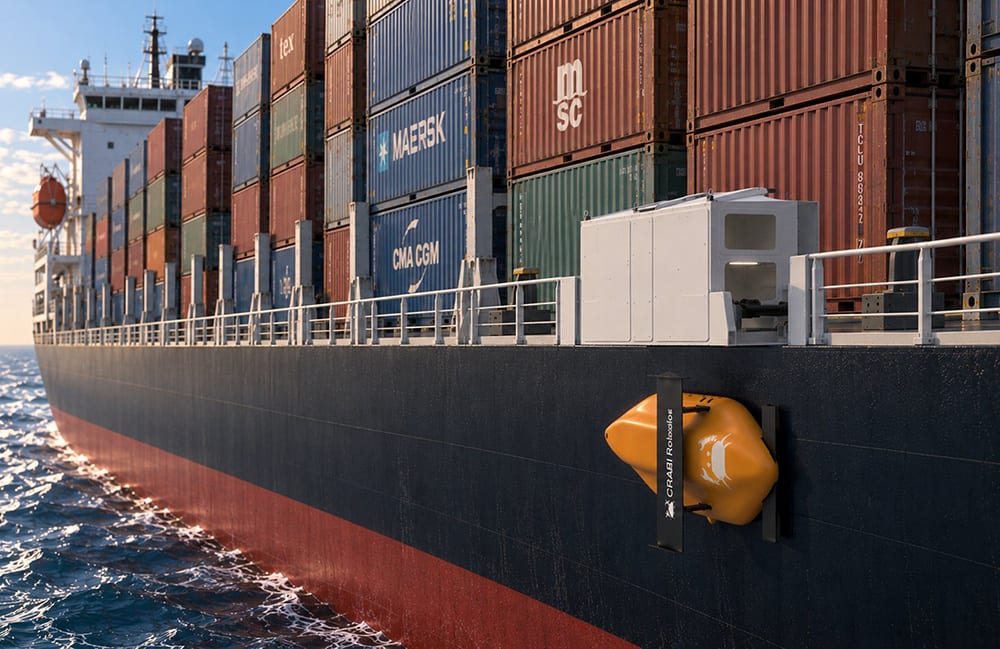
One of those marine startups is CRABI Robotics, which develops an underwater hull-cleaning robot. The company started as a three-person team with an idea about how to make oceans cleaner. A photo supplied by MassRobotics shows CRABI Robotics performing in-transit cleaning and inspection of marine vessels.
Levi Gershon, CEO of CRABI Robotics, said getting to the water is one of the hardest parts for ocean startups. He said a facility on the harbor, steps from where a team builds, will help the next marine company move a lot faster than his own company could.
What this means for the field
The facility targets a specific, stated bottleneck. The source describes the current routes to water as renting boat time, borrowing a tank or traveling to a remote site. All three depend on someone else's schedule or on distance. A shop and a test site within walking distance of each other change that. A team that can test in the harbor on the day it builds a prototype can run more test cycles in the same period, and the cost per cycle is likely to fall.
The setup also fits MassRobotics' existing model. The organization already houses more than 100 resident startups and runs a machine shop. Adding water access extends a build-and-test model to a sector where physical testing is harder to arrange than it is for many land-based robots. A warehouse robot can be tested in a warehouse-like room. An underwater vehicle needs water, and a way to launch and recover it safely.
Several points remain unproven. The opening is set for early 2028, and the source gives no pricing, membership terms or booking process. It does not say how startups outside the resident group will get access, or how time on the float and tank will be shared among users. Those details will decide whether the facility removes the testing barrier or becomes another scheduled resource that teams queue for.
Harbor testing also has limits. The source describes a float alongside the pier and a water tank. It does not describe open-ocean conditions, deep water or long-range missions. Companies building vehicles for those settings will likely still need other sites for later-stage trials. The facility looks best suited to early development, where frequent, low-cost tests matter most. That is consistent with the source's own emphasis on early-stage teams.
The claim that the site will make Boston a global center for marine robotics is a goal, not a result. It will depend on how many companies use the pier once programming begins in 2027, and on what they build. For now, the concrete change is narrower and easier to measure: a defined set of test equipment, on the water, next to a fabrication shop, with a start date. If that delivers shorter gaps between building and testing, the effect should show in how quickly the resident marine startups move from prototype to field trial.