
A twin-line push tray sorter is rated at about 7,500 to 25,000 trays per hour, while the tSort robotic system is specified at more than 50,000 items per hour. The two figures use different units and do not convert one to one. They still show the central contrast in a vendor comparison of the two approaches to sorting mixed loads. A push tray sorter is a fixed machine sized at purchase. tSort is a fleet of robots that grows by adding units.
What a push tray sorter does
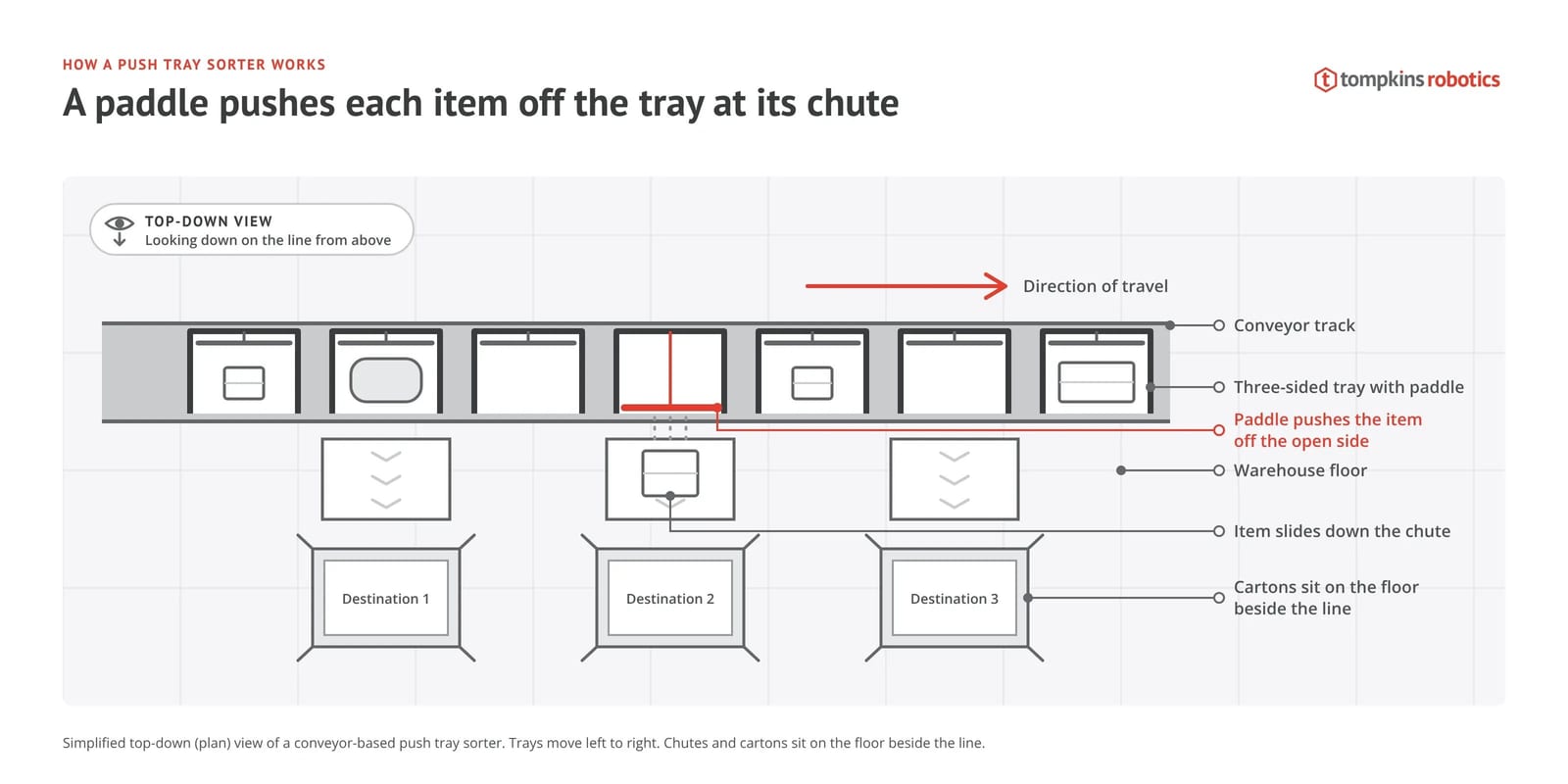
A push tray sorter moves items one at a time on three-sided trays along a loop or straight line. When a tray reaches its assigned destination, a mechanical paddle pushes the item off the open side into a chute, tote or outbound carton. It belongs to the tray sorter family alongside split tray (bombay) and tilt tray sorters. All three use a fixed track and differ in how the item leaves the tray.
Lines come as a single row of trays or a twin line with two rows side by side, which roughly doubles capacity on the same track. Many accept induction from both sides, and manual induction is common where volume is low.
The paddle is the main draw. Because it pushes sideways rather than tipping or dropping, the same tray can carry a rigid carton and then a floppy poly bag without a hardware change. The paddle can also push an item straight into an outbound carton or tote, so no one handles it a second time. A push discharge is more controlled than a tilt discharge, which helps with softer items. Most lines run at around 70 dB.
Industry figures put a single line at about 2,500 to 15,000 trays per hour and a twin line at about 7,500 to 25,000, with carriers rated at roughly 40 to 50 lbs. These are rounded figures, and exact specifications vary by manufacturer and configuration.
Where the fixed design runs out of room
The tray is flexible, but the system around it is not. The number of destinations depends on the length of the loop or line. Adding destinations after installation means extending the track, which takes engineering, fabrication and downtime. The throughput ceiling is set by the configuration bought, and moving from a single line to a twin line amounts to buying a different machine. Relocating the sorter, even within the same building, is a construction project.
The weight ceiling matters too. With carriers topping out around 40 to 50 lbs, the heaviest items in a growing catalog may need a separate path.
The comparison frames this as a bet that load mix, volume and destination count all stay close to what the line was sized for. Seasonal SKU shifts, growth in store and customer counts, and peaks beyond the line's rating are the ways that bet can fail.
How tSort handles the same load
In tSort, autonomous mobile robots do the work that trays and track do on a push tray line. Each robot carries one item across an elevated modular platform and discharges it at the right destination. There are no conveyors or fixed tracks. A software platform called Transcend assigns destinations and runs the sort plan.
The stated specifications are over 50,000 items per hour, more than 6,000 destinations, items from 1 oz to 66 lbs, and up to 75% less space than a traditional sorter. Go-live is quoted at 5 to 7 months. Capacity is added by adding robots, and sort plans change in software rather than through construction. The system accepts square, round, bagged or loose items, so cartons, poly bags and loose product run side by side. The developer says more than 30,000 of its robots operate across 300+ installations worldwide.
On a dimension-by-dimension basis, the comparison sets a push tray line sized to peak on day one against a robot fleet that grows with volume. It also sets a dedicated footprint against a smaller one, and a fixed conveyor build against a software-defined sort plan.
Customer results the vendor cites
Kmart Australia handles tens of thousands of SKUs across cartons, poly bags, loose items and mixed packaging, which is the mix push tray sorters are sold on. It sorts them with tSort. The reported results are installation to go-live in under 5 months, roughly 50% lower capital investment than a traditional tilt tray or crossbelt system, and a footprint cut by more than 60% while capacity rose.
A second example is an unnamed major global retailer that replaced a traditional fixed sorter with tSort. It reports 99.9% sortation accuracy, a 250% increase in sortation destinations, and installation completed in 7 weeks.
What this means, and what remains unproven
The comparison highlights a real structural difference. Tray sorters of every type, push, bombay and tilt, share a fixed track, so changes to destinations or throughput mean changing the hardware. A robot fleet moves that constraint into software and unit count. For operations whose SKU mix, customer base or peak volume keeps shifting, the cost of changing course is arguably the more important number, and the suggested buyer questions reflect that. They include what it costs to add 200 destinations in year three, how long the line would be down, and what happens when a 60 lb item arrives.
Push tray keeps a case where conditions are stable. If the load mix is wide but predictable, destinations will not grow, volume fits one configuration, and floor space is available, a fixed line avoids the need to manage a fleet.
Much of the evidence is still one-sided. Every tSort figure above comes from its developer, and the customer results are self-reported. The Kmart capital savings are measured against tilt tray or crossbelt systems, not against a push tray line, so they do not directly answer the push tray question. The throughput comparison mixes trays per hour with items per hour, which the comparison itself says cannot be converted directly. No pricing is given for either system, so total cost over a multi-year period cannot be checked. Nothing here shows how a robot fleet performs at the upper end of its stated destination count or during sustained peak. Independent side-by-side benchmarks on the same load profile would settle most of these points. Until they exist, buyers can reasonably treat the flexibility argument as well reasoned and the numeric advantages as claims to test in a trial.