
The U.S. Food and Drug Administration authorized Aletta on 19 August, making it the first autonomous blood draw robot cleared in the United States for use on adults outside hospital settings. The device was developed by Vitestro, a Dutch medical robotics company. European regulators authorized it two years earlier.
Aletta takes over the steps a phlebotomist normally performs by hand and by feel. A trained health care professional finds a vein, inserts a needle and fills the tubes. The machine does the same work with imaging and software.
How the machine draws blood
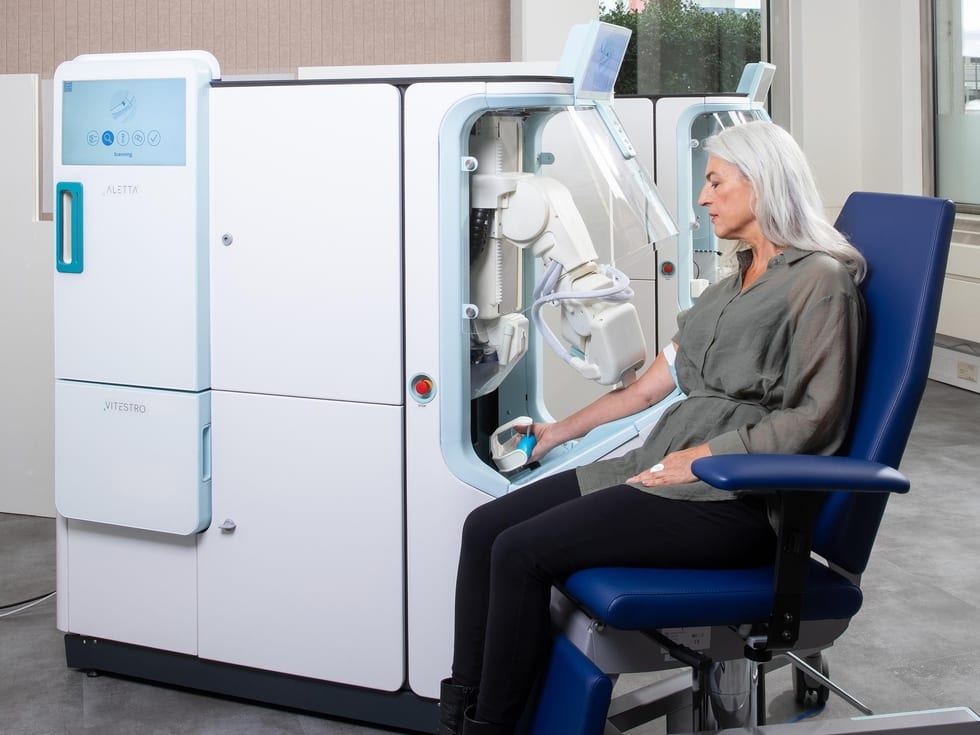
The patient sits down, places an arm in a cradle and presses a button. A near-infrared light scans the inner elbow to locate veins. The device applies a puff of alcohol to the skin. An ultrasound probe then moves across the arm to measure how deep the vessel runs and which way it bends. Doppler imaging captures the direction of blood flow so the system can rule out an artery.
A cuff tightens around the upper arm and the needle enters the skin. Blood flows into the collection tubes, and each tube is tipped end over end nine times. The needle withdraws and the patient receives a bandage. No person touches the patient during the procedure.
The device includes safeguards. Sensors track arm movement and needle position, and the process halts if something goes wrong. If Aletta cannot identify a suitable vein, the patient is referred for conventional phlebotomy, and a phlebotomist stays on hand to take over.
Trial results and the staffing problem
In a clinical trial of more than 1,600 people in the Netherlands, Aletta drew blood on the first attempt in 94.5 percent of cases. That figure included people with hard-to-access veins, people with obesity and elderly patients. Joe El-Khoury, a clinical chemist at Yale who was not involved in the trial, called the performance exceptional and said it is as good as, if not better than, that of a typical professional phlebotomist.
Vitestro frames the device as a response to labor shortages. One phlebotomist can supervise up to three Aletta machines, according to Luuk Giesen, the company's chief medical officer. Surveys of medical laboratories, drawn mostly from U.S. institutions, put median annual turnover among phlebotomists at nearly 25 percent and the vacancy rate at close to 10 percent. Those gaps can limit how much routine testing a lab can handle, including blood counts, cholesterol and metabolic markers.
Max Balter, a surgical-robotics specialist at Medtronic who worked on autonomous blood-draw systems in graduate school, said the FDA clearance moves the whole industry forward.
The skin tone question
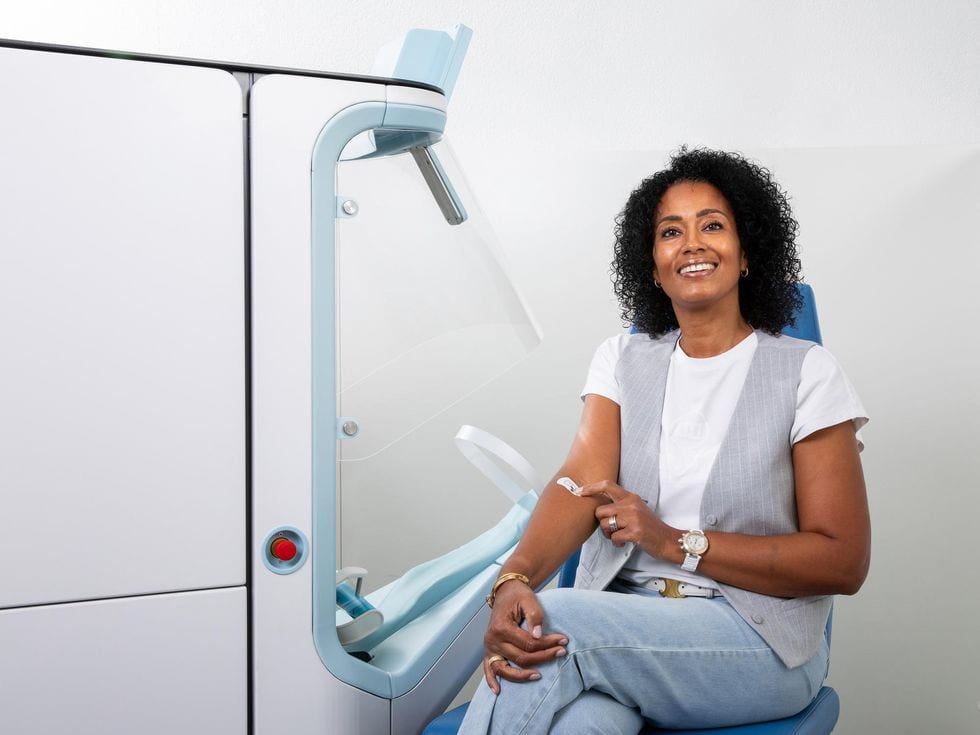
Aletta still fails roughly once in every 20 attempts. Some of those cases may involve elusive or unusually deep veins. Skin pigmentation is another possible factor. Near-infrared mapping depends on hemoglobin absorbing light differently from surrounding tissue. Melanin in darker skin can absorb more of that light before it reaches the camera, which reduces contrast.
Some experts have raised concerns that the infrared sensors will perform poorly on darker skin. Giesen acknowledges the issue could affect first-pass imaging. He says ultrasound is the main determinant of vein selection and needle placement, and that it relies on sound rather than light. He says Vitestro has unpublished data showing no effect of skin tone on performance. The company's website says the technology works well for all skin tones, and the FDA's announcement of the authorization repeated that claim.
El-Khoury, who has written about racial disparities in medical devices, says such claims need evidence. He points to pulse oximeters, which can be less accurate in people with darker skin and whose problems went largely unrecognized for decades.
Brooke Katzman, a clinical chemist at the Mayo Clinic who is collaborating with Vitestro, wants more data on sample quality. The Dutch trial reported little damage to red blood cells. Other measures remain to be assessed, including clotted tubes, insufficient blood and proper tube filling, as do the results of routine laboratory tests. Katzman plans to start a U.S.-based trial next year to collect that data.
A long line of research
The device is named after Aletta Jacobs, the first female doctor in the Netherlands. It builds on decades of work on robotic phlebotomy by groups in Europe, the United States and China. Martin Yarmush of Rutgers University pushed the concept particularly far. In one version of his team's platform, the robot was coupled to a benchtop blood analyzer. It drew samples and measured immune cells and red blood cells within minutes.
That system never left laboratory testing. VascuLogic, the company spun out to commercialize it, is defunct. Other companies, including ROPHAI, BHealthCare and MagicNurse, continue to work in the field. Gregory Retzinger, a clinical pathologist at Northwestern University's Feinberg School of Medicine who collaborates with Vitestro, says fully automated testing at the point of care is the future. He has tried Aletta and described it as painless and fast.
Vitestro plans to launch Aletta in Europe next year, with the U.S. market to follow. Giesen says the company is keeping the machine focused on blood collection for now.
What this means and what is unproven
The authorization matters mainly because it is a regulatory first. Earlier autonomous blood-draw projects, including the Rutgers platform, produced working prototypes but did not reach clinical use in the U.S. Aletta now has a cleared path, and competitors such as ROPHAI, BHealthCare and MagicNurse will be measured against it.
The economic case rests on supervision ratios. If one phlebotomist oversees three machines, a lab could in principle cover more draws with the same staff. That follows from the stated ratio, but it depends on how often the machine hands off to a human. At a 94.5 percent first-attempt success rate, about one patient in 20 still needs a person. Whether supervision stays at that level in a busy U.S. lab is untested, because the efficacy data come from a Dutch trial.
Three questions remain open. First, skin tone performance rests on an unpublished company dataset and on the FDA's repetition of the company's claim. Independent data would settle it. Second, sample quality has not been fully established, since clotting, tube filling and downstream test results are still to be assessed. Katzman's planned U.S. trial is the first announced effort to fill that gap. Third, the clearance covers adults outside hospitals, so use in other settings and age groups is not covered by this decision.
The Rutgers work points to a longer-term direction, with robots handling both the needle stick and the analysis. Aletta does not attempt that, and Vitestro says it is staying with collection for now. The near-term test of the autonomous blood draw robot is narrower. It has to match human phlebotomists on first-attempt success, sample quality and equity across skin tones, and it has to do so outside the Netherlands.