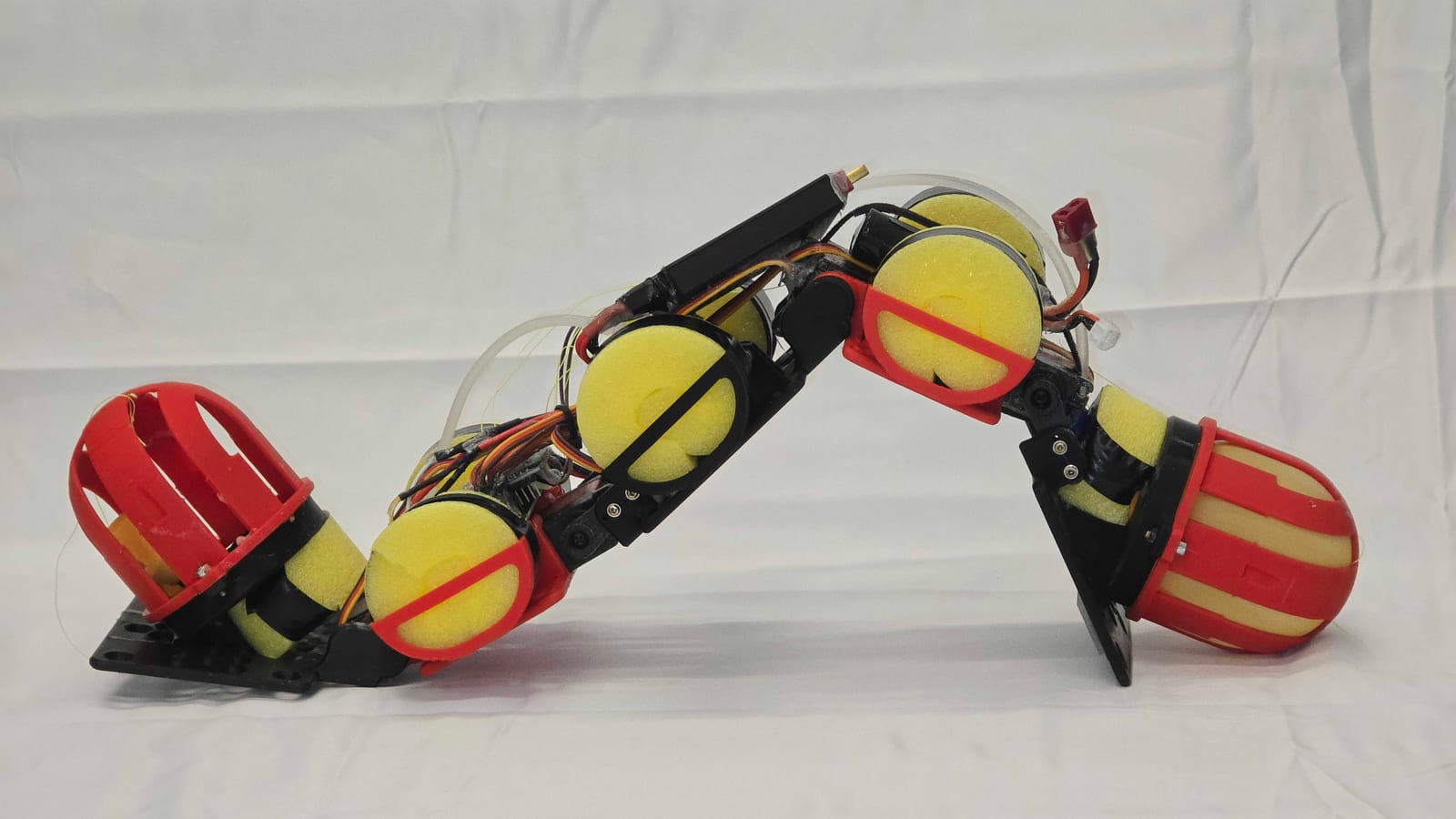
WorMa, an undulatory robot built at NYU Tandon School of Engineering, climbed a 19.5-degree incline that every other weight configuration the team tested could not. The robot pumps water between its head and tail, and that shift in mass lets it climb slopes, clear steps and swim while keeping the same basic gait.
One gait, a moving mass
Most robots that handle several kinds of terrain change how they move. They switch gaits, swap limbs or add mechanisms. WorMa takes a different route. Its gait stays essentially the same, and the variable that changes is where the water sits in its body.
The robot moves water between its head and its tail. Putting more of the water at one end changes how the robot loads the surface under it. The researchers treat the water placement as the control input, and the three tasks they demonstrated each call for a different placement: slopes, steps and swimming.
Slope climbing with the water forward
On an incline, shifting water toward the head increases the force pressing the robot's front contact points against the surface. More force at those points gives them more traction.
The test results show how much the placement mattered. Head-biased placement was the only configuration that carried WorMa up the steepest incline tested, 19.5 degrees. Every other configuration slid back down the slope.
Head-biased placement also reduced the robot's cost of transport by at least 33 percent compared with the other configurations. Cost of transport measures how much energy a robot spends to move a given weight over a given distance. The team therefore got a gain in efficiency as well as in grip. The figure is a minimum, and it is measured against the other water placements the team tried, not against other robots.
Steps need a sequence
Steps proved harder than slopes. Neither a fixed head-heavy robot nor a fixed tail-heavy robot could clear a step on its own. A single static weight distribution was not enough for this task.
The researchers solved it by changing the distribution during the maneuver. WorMa first approaches the step with water in its head, which gives it traction. The water then moves to the tail, and the robot raises its head and neck so the tail can push the whole body closer to the step. Once the head anchors on the step's edge, the water shifts back to the head and the robot continues forward.
That sequence got WorMa over steps as high as 15 centimeters. The robot is therefore moving its mass in time with its posture, not just holding one weighting for the whole task.
What the results do and do not show
The central result is that a single internal variable, the location of water, can stand in for several mechanical adaptations. The slope tests show that the same body and gait behave very differently depending on where the mass sits. Among the weightings tested, only the head-heavy one climbed the steepest slope, and no fixed weighting cleared a step. Both findings point the same way: a movable mass gives the robot options that a fixed mass does not.
The approach also differs from the usual design trade in undulatory and snake-like robots, where a body shaped for swimming is rarely good on land. WorMa's water serves as a mass that can be moved and, according to the team, as part of how the robot swims. Keeping one gait across all three modes simplifies the control problem, because the changing quantity is the water position rather than the whole movement pattern. That is a reasoned reading of the reported design and not a measured comparison.
Several things remain unproven. The reported slope tests stop at 19.5 degrees, and the report does not say whether the robot could go steeper, because that was the steepest incline tested. The 15-centimeter step is likewise the highest reported, not a stated limit. The account gives no size, weight or payload for the robot, no swimming speed and no data on how it handles loose, wet or uneven ground. It does not say how much energy the pumping itself uses, which matters for any cost-of-transport claim. The 33 percent reduction compares water placements within the same robot and cannot be read as a comparison with legged, wheeled or other undulatory machines.
The step-climbing sequence also depends on correct timing. The robot has to shift water, raise its head and neck, and anchor on the edge in order. Whether that sequence works on steps of different shapes or surfaces with different friction has not been shown. Until those tests exist, WorMa is best read as a clear demonstration that mass redistribution can extend one undulatory robot across three tasks, not as proof that it is ready for field use.
For the wider field, the useful point is the design principle. If a movable internal mass can raise traction and lower energy cost on a slope, other soft or undulatory robots may be able to borrow the idea. That remains an open question until others test it on different bodies and terrain.