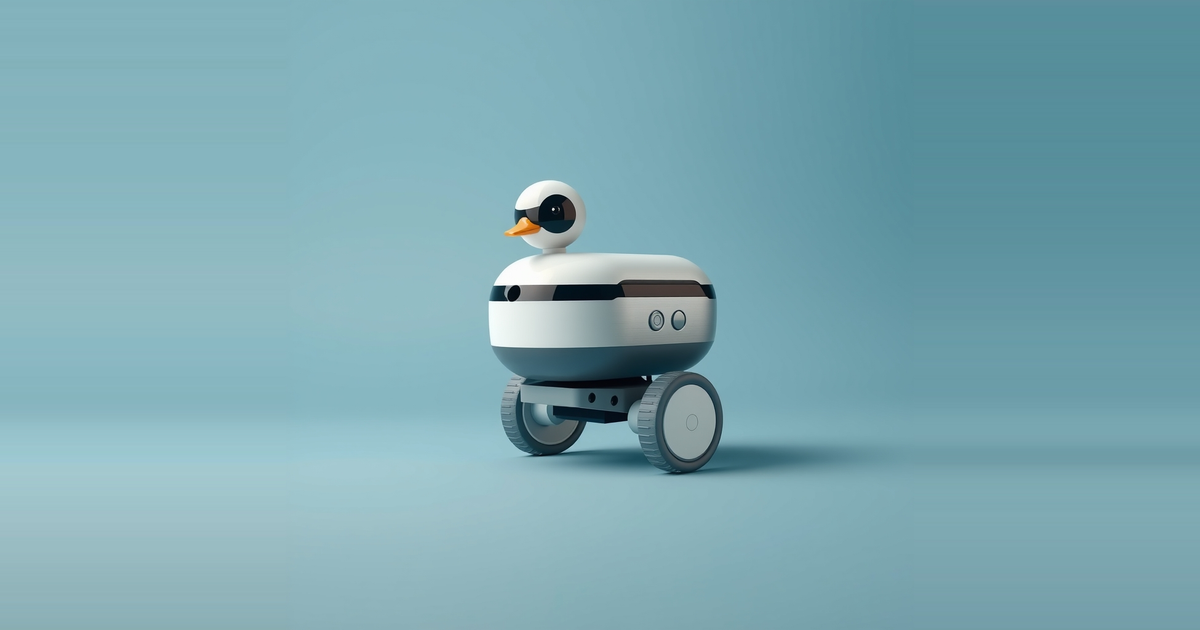
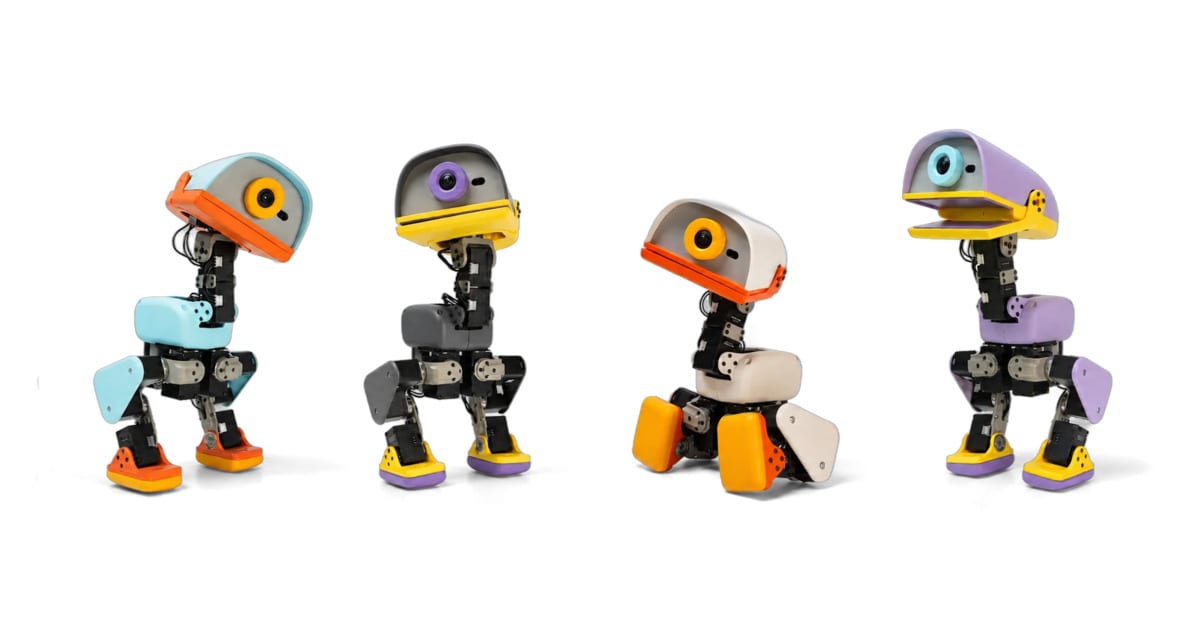
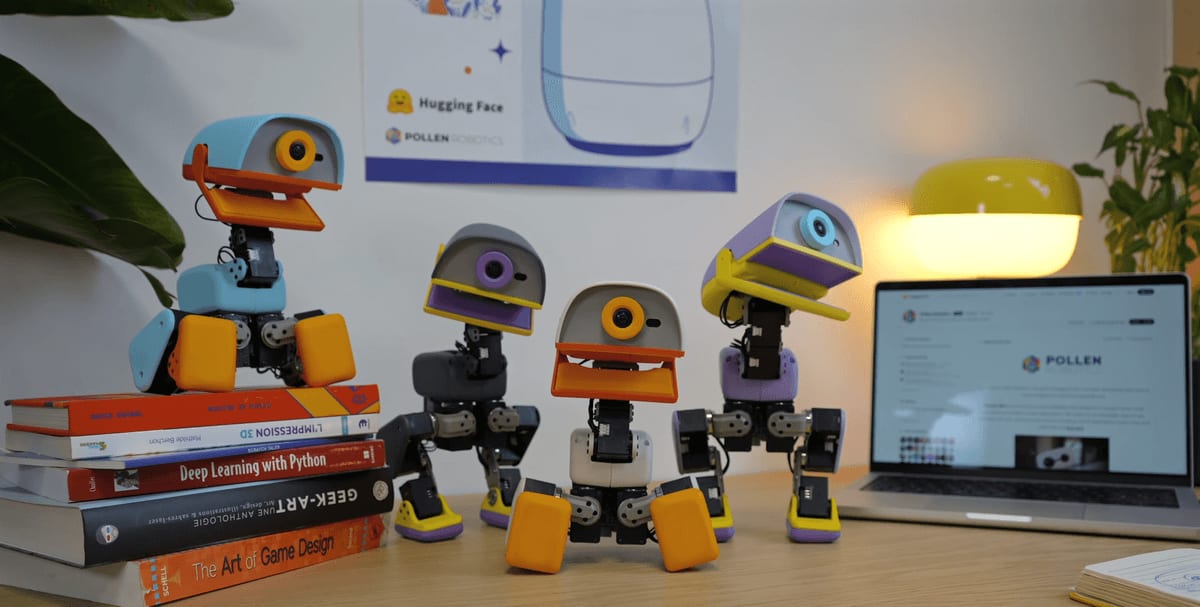
Pollen Robotics is taking pre-orders for the Microduck robot at $399, with shipments promised before Christmas. The biped stands 25 centimeters tall, weighs 780 grams, and is built to waddle, fall over, and get back up on its own.
The Microduck robot packs 15 degrees of freedom into that small frame. Pollen describes it as a machine that learns new tricks, and the company says the software is fully open source.
What the robot does out of the box
Pollen lists a set of behaviors that work without any added programming. Microduck walks, sits, and crouches. It roller skates. It picks up objects with an articulated beak. When it falls, it recovers without help.
The falling and recovering is part of the pitch. Pollen describes the robot as one that waddles, falls, gets back up, and learns. A small legged robot that can right itself is easier to experiment with, because a failed walking policy does not end a session.
Users can drive the robot with a game controller. They can also add plug-in accessories and use NFC-tagged objects to trigger actions, or run autonomous behaviors. Pollen also describes a multi-robot mode in which several Microducks gather for races and football.
Sensors and connectivity
The hardware list is long for a 780-gram machine. Microduck carries a front camera and an 8x8 lidar. It has two inertial measurement units, microphones, and a speaker. For connectivity it has NFC, Wi-Fi, and Bluetooth.
Pollen has not stated a battery capacity or runtime in the material available. It has not given a processor specification or a payload figure either. Those details will matter to anyone planning to build on the platform.
Price and availability
The pre-order price is $399, and Pollen says units ship before Christmas. The company has not said how many units it plans to build or which regions it will ship to. It has not said whether the accessories mentioned alongside the robot cost extra.
Pollen Robotics is now part of a larger corporate structure. Nvidia has paid $12.9 billion for the company that acquired Pollen. It is not clear from the available material how that deal affects Microduck's development, pricing, or support.
Where it sits among small open-source bipeds
Microduck arrives in the same week as another project built on a similar idea. EmoLo is a research effort that runs on Open Duck Mini V2, a low-cost, open-source bipedal robot inspired by Disney's BDX droids. With a single reinforcement learning policy, EmoLo generates distinct walking styles tied to different emotional expressions. Its authors present it as evidence that expressive whole-body motion can be achieved on an accessible platform.
Other small machines also appeared this week. NYU engineers unveiled ScaFi, a fish-inspired robot designed so it can be scaled up or down without starting from scratch. A separate paper in IEEE Transactions on Robotics describes a 54-gram robot that out-jumps a kangaroo. Those are research results, not products. Microduck is a product with a price and a ship window.
Why it matters, and what is still unproven
The significant number here is $399. Small legged robots with a full sensor set, an open software stack, and a manipulation feature such as a beak gripper have mostly been research hardware or hobby builds. A firm price on a finished, supported unit gives students, hobbyists, and small labs a defined starting point. Open-source software lowers the cost further, because users can modify behaviors instead of waiting for vendor updates.
The platform also links to ongoing work. EmoLo shows that researchers are already using Duck-style bipeds as testbeds for learned locomotion. A commercial robot in the same form factor, with an 8x8 lidar and an IMU pair, could give that kind of work a common base. That is an inference from the specifications, not something Pollen has claimed.
Several things remain unproven. Pollen's list of behaviors comes from the company's own description, and no independent testing is available. The claim that the robot learns new tricks is not accompanied by details on how users teach it or how long training takes. Battery life, durability under repeated falls, and the quality of the lidar at 8x8 resolution are all unstated. An 8x8 lidar gives a coarse picture of the surroundings, so obstacle avoidance and mapping will probably be limited, though the source gives no test results.
Delivery is the other open question. A pre-order with a ship date of before Christmas is a promise, not a shipment. The price is also tied to the pre-order, and Pollen has not said whether it will hold at general release.
For now, Microduck is a well-specified, low-priced entry in the small biped category with open software. Whether it becomes a useful research and teaching tool will depend on shipping on schedule, the maturity of its software, and what the community builds on it.