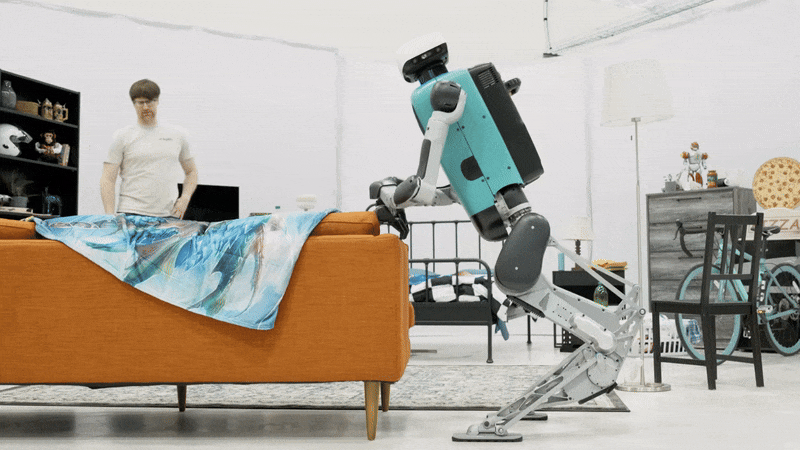
Agility Robotics has released a video of its Digit humanoid pulling a couch, captioned "Please help me move." The clip is one of several the company has published in a lighter tone, but the Digit couch drag stands out because the load is large and awkward, which is hard for a bipedal machine to handle.
The video arrived alongside a group of other robotics demonstrations that show how varied humanoid and legged work has become, from payload balancing to harvest labor.
Digit takes on the furniture
Agility's footage shows Digit moving a couch by dragging it. The company's videos have often leaned toward the playful, and the caption keeps to that style. The task itself is less casual. Dragging a heavy, bulky object means the robot has to manage contact forces while staying upright on two legs.
The video gives no specifications. It does not state the couch's weight, the robot's payload rating, the distance moved, or whether the run was autonomous or teleoperated. Those details would be needed to judge how the demonstration relates to commercial work.
A tray, a koala and a skin
Other groups are working on narrower problems that bear on the same goal. A project called SteadyTray targets the oscillations that bipedal walking passes to anything a humanoid carries without securing it. Its authors describe ReST-RL, a hierarchical reinforcement-learning architecture that separates locomotion from payload stabilization. They say it was deployed on the Unitree G1 humanoid and showed reliable zero-shot sim-to-real transfer across various objects and external force disturbances.
The RAI Institute showed a gripper modeled on the koala, an animal with two thumbs on each hand. The group did not give performance figures in the clip.
At the University of Tokyo, researchers built a three-layer joint-covering skin with 44 pressure- and stretch-sensitive elements for the musculoskeletal humanoid Musashi-W. The design copies a human mechanism: people use stretched skin around joints, along with muscle signals, as a cue for proprioception.
Carnegie Mellon University's Safe AI Lab presented APEX, a system that lets a humanoid navigate obstacles with adaptive, full-body maneuvers. The lab contrasts this with the choreographed movements behind many humanoid videos posted online.
Soft jumpers, drones and a harvest
North Carolina State University researchers made teardrop-shaped soft robots that leap upward or forward under infrared light and keep jumping while the light stays on. Each is a liquid-crystal elastomer ribbon with a thin aluminum tube bent into a V at one end. The infrared lamp makes the ribbon's surface contract, which rotates the ribbon. The stiff V stops it from simply rolling in place, so the ribbon twists tighter and stores energy. At a critical point the ribbon releases that energy, the V snaps down against the surface, and the robot launches into the air.
DARPA's Lift Challenge drew heavy-lift drone designs that impressed observers enough that the challenge is set to return in 2028. DARPA's Triage Challenge finals are scheduled for November.
In Turpan, China, where summer ground temperatures can exceed 50 °C, DEEP Robotics' Lynx M20S joined this year's grape harvest. Farmers there have traditionally carried heavy baskets back and forth in the heat, and extra time in the sun can affect the fruit's freshness.
Other clips covered a LimX Dynamics robot attached to the end of an industrial robotic arm to solve a mobility problem, and ROBOTIS's first OH! GYM! Project cohort. In that program, university and graduate students spent one month developing humanoid behaviors on the open-source AI Sapiens K1 platform, moving from simulated motions to a physical robot through repeated Sim2Real experiments.
What the Digit couch drag does and does not show
Figure's statement in the same set of videos frames the commercial question: solving for a robot in every home is not a data-and-compute problem but a safety-and-cost problem. The Digit clip fits that framing. A robot that moves furniture works near people and objects it cannot easily replace, so how reliably and safely it handles heavy contact matters more than whether it can do the task once on camera.
The other work suggests where the gaps are. SteadyTray addresses unsecured loads on a Unitree G1, which is a different robot from Digit, so its results cannot be read as evidence about Agility's machine. CMU's APEX points at adaptation over choreography, which is the property a household or workplace task like moving a couch would need. The Tokyo skin and the RAI gripper address sensing and grasping, two areas where a dragging or carrying task would depend on feedback. None of these projects reports a head-to-head comparison with the others, so any ranking would be conjecture.
What remains unproven is considerable. Agility has not stated the couch's weight, the success rate across attempts, or the autonomy level. Without those figures, the clip shows capability but not repeatability. The Digit couch drag is a credible sign that humanoid legs and arms can handle bulky loads, but cost and safety, the factors Figure names, are not addressed by any video in this set. Readers should treat the demonstration as a starting point and watch for published payload ratings and test data.