
The Pentagon's fiscal year 2026 budget requested $13.4 billion for autonomous systems, and the department is asking for a further $53.6 billion for autonomous systems and drones in 2027. Even so, the United States has no national robotics strategy, and it remains one of the few leading industrial nations without a centralized plan.
Defense money fills the hardware gap
The US has long left technology to free-market investors. That approach is credited with the growth of large technology companies and Silicon Valley, which together account for roughly 12% of national GDP. It is also credited with American leadership in artificial intelligence, a field that rewards high projected margins and fast software scaling.
Robot hardware works differently. It requires higher, longer-term capital spending and returns less in the short term than software, which can weaken the incentive to compete with established manufacturing nations. The Department of Defense, also referred to as the Department of War, has become a main source of hardware investment. Private capital has followed: defense technology venture investment reached a record $19.8 billion in the first quarter of 2026 alone.
That spending is tied to current conflicts. The US is funding drone production in Ukraine and has recently deployed humanoids there. Autonomous systems have also played a significant role in the Strait of Hormuz. The Pentagon funds early-stage research and specialized military platforms, but its mandate does not extend to the commercial scaling needed for broader civilian and industrial use.
A large buyer that imports its robots
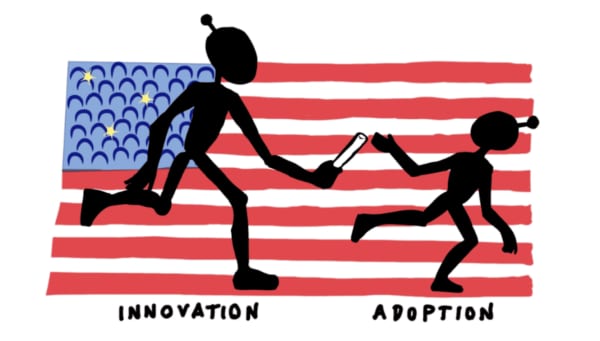
The US is the third-largest consumer of industrial robots in the world. Industrial adoption rose 11% last year in logistics, packaging and automotive. Yet the country mostly relies on foreign imports for baseline industrial robot installations. A few US companies build application-specific machines, including Intuitive Surgical, Amazon Robotics and Agility. Japan, by contrast, relies on imports for only 2% of its installations.
Washington now treats this dependence as a security problem. Robots have been reclassified as a critical dual-use technology, and foreign supply chains are seen as operational chokepoints. The government has responded mainly with export controls and protective procurement rules.
In 2021 the President issued NSPM-33, which requires federally funded research institutions to build internal compliance frameworks. It applies rigid vetting to researchers who may be tied to Malign Foreign Talent Recruitment Programs or who hold dual national affiliation. In early 2026 lawmakers proposed the bipartisan American Security Robotics Act, H.R. 8189. It would ban federal procurement and operation of unmanned ground vehicles and humanoids made by foreign adversaries, with China the stated target.
Fragmented agencies, early legislative moves
Federal funding is not scarce, but it is spread across agencies with separate mandates. The National Science Foundation funds basic research. The Department of Energy runs national laboratories and funds energy-related robotics. The National Institutes of Health covers medical robotics, NASA covers space applications, the ARM Institute supports manufacturing through the defense department, and DARPA funds national security work. Each program serves a narrow mission, and none sets an overall direction.
Pressure for a unified plan echoes the semiconductor concerns that led to the CHIPS and Science Act of 2022, which moved the US toward state-supported industrial policy. Congress has started to respond. In 2025 four representatives relaunched the bipartisan Congressional Robotics Caucus. In June 2026 legislators introduced the bipartisan National Commission on Robotics Act, H.R. 7334, which would create an independent commission of 18 robotics experts to provide evidence-based policy for accelerating domestic development. Executive orders on drone dominance, the Golden Dome and the Genesis Mission have also called for high-level coordination.
Industry and academia write their own plans
In the absence of a federal plan, outside groups have published theirs. In 2025 the Association for Advancing Automation released a vision for a national robotics and automation strategy. It proposes a government robotics office, new standards for robotic hardware and software, tax incentives for adoption and worker training programs.
The Special Competitive Studies Project issued a national robotics strategy memo to the President that pairs mass industrial adoption with tougher trade restrictions on Chinese technology. It then launched a National Security Commission on Robotics for Advanced Manufacturing. Members include GM, Boston Dynamics, Nvidia, AMD, the University of Michigan and MIT's Industrial Performance Center.
Academics led by Henrik Christensen of UC San Diego publish a US robotics roadmap every four years. Earlier editions led to the National Robotics Initiative, a multi-agency program that ran from 2012 to 2022 and backed foundational research, notably on collaborative robots working alongside people. Christensen also published a Global Robotics Technology Roadmap 2025–2035 comparing strategies in Europe, Asia and the US.
All three groups cite a shrinking population and workforce and a surplus of dull, dirty and dangerous jobs. They also acknowledge fear of job displacement, especially among blue-collar and immigrant workers. Christensen and colleagues recommend human-centered collaborative robots and wearable devices to balance growth with worker empowerment. Recent mass layoffs alongside collaborative robot installations show how hard that balance is to strike.
What this means for the field
The facts point to a gap between where US money goes and where the US is weak. Defense budgets and venture capital are large and growing, but they back research, prototypes and military platforms. The weak point is volume manufacturing of baseline industrial robots, and no agency is charged with fixing it. A commission that only recommends policy would not close that gap by itself, since the bill as described provides advice, not production capacity.
The proposals also pull in different directions. The Special Competitive Studies Project wants mass adoption and stricter limits on Chinese technology, while the US mostly imports the robots it installs. Restricting suppliers without building domestic output could raise costs or slow the adoption these groups want. None of the plans described says how that would be resolved.
There is one precedent. Academic roadmaps led to the National Robotics Initiative, so the current documents could shape federal programs. The initiative ended in 2022, though, and it funded research rather than factory capacity. The CHIPS comparison is useful but unproven: semiconductors and robots differ, and no robotics bill described here carries funding on the scale of that law.
What remains unknown is whether either the commission bill or the procurement ban will pass, and whether any resulting policy will change who builds robots in the US. Until it does, Japan's 2% import figure is the benchmark the US is measured against.