
Online shoppers are expected to spend more than $275 billion this holiday season, according to Adobe's forecast, and third-party logistics (3PL) providers will feel that volume in how fast they can move inventory, not only in how much they can store. One tactic available before Black Friday and Cyber Monday is SKU slotting: re-assigning products to automated or manual picking zones based on how often they are picked.
The approach comes from Jonathan Puckett, Head of Solutions Excellence for GreyMatter, a warehouse orchestration product. It rests on the Pareto Principle and argues that operators can gain throughput without waiting for new equipment or more floor space.
Why velocity drives the slotting decision
The Pareto Principle holds that roughly 80% of sales often come from about 20% of products. Puckett notes that the ratio is not universal and that each operation's own data will show how closely it applies. The working assumption is narrower: a small share of SKUs may account for a large share of picks.
That matters because every item entering a warehouse is decanted, put away and retrieved. When fast-moving SKUs generate frequent retrievals from an automated system, they can occupy totes and stations that other orders need. The effect grows as peak volume rises. If those items are not positioned for frequent retrieval, the result can be congestion, extra touches and bottlenecks in both automated and manual workflows.
Adding automation or expanding capacity can address these limits, but Puckett points out that such changes take time. Re-slotting is the faster option. In some systems and order profiles, moving certain high-velocity SKUs to dedicated floor-pick locations could free automated capacity for other inventory without slowing fulfillment.
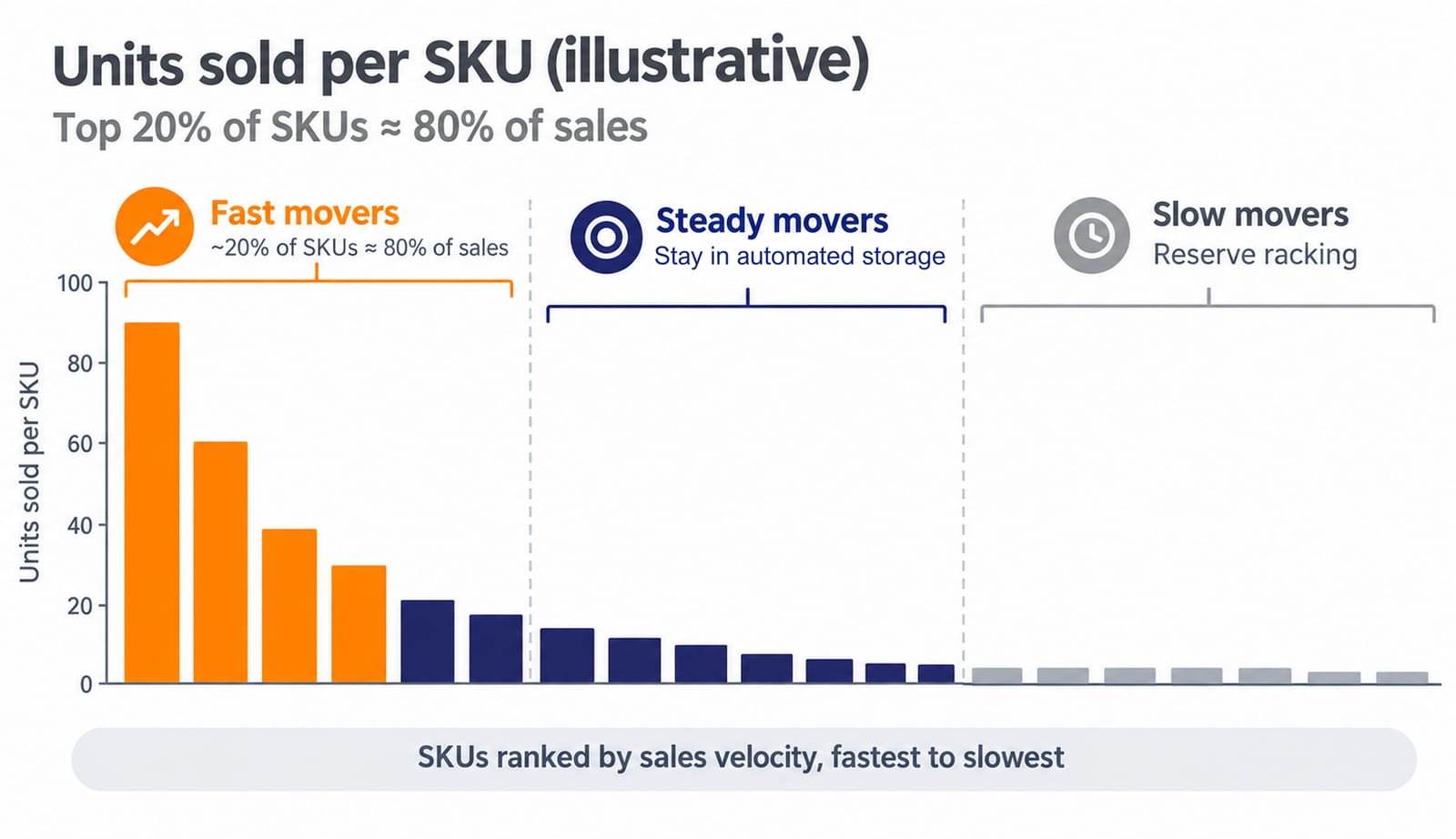
Sorting SKUs into fast, steady and slow movers
The method starts by identifying SKUs that fall outside the normal range of movement, meaning those that sell very quickly and those that sell very slowly. Each group gets a different review.
For fast movers, the question is whether frequent picks are causing congestion at automated stations. Depending on the operation, dedicated floor-pick locations or cross-docking may suit some of these SKUs better than automated retrieval.
For steady movers, the task is to check how well existing automated workflows handle predictable demand and whether inventory sits where it can be retrieved efficiently.
For slow movers, the suggestion is to shift infrequently picked items to reserve storage. That frees prime locations for inventory that moves more often.
Puckett is explicit that the goal is not to pull every fast mover out of automation. The aim is to match placement to actual demand. He also says that during peak season, swings in order volume and SKU demand can expose constraints, and that finding them early shows where to adjust slotting, staffing or task allocation. Depending on the operation, adjustments may include temporary labor, dedicated manual-pick zones or a different split of work between automated and manual processes.
Measuring results and coordinating the work
For the review after peak, Puckett lists four metrics: origin time, operator wait, transfer time and SKU sensitivity to volume. Together they are meant to show where work slowed as demand rose and where capacity became constrained. The findings then indicate which slots need to change, whether staffing matched demand and where automated and manual workflows need tighter coordination. Puckett recommends making this a yearly review so it becomes a repeatable process rather than a scramble each peak season.
Once work is split across automated and manual zones, both have to be coordinated as demand and capacity shift. Puckett describes orchestration software, with GreyMatter as his example, as assigning tasks across connected workflows using factors such as order priority, inventory position and real-time capacity. The stated benefit is directing work to the right resources while keeping visibility across the operation.
He cites results from GreyMatter deployments: operators have reached 250,000 units picked in a single day, 99.95% on-time fulfillment and 750 units picked per person per hour. He adds that actual results depend on the operation and deployment.
What this means for the field
The core advice is sound, and it is modest. Slotting by velocity is a data exercise using information most warehouses already hold, and it needs no capital spending. That makes it a realistic option in the weeks before peak, when major changes are impractical. The guidance also avoids a common assumption that more automation always means better throughput. It treats automated stations as shared, finite resources that high-frequency SKUs can overload.
There are limits to what the piece establishes. It offers no data showing how much throughput re-slotting recovers, and it gives no figures for how many SKUs typically move to floor-pick zones. The 80/20 ratio is presented as a starting point, and Puckett concedes it varies by operation. The four review metrics are named but not defined or benchmarked, so a reader cannot yet tell what a good result looks like for any of them.
The deployment figures also need careful reading. They come from the vendor of the orchestration product being discussed, are not tied to any single customer, and are not linked to the slotting method itself. The 250,000 units per day, 99.95% on-time rate and 750 units per person per hour describe what GreyMatter sites have reached, not what re-slotting alone delivers. Puckett's own caveat that results depend on the operation and deployment applies fully.
Compared with the alternatives, the trade-off is time against scale. Expanding capacity or adding automation can raise the ceiling but cannot be done mid-season. Re-slotting works within the existing ceiling. Whether it is enough depends on how far a given warehouse sits from that ceiling and how skewed its pick distribution is. Operators who test it should measure SKU slotting changes against their own baseline on the four metrics, since that is the only evidence the approach can currently offer.