
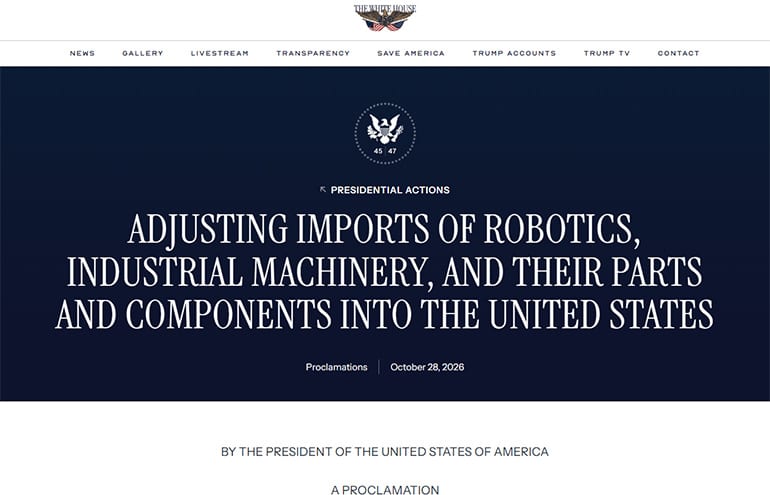
President Donald Trump has signed a proclamation stating that imports of robotics, industrial machinery and their components threaten to impair U.S. national security. The Section 232 robotics finding rests on a report the secretary of commerce submitted after an investigation into the national security effects of those imports.
The proclamation does not impose tariffs. It directs the secretary and the U.S. trade representative to negotiate with trading partners to adjust imports of robotics, industrial machinery and their components so that they no longer threaten national security.
What the proclamation says
The secretary of commerce found that these products are being imported into the United States in such quantities and under such circumstances as to threaten to impair national security. The president cited Section 232(d) of the trade law, which allows him to weigh the close relation of the nation's economic welfare to its national security.
The proclamation describes robotics and industrial machinery as critical to virtually all modern manufacturing, including defense, commercial and dual-use work. It puts a figure on the economic stakes: approximately $7.1 trillion in shipments of manufactured goods in 2024, and approximately $86 billion worth of equipment produced that year.
The government also tied robots to sectors it considers vital to competitiveness, from military and law-enforcement missions to agriculture, automotive and electronics manufacturing. The secretary reported that the value of imported systems has grown over the past decade and that cybersecurity risks have grown with it.
One passage names specific machines. The Section 232 statement cited advanced robots, including autonomous robots, humanoid and quadruped robots, and autonomous ground vehicles, as providing direct support to the U.S. military.
The president acknowledged that investment in U.S. robotics production capacity has increased. He said it is not enough to meet U.S. demand.
Negotiations come before any tariffs
Brendan Schulman, vice president of policy and government relations at Boston Dynamics, described the next step in a LinkedIn post. He wrote that the federal government will pursue negotiations with trading partners over the next six months to adjust imports, followed by further consideration of other trade policy measures. The six-month period is his description of the process, not a deadline quoted from the proclamation.
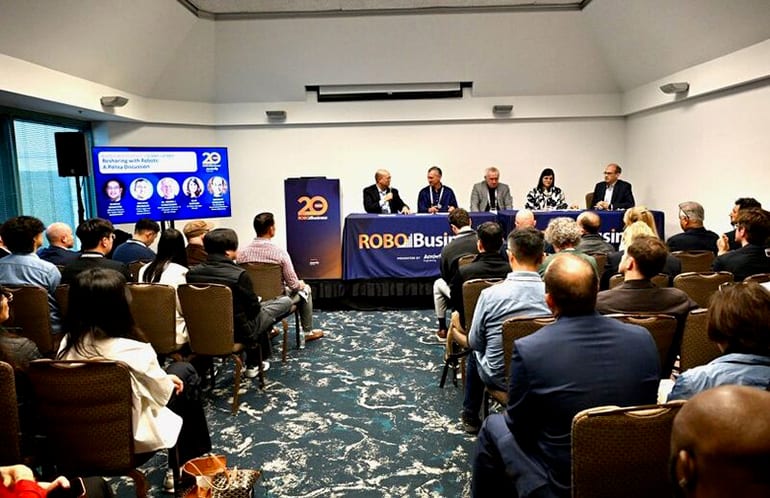
Schulman linked the proclamation to a recent FCC action on robots, which he discussed on a panel at the RoboBusiness conference in Santa Clara. He called both a strong signal of government support for people building domestic robot supply chains. He also noted that the Special Competitive Studies Project Robotics Commission reached similar findings.
Ash Sharma, vice president of research and chief information officer at Interact Analysis, cautioned against reading the finding as an immediate trade penalty. He said it should not be taken as a new robotics tariff today, but that it clearly indicates the direction of travel. In his view, tariffs, quotas or other trade measures could affect supplier competitiveness, pricing and manufacturing localization in the U.S. He added that the effects could reach components as well as finished robots.
Industry reaction centers on components
Robert Little, a former chief of robotics strategy at Novanta and a business development advisor, said the U.S. still has limited industrial robot manufacturing. He pointed to investments that FANUC, Teradyne Robotics and Yaskawa have announced to expand U.S. production, and said he expects more.
His larger concern is the supply base underneath the robots. Little named sensors, actuators, precision gears and encoders as areas where domestic supply has gaps. He said that is where the country needs the most help to strengthen its manufacturing ability.
The proclamation's wording covers components as well as complete machines, which matches that concern. Most of the major industrial automation providers are based overseas, so how the negotiations go is not yet clear. The policy is also driven by the threat the U.S. sees from China, which is behind both this investigation and the recent FCC restrictions.
Analysis: what the finding changes and what it does not
The finding matters first as a legal step. A Section 232 determination establishes a national security basis for trade action on a product category. Robots now sit in that category alongside the other goods the statute has been used for. Companies that buy robots, build them, or supply parts to those who do can now plan around the possibility of further measures.
The sequence in the proclamation is the second thing to weigh. It orders negotiations first. That gives governments and suppliers a window to reach agreements on import levels or terms before any tariff is considered. Sharma's reading and Schulman's description of the process point the same way, so the near-term effect is more likely to be planning and lobbying than price changes. That is an inference from the stated process, not a forecast of the outcome.
The finding also fits a pattern. The FCC restrictions Schulman mentioned and the commission findings he cited aim at the same goal of domestic robot supply chains, through different tools. Taken together, they show several parts of the federal government moving on robotics at once. That is a change from a field that has had limited standing in trade policy.
Several things remain unproven. The proclamation, as described, gives no import volumes, no country list and no list of covered product codes, so the scope of any eventual measure is unknown. It is also unknown whether negotiations will produce import adjustments that satisfy the national security test, or whether the administration will move to tariffs or quotas.
The central open question is whether policy can change the supply picture. Little's point about sensors, actuators, gears and encoders suggests that finished-robot assembly in the U.S. will not solve the dependence by itself. A factory that assembles robots from imported parts still relies on imports. The investments from FANUC, Teradyne Robotics and Yaskawa address production capacity, but the source gives no evidence yet of comparable commitments in components. Whether the Section 232 robotics process closes that gap will depend on actions that have not yet been announced.