
A gel film the length and width of a stick of gum can swim through water when a flash of light hits it. The film is the body of a muscle-powered swimming robot built by engineers at MIT, and it moves at up to about four body lengths per minute.
The team describes the design in a paper in Advanced Functional Materials. The robot's skeleton is a film of gel split into two halves, and each half acts as a fin. A layer of live muscle cells, much thinner than a single strand of hair, covers each fin. The cells are genetically engineered to twitch in response to light.
How the robot swims
When light falls on one fin, the muscle cells on its surface twitch and the whole fin flaps. The force is enough to pull the robot through water. Researchers steer by flashing light on one fin or the other, and they set speed by changing the interval between flashes.
Ritu Raman, associate professor of mechanical engineering at MIT and senior author of the study, describes the robot as having two independent muscles. Light on one fin moves only that fin. Light on both makes both flap.
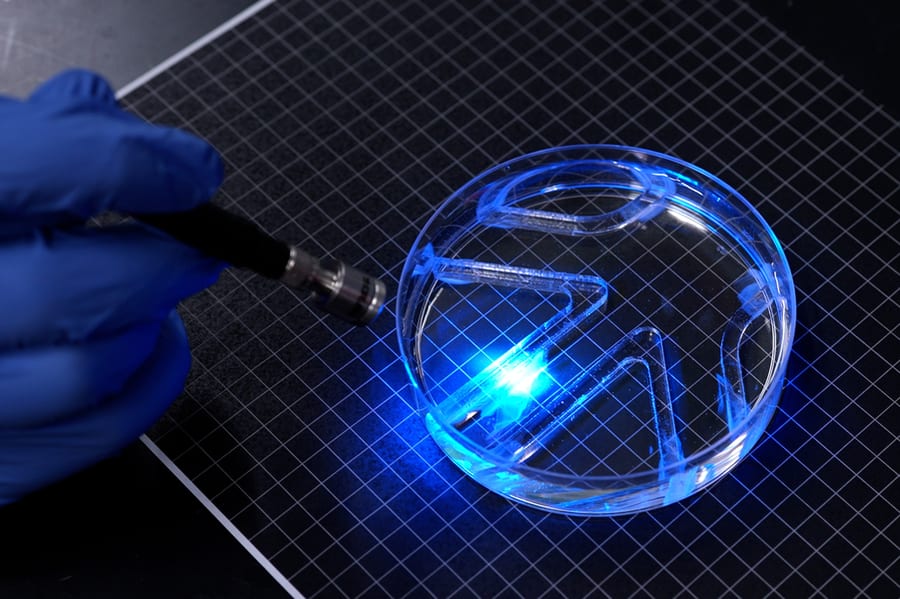
In testing, the team submerged the robot in a large petri dish and placed a maze in the water. A researcher moved a light source by hand over the robot. The robot followed the light, flapping its fins to swivel and swim through the maze.
At its fastest, the robot covers about four body lengths in one minute. Olympic swimmers can cover up to 65 body lengths per minute. The cow shark, which explores the ocean at a comparable rate, moves at about the same pace as the robot. "It takes a lot of force to move through water versus air," Raman says. "The robot's quite strong, given its size."
The group says this is the first very thin, two-dimensional, muscle-powered robot capable of locomotion. The first author is Maheera Bawa. Arielle Berman, Laura Schwendeman, Ferdows Afghah and Seanbiron Johnson are co-authors. The Office of Naval Research supported the work in part.
Tuning the skeleton
The new robot builds on an iris-inspired disk of artificial muscle tissue that Raman's group developed last year. That disk was a gel stamped with concentric and radial grooves, with muscle cells deposited on its surface. The cells grew in a thin layer along the grooves and, when lit, stretched and squeezed the disk much as an iris dilates and constricts a pupil.
The work showed that muscle could be grown in a very thin layer, in complex patterns, and made to move in several controllable directions. The movement was small, though. "They only moved about 100 microns," Raman says. "From a robotics perspective, their movements were tiny."
To get more force, the team focused on the gel beneath the cells. The earlier design used fibrin, an ultrasoft gel that can shrivel under the forces the muscles generate. The researchers tuned three properties: the gel's composition, its stiffness, and the size and shape of the stamped grooves.
They tested several gel formulations, stiffnesses and groove geometries. Cells aligned better in square-bottomed grooves than in long, curved ones. Better-aligned cells tend to fuse into fibers, which form stronger and more coordinated muscle tissue.
They replaced fibrin with gelatin methacrylate, known as GelMA, a material common in tissue engineering. Cells aligned better and produced the most force on stiffer versions of the gel. A film half a millimeter thick supported a single layer of cells well. It was light enough that the cells stayed attached when they contracted instead of peeling away.
Finally, the team trained the muscles with a routine of flashing lights to strengthen them. The finished robot combined the GelMA film, square-bottomed grooves on both sides, and the exercised muscle cells, which fused into aligned fibers.

What the team says comes next
The researchers describe the current body design as basic. Their aim was to show that a thin muscle layer could produce enough force to swim. Raman says the next goal is to optimize the body for faster swimming.
She also points to possible uses. Biohybrid robots powered by living muscle could one day handle delicate jobs, such as exploring environments too fragile or unpredictable for conventional hardware, because living tissue is soft, responsive to its surroundings and can heal itself. Even at slow speeds, she says, a muscle-powered swimmer could be used for environmental monitoring in aquatic settings.
Analysis: what this changes and what it does not
The main shift is in architecture. Raman notes that biohybrid robots from her group and others are built from bulky, three-dimensional chunks of lab-grown skeletal muscle that need millions of cells. This robot uses a single cell layer on a thin gel. That points toward designs that are cheaper and more efficient, as Raman suggests, though the source gives no cost or efficiency figures to confirm it.
The result also shows where the bottleneck was. The cells were not the limiting factor in the iris-inspired disk, which moved only about 100 microns. The substrate was. Changing the gel material, stiffness and groove shape, then training the muscle, turned a tiny deformation into propulsion. For the field, that suggests progress in muscle-powered robots may depend as much on scaffold engineering as on the muscle itself.
The speed comparison needs careful reading. Four body lengths per minute is far below the 65 an Olympic swimmer can manage. The cow shark comparison shows the robot is slow but not static. It does not make the machine competitive with conventional underwater robots, and the source offers no such comparison.
Several things remain unproven. The robot was steered by a light source moved by hand in a petri dish, so it has no onboard sensing or autonomy. The tests were in a simple maze in still water. The source does not report how long the muscle stays active, how the robot would fare outside a lab, or what it takes to keep the cells alive. The claims about self-healing and fragile environments describe the properties of living tissue and the team's expectations. They were not demonstrated in this study.
The next test is the one Raman names: whether a better body design can raise the speed of this muscle-powered swimming robot without losing the force that the tuned gel provides.