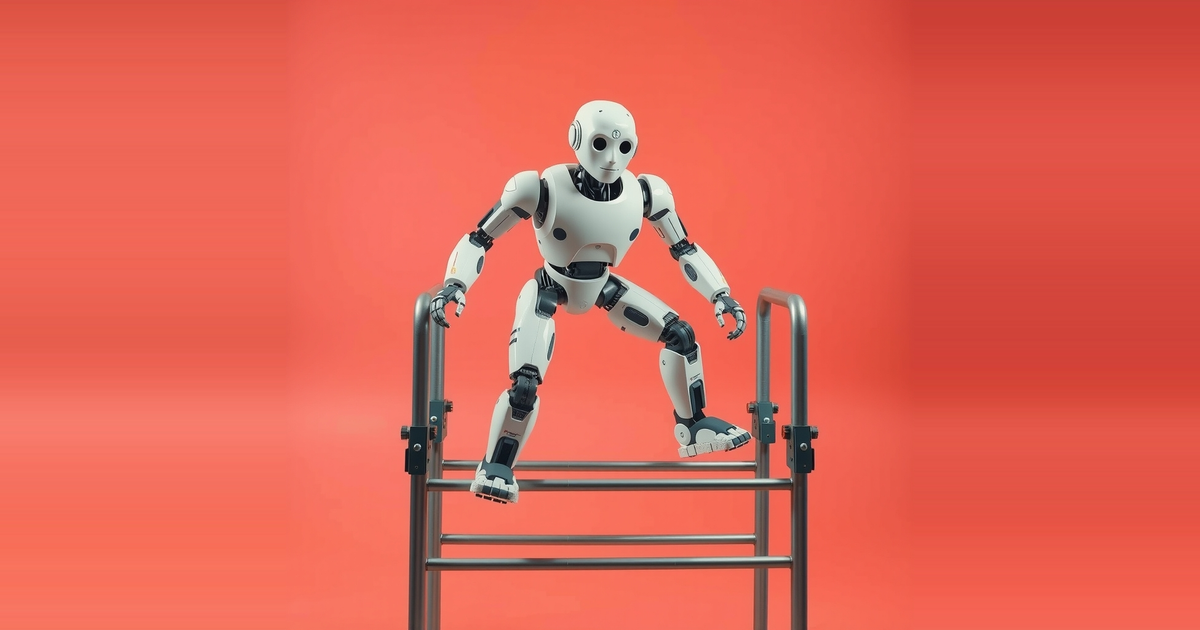
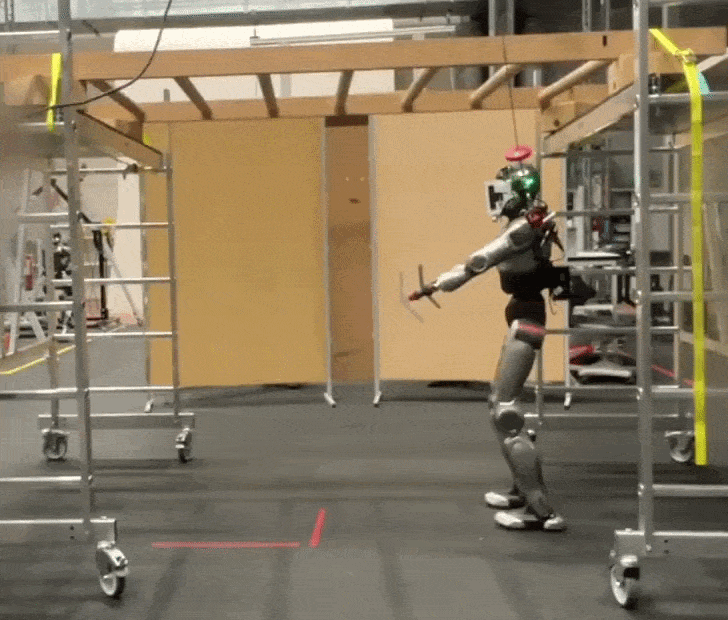
A humanoid robot at ETH Zurich's Robotic Systems Lab now completes a monkey-bar course in three stages: it jumps to the structure, moves along it through sparse bar contacts, and lands safely. The lab describes humanoid monkey bars as a test of a broader problem, which is moving through sparse three-dimensional structures. The robot has to perceive thin, overhanging geometry while carrying out agile, accurate whole-body motions.
Why monkey bars are a hard test
Most humanoid locomotion work assumes the ground is the main contact surface. Monkey bars remove that assumption. The robot has few places to put its hands, and the bars are thin and sit above it. A small error in perceiving where a bar is, or in timing a grip, means a missed contact and a fall.
The ETH Zurich team frames the task as two problems at once. One is perception: the robot must detect narrow, overhanging structures. The other is control: it must execute whole-body motion with enough accuracy to make contact with those structures. The course also includes the transitions at each end. The robot must jump to reach the bars and land safely when it lets go. Those moments are often harder than the swinging section in the middle.
The same lab published a second locomotion result. It describes a reinforcement learning framework for agile and generalized legged locomotion across terrain. Its central addition is an attention-based map encoder in the control policy. The researchers say the work targets conditions where perception and control must be tightly integrated, such as visual occlusions and sparse footholds.
They also describe a gap in prior work. Some existing methods show agility on parkour courses but rely on end-to-end sensorimotor models, which the researchers say generalize poorly and are hard to interpret. Other methods aim at generalized locomotion but tend to be less agile and struggle when the view is blocked. The new framework is meant to combine agility and generalization in one approach.
Other work shown alongside it
The same set of videos covered several other projects. Unitree said it has open-sourced UnifoLM-WLA-1.0, an embodied foundation model. The company says one model coordinates desktop manipulation and whole-body mobile manipulation, and that it supports generalization across tasks and across end effectors. Unitree also claims state-of-the-art results on multiple benchmarks among open-source models. That benchmark claim is the company's own.
The DRAGON Lab showed a multi-link aerial robot that uses its centroid and joint motion to achieve hybrid impedance-admittance control. The target is contact-rich aerial manipulation, such as sliding along a surface. The lab says the work will be presented at IEEE IROS 2026.
Other clips included a two-headed robot from the General Robotics Lab, a demonstration from KAIST's RaiLab, and a Texas A&M Advanced Vertical Flight Lab aircraft that the lab's own caption suggests should not fly. Flexiv showed a dishwashing demo. DEEP Robotics showed a robot delivering a burrito to a hiker climbing a mountain in the rain.
ANYbotics also featured a talk by CEO and co-founder Péter Fankhauser. He covers why legged robots became a way into demanding industrial plants and what it took to certify one for explosive atmospheres after experts called that impossible. He also discusses where autonomous industrial work goes next.
A reminder from disaster robotics
The Center for Robot-Assisted Search and Rescue marked the anniversary of the September 11 attacks. It describes that response as the first documented use of robots for urban search and rescue, and says it helped create the field of disaster robotics. Personnel began assembling on the afternoon of September 11 and worked the pile from late that day through October 2, when the last available robot failed.
The robots found no survivors. They did locate remains, and they helped search for routes through the rubble toward basements and stairwells where trapped firefighters might have gone. That history sets a practical bar for any robot meant to move through cluttered, irregular structures.
What the monkey-bar result does and does not show
The monkey-bar work matters because it targets a specific weakness. Humanoids are usually evaluated on flat ground, stairs or modest obstacles. A course made of thin overhead bars forces the system to handle sparse contact, where each grip carries real weight and there is little margin for error. The lab's choice to include the jump and the landing also means the test covers the whole sequence, not just the steady-state swing.
The result also sits alongside the lab's attention-based locomotion framework. Together they point to a consistent direction: perception-aware control that stays agile without being tied to one course. The researchers' own criticism of earlier methods, that agile systems generalize poorly and generalized systems lack agility, is a fair summary of the tradeoff the field faces.
Several things remain unproven. The source material describes the task and shows a video, but it gives no success rates, no number of trials, no bar spacing, and no robot specifications. It does not say whether the robot works on bar layouts it has not seen, or how it performs when sensing is degraded. Those details determine whether this is a reliable capability or a well-tuned demonstration.
The comparison with disaster robotics is also worth stating carefully. Nothing in the monkey-bar work claims a rescue application. The 9/11 record, though, shows that real structures are cluttered and unforgiving, and that robots operating there can fail from conditions that no benchmark course captured. Sparse-contact traversal is a plausible building block for such environments, but the evidence here covers a controlled course only.
The next public checkpoint for this line of work is the research calendar. CoRL 2026 is listed for 9–12 November in Austin, and the Humanoids Summit Seoul was listed for 22–23 September. Papers and talks at venues like these are where success rates, hardware details and comparisons with other methods would need to appear before the capability can be judged against alternatives.