
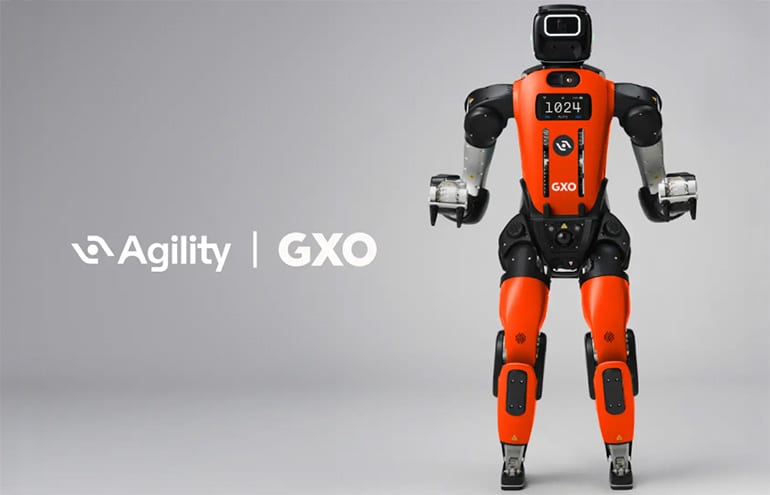
Agility Robotics will put its Digit humanoid into GXO Logistics sites in North Carolina and Tennessee, extending a partnership that began in late 2023 at a single facility in Flowery Branch, Ga. The Digit humanoid deployment will support e-commerce fulfillment, and the companies expect to start installing Digit 4 units in early 2027.
GXO said it will move to Digit 5 once that version is commercially available. Agility unveiled Digit 5 last month. It has new legs, is designed to operate safely near people, and targets a wider range of industrial workflows than earlier versions.
What the expanded agreement covers
The new agreement adds sites in two states to a relationship that has so far rested on one location. Neither company said how many robots will be deployed, how much GXO is investing, or when it expects a return on that investment.
Peggy Johnson, Agility's CEO, described GXO as the first customer to put Digit to work in live operations under a commercial agreement. She said customers have moved from asking whether humanoids can work to deciding where to scale them. Patrick Kelleher, GXO's CEO, said the expansion reflects confidence in the technology's ability to create measurable value for customers and a better working environment for staff.
GXO described the move as part of its approach to warehouse automation through practical implementation, and said it works with technology developers to test, refine and deploy new systems in live operating environments.
What Digit has done so far
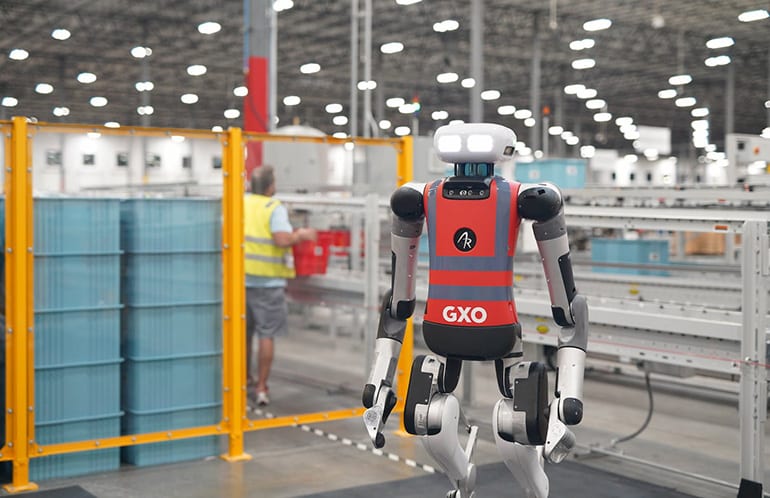
GXO and Agility first deployed Digit at Flowery Branch in late 2023. The companies called it the first commercial deployment of humanoid robots in live operations and the first robotics-as-a-service agreement for humanoids.
Since then, Digit has moved more than 100,000 totes at that facility. The robot works alongside existing automation, picking up totes and placing them onto conveyors. It is managed through Agility Arc, a cloud-based fleet management and integration platform. That tote-handling work is repetitive material handling in an active logistics setting, and it is the task set the new sites will build on.
Agility says it has logged more than 65,000 hours of real-world operation while working within industry safety standards. The company, founded in 2015 and based in Salem, Ore., won the inaugural RBR50 Robot of the Year award in 2024 as one of the first humanoid makers to enter commercial trials. It received 2026 honors for the 100,000-tote milestone at GXO.
Agility's wider position
The GXO news arrives during a busy month for Agility. The company recently received U.S. Securities and Exchange Commission approval for its planned merger with the special-purpose acquisition company Churchill Capital Corp. XI, a step toward becoming publicly traded. This month it also selected Nyobolt for fast charging, expanded its partnership with NVIDIA, and said it plans to deploy Digit at an AGCO factory for agricultural equipment in 2027.
On manufacturing capacity, Agility points to its 70,000-square-foot RoboFab facility, which it says can build up to 10,000 robots per year. It has also announced plans for a 50,000-square-foot facility in Pittsburgh to support commercial deployments, and has expanded its software and service capabilities.
A company spokesperson said Agility has paid programs with a global automaker, a major automotive component supplier and a global consumer products maker. It reports more than 30 prospective customers in its pipeline across manufacturing, logistics, aerospace, defense and consumer products.
GXO, spun out of XPO in 2021 and based in Greenwich, Conn., describes itself as the world's largest pure-play contract logistics provider. It has more than 150,000 employees across over 1,000 facilities totaling more than 200 million square feet. Last month it partnered with Exotec to automate fulfillment for Guess in the Netherlands.
Analysis: what the expansion does and does not show
The most meaningful fact here is repetition. A second and third set of sites is a different kind of evidence from a first pilot, because it suggests GXO saw enough in Flowery Branch to commit more floor space. For a humanoid maker, a repeat order from a large logistics operator carries more weight than a new trial announcement.
The limits are just as clear. In its second-quarter earnings call in August, Kelleher said GXO had run 45 humanoid pilots, had another launching in Europe, and had not yet achieved return on investment. He said he thought the company was a couple of years from that point. Nothing in the expansion announcement changes that statement, and no financial terms were given. The expansion is therefore best read as continued investment in learning, not proof of payback.
The comparison with GXO's other humanoid work is useful. The company has also tested Apptronik's Apollo and Reflex Robotics' Reflex. Digit stands out in this group because it has a stated commercial agreement and a documented volume of work, more than 100,000 totes. That is a narrow measure, though. Totes moved says little about uptime, staffing effects or cost per unit handled, and none of those figures have been disclosed.
Timing also adds uncertainty. Deployments begin with Digit 4 in early 2027, and GXO plans to migrate to Digit 5 later. Running one generation while preparing for the next means the new sites may serve partly as a transition platform. How smoothly that upgrade happens, and whether Digit 5's new legs and closer-to-people safety design hold up in production, remains unproven.
Finally, Agility's manufacturing plans are built around a capacity of 10,000 robots a year, while the only deployment numbers cited are one facility's tote count and a pipeline of prospects. The gap between that capacity and confirmed orders is where the next evidence will appear. The field should watch for robot counts per site, measured productivity, and whether GXO's stated ROI timeline holds.