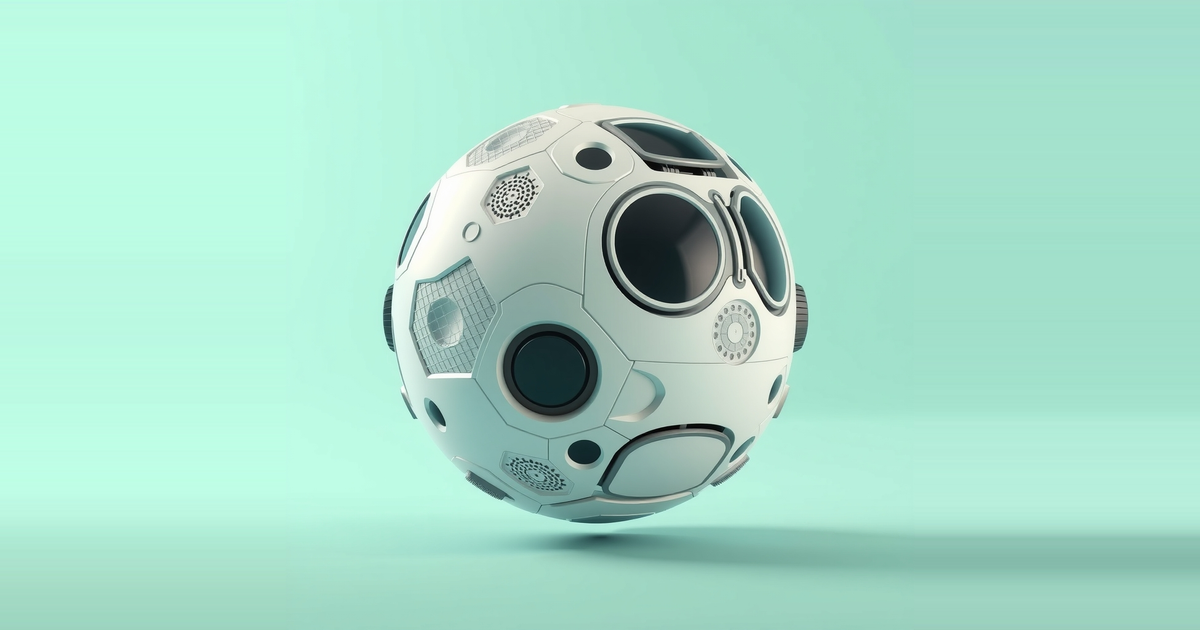
A 1.8-meter-wide, 150-kilogram inflatable ball rolled over rocks, gravel and wet clay in a central Texas quarry in February, and its builders say the same design could one day descend into the Moon's permanently shadowed craters. The machine is RoboBall III, built at Texas A&M University as a lunar crater robot that can move through terrain too risky for astronauts and too steep for conventional rovers.
A ball designed not to tip over
Rishi Jangale, a mechanical engineer nearing the end of his Ph.D. at Texas A&M, has worked on RoboBall with his labmates for about five years. The concept belongs to his advisor, Robert Ambrose, a former NASA robotics engineer who first conceived of it in 2003.
Ambrose's starting point was tipping. A wheeled robot in low lunar gravity can roll over and be lost, while an inflatable sphere cannot tip. The shell also separates the internal components from sharp rocks, dust and temperature swings that run from more than 93 °C in sunlit spots to minus 240 °C in the shade inside craters.
The target is the kind of place that rovers and crews cannot safely reach. Shackleton crater at the Moon's south pole is 21 km wide and 4 km deep, with smaller, deeper craters inside it. Parts of it never see the sun. Those dark, cold pockets hold layers of ancient lunar geology and stores of frozen water that could support a future lunar base. "NASA is not going to let astronauts get anywhere near these craters, because if someone falls in, you're not going to be able to get them out," Jangale says.
How RoboBall drives
RoboBall moves by shifting a pendulum inside its shell, which changes the position of its center of mass. If the pendulum arm points forward, the shell rolls forward to compensate, and it keeps rolling as long as the center of mass stays ahead of the ball's center. Leaning the pendulum a few degrees left or right steers the ball in that direction. "The robot wants to go where you point the pendulum," Jangale says.
On steep slopes, the same mechanism works as a brake. Angling the pendulum uphill lets the ball control its speed on the way down. The 340-pound ball is soft enough to bounce lightly over bumps, but slight overpressure keeps it relatively firm.
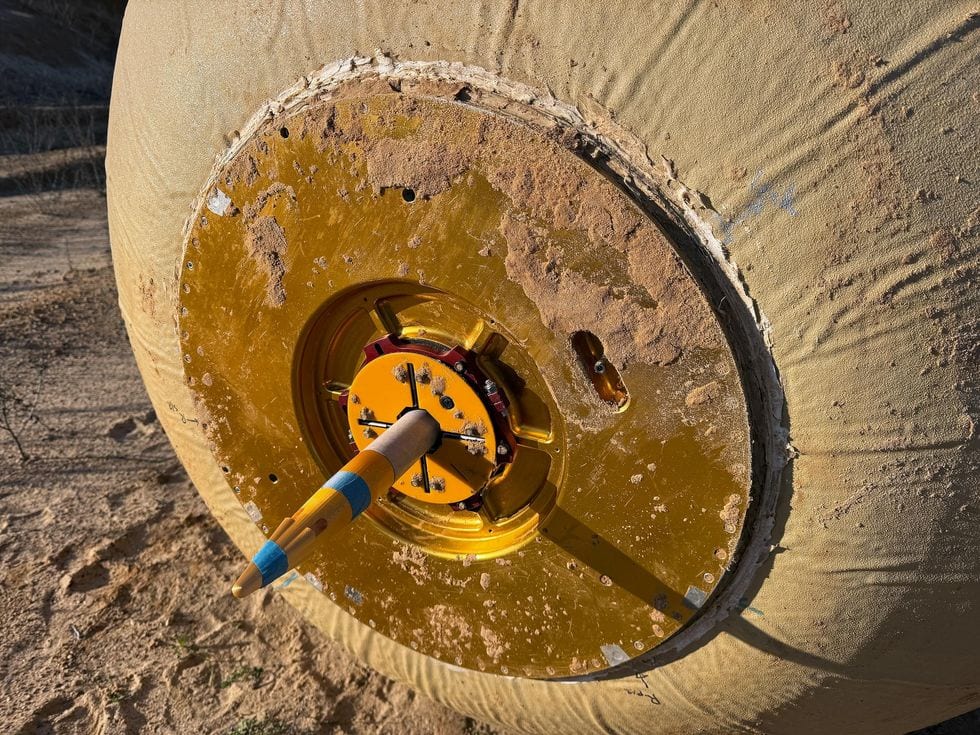
The drive uses just two actuators, and both sit fully inside the shell, protected from dust. Hiro Ono, an aerospace engineer who worked on robot mobility at NASA's Jet Propulsion Lab for 13 years before joining Georgia Tech, calls that feature "unique." "The beauty here is the simplicity," he says.
From prototype to quarry tests
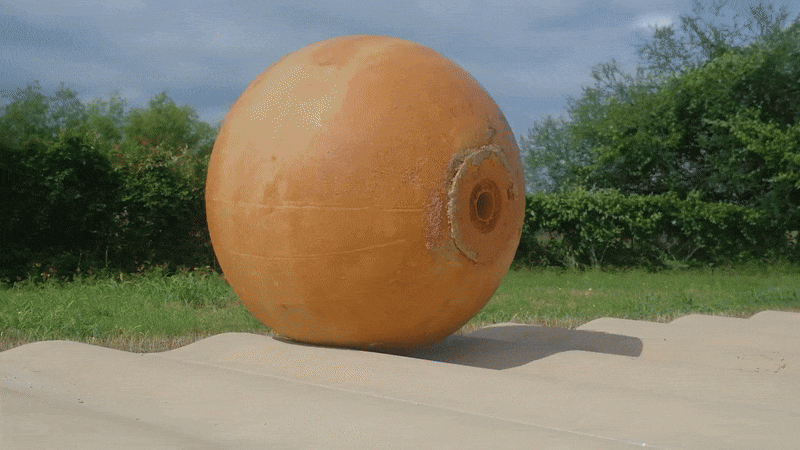
Ambrose's lab finished a proof of concept in 2022, the 0.5-meter-wide RoboBall II. The full-size RoboBall III took about 11 months to build. The team broke robots and rebuilt them quickly. Jangale recalls software errors and a drivetrain that was too weak to roll over soft bumps in early tests.
After the first quarry tests, the team spent about seven months designing and building an upgraded RoboBall III with 2.5 times more torque. That is enough to fling the ball over small obstacles and roll up 20-degree slopes.
The results appear in a paper in IEEE Transactions on Field Robotics, which also describes the robot's design and a hypothetical lunar mission. In the tests, the remotely operated ball descended the quarry's slopes, crossed soft terrain, and used small rockets to launch hypothetical payloads out of the crater.
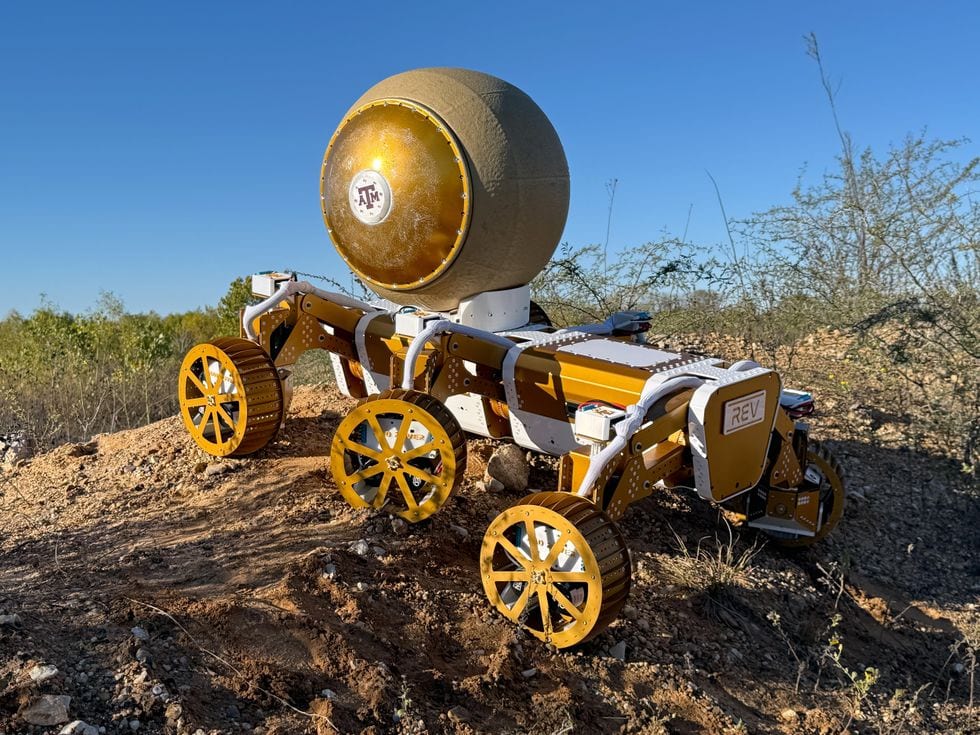
The mission concept has three steps. A wheeled rover carries RoboBall across the surface to a crater's edge. The ball inflates itself and charges from the rover's large battery, then heads into the crater on its own. A small rocket can fire from the ball's center to return a sample to the rover outside. Unlike a small tethered rover, RoboBall would not roll back up. With no tether, though, it would have a far greater range for collecting geological samples.
The scientific case rests on sample context. Sara Russell, a cosmic mineralogist at London's Natural History Museum who is not involved in the work, notes that NASA has not brought lunar samples back to Earth in over 50 years. Meteorites from the Moon reach Earth, but she says they lack the "gold standard" field context about where a sample came from.
What stands between RoboBall and the Moon
The current version cost roughly $250,000 to build and is not ready for flight. Its gold-treated aluminum parts suit space missions, but its other materials do not. Space-grade electronics will cost more. The shell is tough enough to roll over steel shards and withstand minus 184 °C, but it has never been evaluated in lunar extremes.
The team also plans to make the ball adapt its driving to varying slopes autonomously. It hopes to work with government agencies or spaceflight contractors on a real mission, and with scientists designing lunar instruments that fit the carry-on-luggage-size interior. Later this year, Texas A&M will open a Houston facility with the world's largest indoor simulated Moon and Mars landscapes, 190 km from the quarry.
Jangale is clear about the limits. RoboBall's slightly bumbling motion makes it a poor choice for collecting a sample from one specific rock. "The robot is not the mission," he says. "The robot is a way for you to complete the mission."
Analysis: what the results do and do not show
The strongest argument for the design is its small mechanical footprint. Two actuators, both sealed inside a shell that already handles dust and impact, remove several failure points that exposed wheels, legs and joints carry. Ono's comment on simplicity comes from someone who spent 13 years on robot mobility at JPL, which gives it weight. The design also targets a real gap: the craters in question are ones the source says astronauts will not approach and a tethered rover can only reach on a short leash.
The tradeoff is built into the concept. RoboBall is a one-way descent vehicle that depends on a rover at the rim and on small rockets to return samples. That makes it suited to broad surveys of crater floors and walls, not to targeted sampling. The team's own admission on specific rocks defines the niche: context-rich bulk collection, not precision.
Much remains unproven. The quarry tests show the ball can roll, descend, cross soft ground and launch payloads, but a quarry is not a permanently shadowed crater. The shell has not been tested at lunar temperature extremes, the electronics are not space-grade, and the rocket return has been shown only with hypothetical payloads. Slope handling is currently remote-operated, and the planned autonomy has not been demonstrated. The climb rating of 20 degrees also says nothing yet about how the ball behaves on the steepest crater walls, where the pendulum braking would matter most.
The next test is the Houston facility. If a lunar crater robot like this is to fly, the Houston simulated terrain is where the team can begin to answer those questions on a surface closer to the real one.