
Florent Delgrange, a postdoctoral researcher at the Artificial Intelligence Lab of Vrije Universiteit Brussel (VUB), won the Best Blue Sky Paper Award at AAMAS 2026 for a paper on foundation world models for agents that learn, verify and adapt reliably beyond static environments. The paper sets out a research agenda, not a finished system. Its central question is how an autonomous agent can keep learning as its world changes without quietly losing the guarantees that made its behavior trustworthy.
Two methods, one gap
Delgrange starts from the limits of two established approaches. Reinforcement learning lets an agent learn by trial and error and can scale to environments where no one could write down every rule. But the agent is usually asked to maximize a reward. A poorly specified reward can be exploited, and a high reward does not show that a safety or coordination requirement has been met.
Reactive synthesis works from the other direction. Given a model of the environment and a logical description of the intended behavior, it can construct a policy that is correct by design. Its weakness is that it normally needs an explicit, fixed model, which an agent in an open and changing world does not have.
The paper proposes joining the two in a single loop. A world model would be learned from experience but structured so that a verifier can reason about it. As the agent learns a policy, it would update the model, measure how reliable its abstraction is, and check whether the policy still satisfies its specification. Verifier feedback could reject an unsafe update, request data from an uncertain region, or trigger a revision of the model.
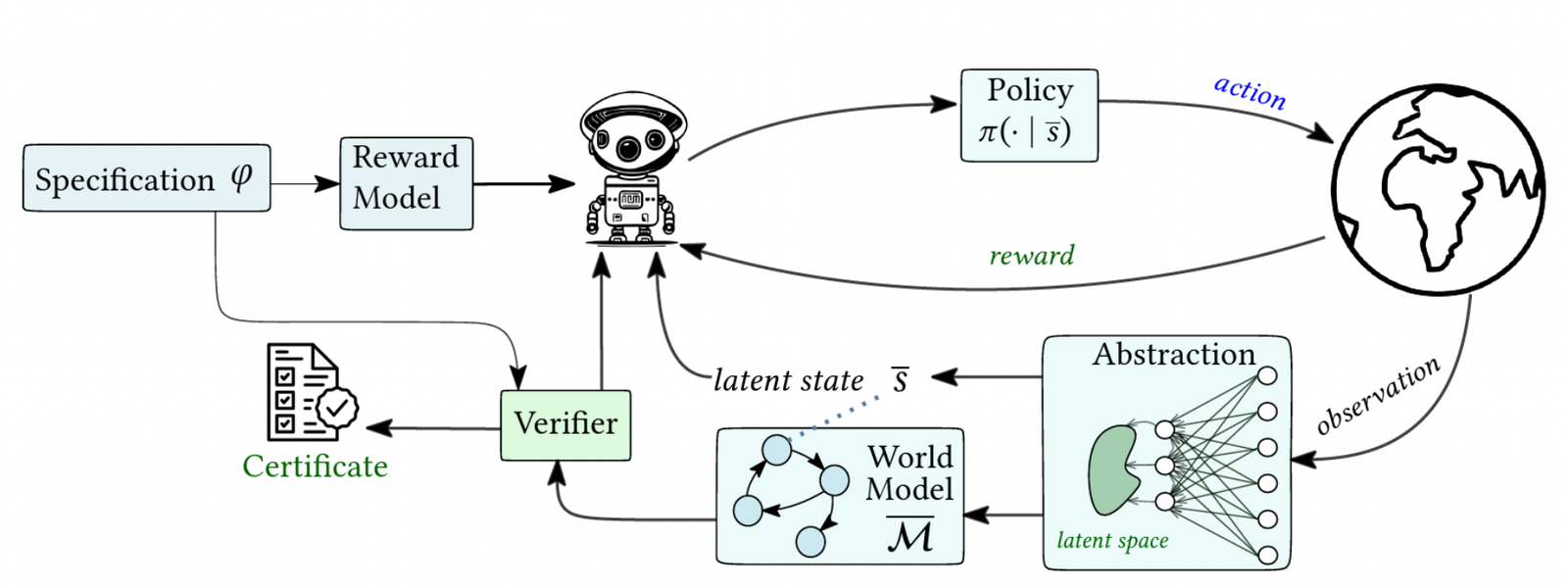
What the model would have to do
Delgrange uses the word foundation to mean reuse, not size. He does not describe a larger video predictor trained on more trajectories. He describes a persistent, structured model that an agent carries across tasks, policies and changing populations of agents. He compares it to a map that records which areas have been surveyed, which conclusions depend on them, and when a change has made an old route unreliable.
He names three properties. The model should be calibrated, so each learned abstraction comes with a measure of its error or coverage and the agent knows where formal conclusions hold. It should be compositional, so verified local dynamics, behaviors and certificates can be reused when a new task is assembled. And it should be semantically queryable, so a formal requirement or high-level instruction can help derive a reward model, a task-specific abstraction or a policy prior with little additional experience.
This differs from most current model-based methods, which learn for a particular task, environment, policy or training distribution and are judged mainly on predictive accuracy. Delgrange argues that average accuracy is not the same as fitness for a guarantee. In his warehouse example, a model might predict nearly every transition correctly but miss a rare interaction with a forklift. That one transition decides whether a collision-avoidance claim is valid. A compact model that ignores colors and textures could, conversely, keep everything needed to reason about routes and collisions.
A warehouse robot as a test case
The worked example is a delivery robot with the task stated as eventually delivering the package while always avoiding collisions. The system would translate that requirement into a reward model, so learning and verification start from the same description. The verifier would then ask whether the policy satisfies the requirement in the learned model, and whether the abstraction is accurate enough along the relevant routes for that conclusion to be trusted.
If a forklift starts using a rarely visited shortcut, the model should lower its confidence in that region. The verifier would withdraw the affected certificate, reject a risky policy update, direct exploration toward the shortcut, and reinstate the guarantee only after the model is recalibrated.
The paper also considers a test-time loop with a language model. The language model would propose small formal programs describing new dynamics. A model checker would test them and return a counterexample or structural inconsistency when they are wrong. The language model would revise its hypothesis, the robot would collect targeted experience, and the cycle would repeat. In Delgrange's phrasing, the language model proposes and the formal verifier checks.
Multi-agent systems
The problem is harder with several agents, because each learner is part of every other agent's environment. Effective dynamics shift as agents update policies, join or leave, share information or take on new objectives. Delgrange suggests that a foundation world model could link each local policy to the assumptions behind its certificate. If one robot changes its route, the system could identify the affected guarantees, gather data where needed and revise only those components instead of re-verifying the whole fleet. Failures would come with a counterexample showing which interaction broke a certificate.
He names scalability as the main obstacle. The joint state space grows quickly with the number of agents, and local guarantees do not automatically compose into a global one.
Analysis: what this does and does not establish
The award recognizes a direction, and the paper does not report a working system. Delgrange says the pieces already exist: formal reward translations, verifiable abstractions, safe policy-improvement methods and program generation. What is missing is an efficient end-to-end agent that keeps them all calibrated while it learns. That is a statement about integration, and integration is where such programs often stall.
The idea matters because it changes what a world model is judged on. Today's models are tuned to predict well on average. Delgrange's warehouse example shows why that can fail for safety claims: a small error in one transition can invalidate a guarantee that the average hides. Making reliability information part of the model, tied to a specific policy and requirement, is a sharper standard than predictive accuracy. It also treats certification as ongoing work, which fits deployments where conditions drift.
Compared with the two traditions it joins, the proposal keeps the scalability of reinforcement learning and the explicit correctness claims of reactive synthesis, but it depends on a part neither supplies: a trustworthy measure of when a learned abstraction is good enough to support a formal conclusion. Whether such calibration can be made tight enough to be useful, without being so conservative that the verifier rejects most updates, is not addressed by the evidence in the paper's description.
Several claims remain unproven. No result shows that verification can run fast enough to influence learning online. No result shows that language-model-proposed programs, checked by a model checker, converge on correct dynamics in practice. And for multi-agent settings, Delgrange himself says the methods for preserving soundness under composition still need to be found. Until those are demonstrated, foundation world models are best read as a well-argued set of requirements for safe adaptive agents, and the next evidence to watch for is a prototype that closes the loop on even a small warehouse-scale task.