
China installed 15,000 humanoid robots in 2025, equal to 85% of global humanoid deployments that year, in the first year of mass production. The figure comes from a country that now counts more than 150 humanoid companies and has made embodied AI a central industry priority in its 15th Five-Year Plan, which covers 2026 to 2030. The China humanoid robot strategy rests on state coordination, an existing manufacturing base and a shared data effort.
From factory automation to embodied AI
The 13th Five-Year Plan (2016-2020) operationalized Made in China 2025, a campaign to move the country from a low-cost factory floor to a high-tech manufacturing leader. It used large government subsidies to offset production costs. Foreign critics called the subsidies market distortion and imposed sanctions. Beijing later retired the Made in China 2025 branding, but carried its robotics goals into sector plans under the 14th Five-Year Plan (2021-2025).
The Ministry of Industry and Information Technology issued two robot-specific initiatives. The 14th Five Year Plan for the Robotics Industry (2021) gave state support to research aimed at replacing foreign suppliers of critical components. The Robot + Application Action Plan (2023) required adoption of domestic robots across ten key sectors, including agriculture, logistics and health.
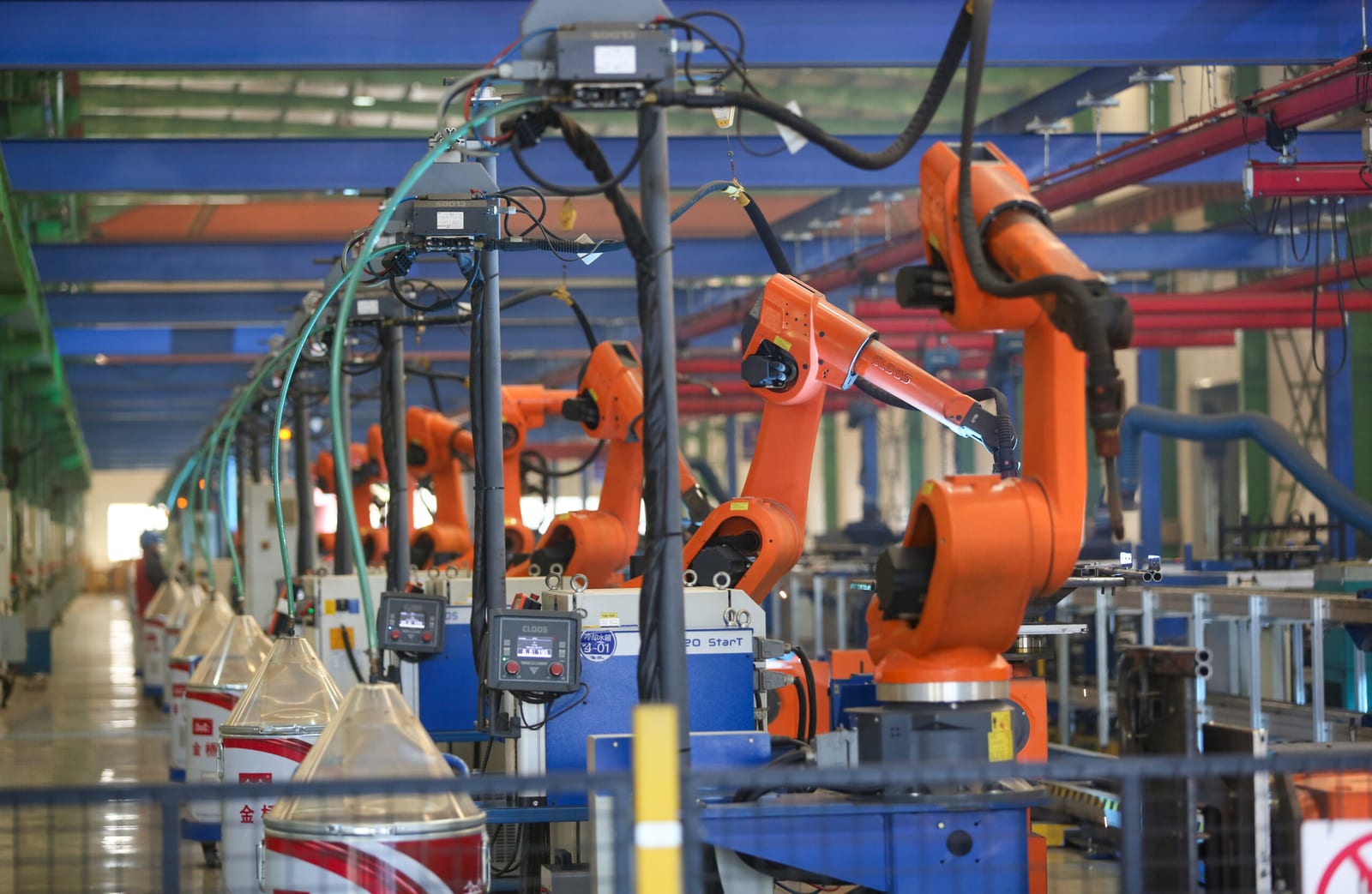
By 2025, domestic share of the industrial robot market had risen from 30% to 57% over a decade, and domestic suppliers became market leaders for the first time. China recorded 295,000 industrial robot installations in 2025, 54% of the global total. Hubs formed in Shanghai for AI research, in the Yangtze River Delta for hardware, and in Shenzhen for startups. China also processes over 70% of global production of rare earths such as neodymium, which are used in electromagnetic motors.
Gaps in precision hardware and chips
Some targets were missed. Domestic robots hold close to 30% of the domestic market in higher-stakes sectors such as automotive, and 15% in high-end machine tools, against near-total share in lower-stakes industries such as textiles. Strain-wave reducers, precision gearboxes and high-performance servo motors still depend on imports from Japan and Germany. The 15th plan prioritizes precision hardware.
Beijing also fell short of its goal of 70% self-sufficiency in semiconductor manufacturing, by an estimated 40%. Robotics depends on advanced logic chips for model training. Chinese purchases of U.S. AI chips fell sharply by late 2025, which points to a push for domestic chips under U.S. export controls and tension across the Taiwan Strait.
Humanoids and shared training data
The 15th plan shifts from advanced automation to embodied intelligence, meaning AI that interacts physically with real environments. Central ministries, provincial governments and state financial institutions must coordinate robotics work, and substantial shares of state-backed venture and guidance funds are being redirected to the sector. Huawei and Alibaba have made large investments in humanoid companies. The plan ties into the AI Plus Action Plan, which favors practical applications that domestic chips can already run, and into sandbox regulations that set aside urban zones for real-world testing.
Training is organized as shared infrastructure. By July 2026, 40 humanoid training facilities had opened in major cities. Robots from different domestic makers are pooled there to practice skills such as grasping and transport. Operators in VR headsets and exoskeletons teleoperate them, capturing motion and spatial data. The data is cleaned, labeled and shared across manufacturers as reference datasets.
The risks are visible. Policy-driven supply currently outpaces demand, and only a fraction of the 150-plus companies are expected to survive. Unitree Robotics listed on the Shanghai Stock Exchange, saw shares rise as much as 629% intraday, then fell nearly 45% in the following days.
What this means for the field
The scale numbers matter because data is the constraint in learning-based manipulation. Pooled teleoperation facilities give Chinese makers a common supply of human motion data that few competitors can match. The humanoid form helps here, since human workers map directly onto the robot body. That logic holds only if humanoids prove to be the right form factor, which the robotics community still debates. Redundant joints add mechanical inefficiency and control complexity.
The comparison with industrial robots is instructive. China led on installation volume and cost, yet lagged in precision components and in higher-stakes sectors. Humanoids depend on the same reducers, servo motors and chips, so the same gaps could limit durability and capability. The 85% share counts deployments, not proven productive work, and the source gives no figure for how many of those units perform paid tasks.
Three things remain unproven. First, whether demand will arrive before overcapacity forces consolidation. Second, whether shared datasets produce generalizable skills rather than narrow task performance. Third, whether domestic chips can close the gap that missed semiconductor targets exposed. The Unitree swing suggests investors are pricing policy support, not revenue. Other countries that outsourced manufacturing are now spending to rebuild foundries and supply chains that China built earlier, which gives its plan a head start that subsidies alone do not explain.