
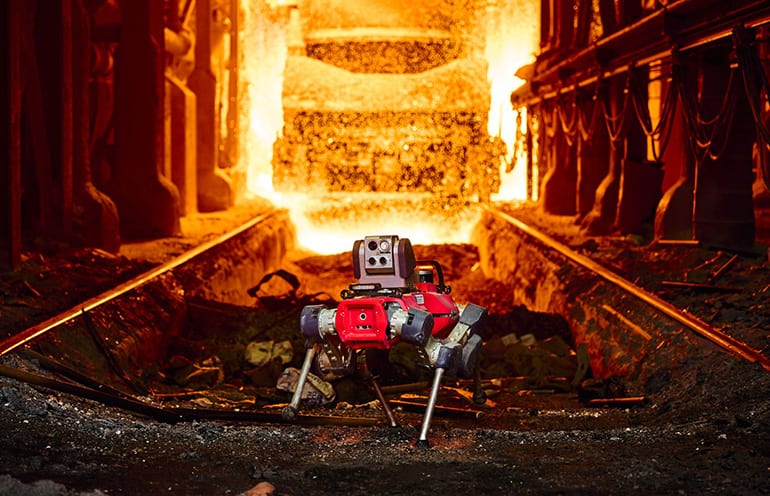
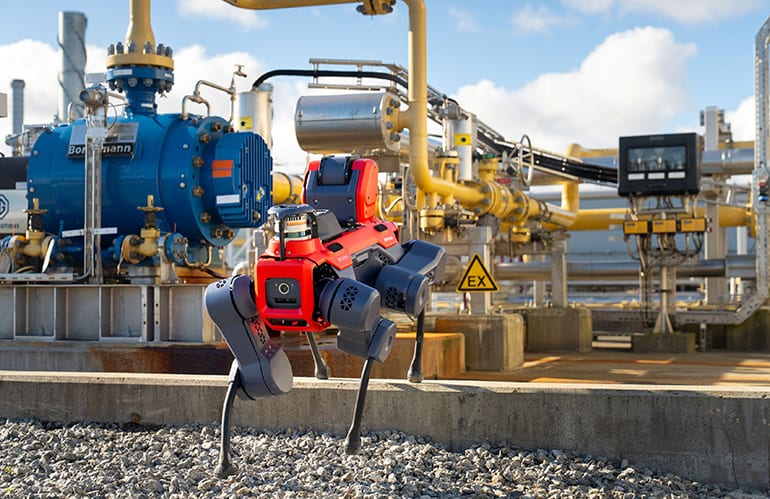
ANYmal X has 12 leg actuators and a battery, and every one of them sits inside a flameproof casing. The AI computer and inspection equipment are in nitrogen-filled, sealed chambers. ANYbotics AG says this makes ANYmal X an explosion-proof legged robot, and the company has begun delivering it to customers. It describes the quadruped as the world's first legged inspection robot for explosive atmospheres.
The robot is aimed at oil, gas and chemical plants. It carries thermal, visual, acoustic and gas sensors and runs routine inspections without a person on site. ANYbotics says it complies with the ATEX standard in Europe and IECEx globally.
Why hazardous zones have stayed closed to robots
Every device taken into a hazardous area, from radios to flashlights, has to be explosion-protected, according to ANYbotics. Each unit needs independent certification showing that it cannot ignite a flammable atmosphere, even when a component fails.
Fixed equipment usually meets this requirement with heavy explosion-proof enclosures or by limiting electrical energy. ANYbotics says neither approach works for a walking robot. A legged machine needs high-power motors and a large battery in a frame light enough to climb stairs. It also needs exposed cameras and sensors for navigation, and it must be able to dock on its own.
The company says each of those parts had to be certified without giving up payload capacity, agility or speed. It does not state the robot's weight, payload or speed in this announcement.
Chief technology officer Andrea Corda described the engineering method. "We asked one question over and over: Which credible event in the life of a walking robot could create an ignition source, and how do we make sure it never does?" he said. ANYbotics ran an ignition-risk assessment covering the robot's service life and added safeguards for each source it found.
How ANYmal X handles ignition risk
Beyond the nitrogen-filled chambers and flameproof casings, the design uses several other measures. Non-metallic shells insulate metallic components. Conductive feet provide grounding. Automatic cutoffs monitor temperature. Charging and data transmission pass through energy barriers, so no connection is exposed to the hazardous area.
Onboard software checks the robot's condition before, during and after each mission. ANYbotics also says it tested durability against shock, vibration, corrosion, solar radiation and salt mist, to confirm the protective measures keep working in normal use.
The company says the robot needs no facility modifications. It reports that ANYmal X can handle steep stairs and narrow walkways. The sensors log each reading to the matching asset, which gives reliability engineers a baseline for tracking wear, leaks, overheating and abnormal noise over time.
The software and the customer base
ANYmal X runs on Shift, ANYbotics' operations platform. Shift schedules missions, organizes findings by asset and helps maintenance teams follow changes over time. It connects to existing maintenance software, including SAP, Yokogawa and SLB. ANYbotics says the whole system is developed and operated under ISO 27001 information security standards.
Chief revenue officer Thierry Obédé said more than 50 power, metals and materials customers use the system to run over 120,000 autonomous inspections a month. He did not say how many of those inspections took place in explosive atmospheres.
Since 2023, BP, Equinor, Shell, PETRONAS, Petrobras, BASF and SLB have tested ANYmal X across hundreds of onshore and offshore missions through the company's Early Access Program. ANYbotics says their feedback shaped the version now being delivered. The robot and its AI stack will be shown publicly for the first time at ADIPEC 2026, by ANYbotics, SLB and Kuwait Oil Co.
ANYbotics was spun out of ETH Zurich in 2016. It reports more than $150 million in backing and about 200 employees in Zurich, San Francisco and Barcelona. The company cites more than 10 patents in ANYmal X and four years of engineering.
What this means, and what is still unproven
The main significance is in the certification, not the walking. According to ANYbotics, the most valuable equipment in a plant, such as pumps, compressors, valves and piping, sits in zones where standard robots are banned. People still enter those zones with protective equipment, handheld gas detectors and entry permits. Inspection robots that cannot enter them can only cover the safer parts of a site. A certified legged robot would extend autonomous rounds into the areas where manual inspection is most costly and carries the most risk.
The engineering approach also differs from how fixed equipment is made compliant. Heavy enclosures and energy limits are not options for a machine that has to climb, carry a battery and expose sensors. Isolating each ignition source individually, as ANYbotics describes, is a component-by-component route. Corda said it amounts to a new explosion-protection approach for a class of autonomous mobile robots. If certification bodies accept it, other makers of mobile robots could follow a similar path, though the announcement does not say whether they will.
Several points remain open. The announcement gives no price, weight, payload, speed or battery runtime. Those figures decide whether the robot is practical across a large plant. The 120,000 monthly inspections come from a different set of customers, in power, metals and materials, so they show the software and the robot family are used at scale but not that ANYmal X has done so in explosive zones. The early-access work is described only as hundreds of missions, which is small beside that figure. The claim of being first, the market size and the downtime costs are all ANYbotics' own statements or figures it cites.
The test now is whether the oil, gas and chemical operators that trialed the robot move from pilots to routine deployment, and whether the first public showing at ADIPEC 2026 comes with performance data. Certification is a necessary condition. Reliable inspections over months of plant operation will show whether it is enough.