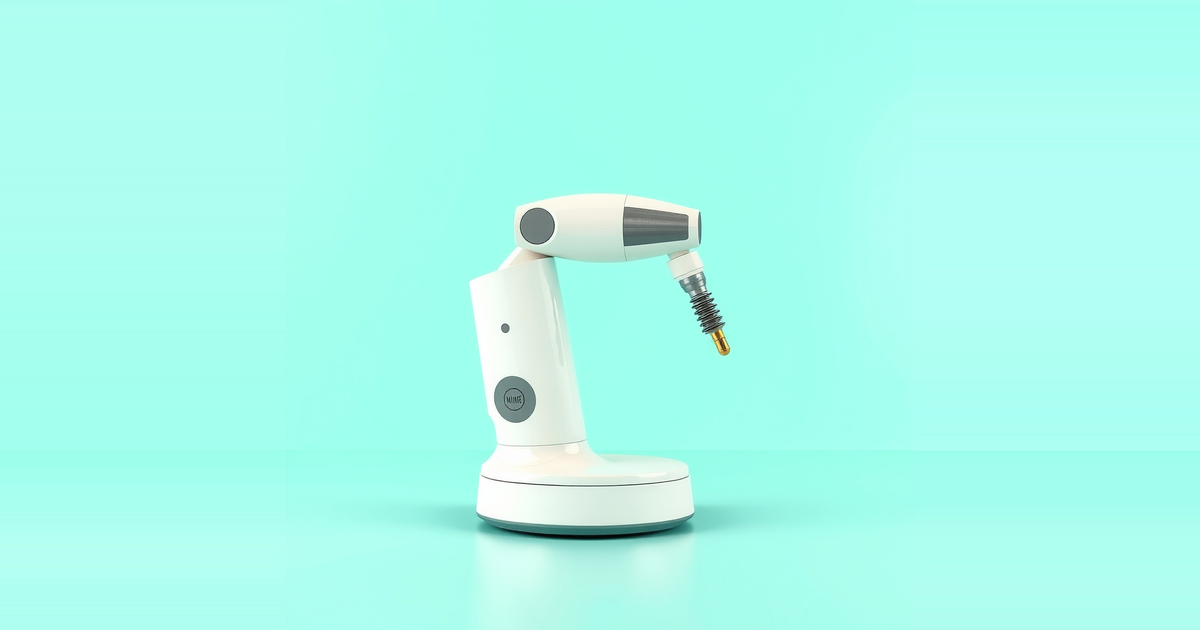
A robot measuring 43 by 26 by 28 millimeters, roughly the size of a wine cork, has prepared test teeth with a positional error below 0.2 millimeters. The dental robot was built by researchers in the Department of Biomedical Engineering at the University of Basel, with the University of Zurich involved in its development. The team reports the work in IEEE Transactions on Medical Robotics and Bionics.
Why a crown takes several visits
A large cavity caused by tooth decay can mean the tooth needs a crown. Under the current process, the first appointment covers several steps. The dentist removes the decay, fills the cavity and prepares the tooth for the crown. She then takes an impression and fits a temporary crown.
The permanent crown is made from that impression. It can only be placed at a later appointment. That gap is the reason the treatment needs follow-up visits.
The Basel group wants to shorten this sequence. In their concept, the dentist scans the tooth at the first appointment and plans exactly how material should be removed. The crown can then be ordered straight away instead of after a second visit. The robot would carry out the preparation according to that digital plan.
A prototype built to fit inside a mouth
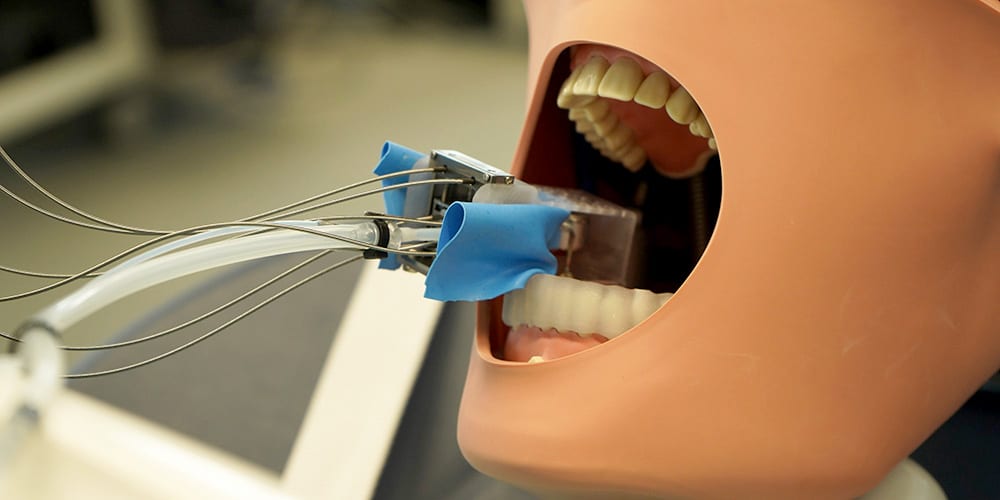
The prototype is called MIR, short for Miniature Intraoral Robot. Only the robot itself sits near the patient. Its motors and control system are located outside it and connect through flexible drive shafts, cables and tubes. That arrangement keeps the part in the mouth small.
“It is designed to be small enough to fit comfortably into an open mouth,” says Dr Yukiko Tomooka, first author of the paper. The robot was mounted on a model patient during the work.
The idea for the system came from researchers at the University of Zurich. The project was funded by Innosuisse and carried out with the Center for Dentistry at the University of Zurich, Basel-based Camlog Biotechnologies GmbH and the University of Bern. Professor Georg Rauter leads the research group in Basel, which regularly works with practicing physicians and dentists on medical robots.
How the tests were run
The team tested the dental robot on tooth models made of synthetic resin and on a ceramic material with a hardness similar to that of tooth enamel. The robot prepares a tooth in two steps. First, a wide drill reduces the tooth surface by removing material from above. Then a longer, thinner drill works on the sides of the tooth.
The positional error stayed below 0.2 millimeters. The robot reached this figure without any sensors that measure or correct its position directly. The researchers expect the error to fall further once sensors are added.
The team also measured the forces generated during drilling. These stayed below five newtons, about the gravitational force of a half-liter bottle of water. The researchers are also studying the noise the system produces, in order to judge whether it suits use in a dental practice.
Sensors and a camera come next
MIR is not ready for clinical use. The next step is to integrate sensors and a camera so the robot can monitor its own position and the progress of the treatment. Rauter describes one benefit: “Even after a power outage, MIR would know where it is and where it needs to continue based on the sensor data.” The aim is to add these parts without making the robot any larger.
Analysis: what the results show and what they leave open
The main significance of this work is the combination of size and accuracy. A device that fits in an open mouth and still holds an error under 0.2 millimeters addresses a basic problem for any intraoral robot. Space is tight, and the drilling target is small. Placing the motors and control system outside the device is the design choice that makes the small body possible.
The accuracy figure is also notable for what it lacks. The robot reached it with no direct position sensing. That suggests the mechanics and the control are sound, but it also means the system has no way yet to detect that it has drifted or been disturbed. Rauter’s power-outage example shows why this matters. Without sensors, the robot cannot recover its place in a job on its own.
The workflow benefit is plausible but unproven. Fewer appointments depend on a chain of steps working together: the scan, the digital plan, the robotic preparation and the immediate crown order. The reported tests cover only the preparation step, and they were run on synthetic resin and a ceramic. Neither material is a living tooth. A real patient moves, produces saliva and has a tooth of varying structure. None of these conditions appear in the reported results.
The source does not compare MIR with other dental systems, so no ranking against competitors can be drawn from it. What can be said is that the design takes a different approach from a dentist’s handheld drill. The plan is fixed in advance from a scan, and the robot executes it. Whether that yields better crown fit than manual preparation has not been shown in these tests.
Several open questions remain. Noise is still under study, and the paper gives no result to judge it against. The drilling force of under five newtons is a measured value, but the source does not say how it compares with forces in conventional preparation. No price, weight or timeline for clinical trials is stated.
For the field, the useful takeaway is narrow and concrete. A small, externally driven dental robot can meet a sub-0.2 millimeter positional target on test materials. The sensor and camera work will show whether it can also stay small, know its own state and handle the demands of a real mouth.