
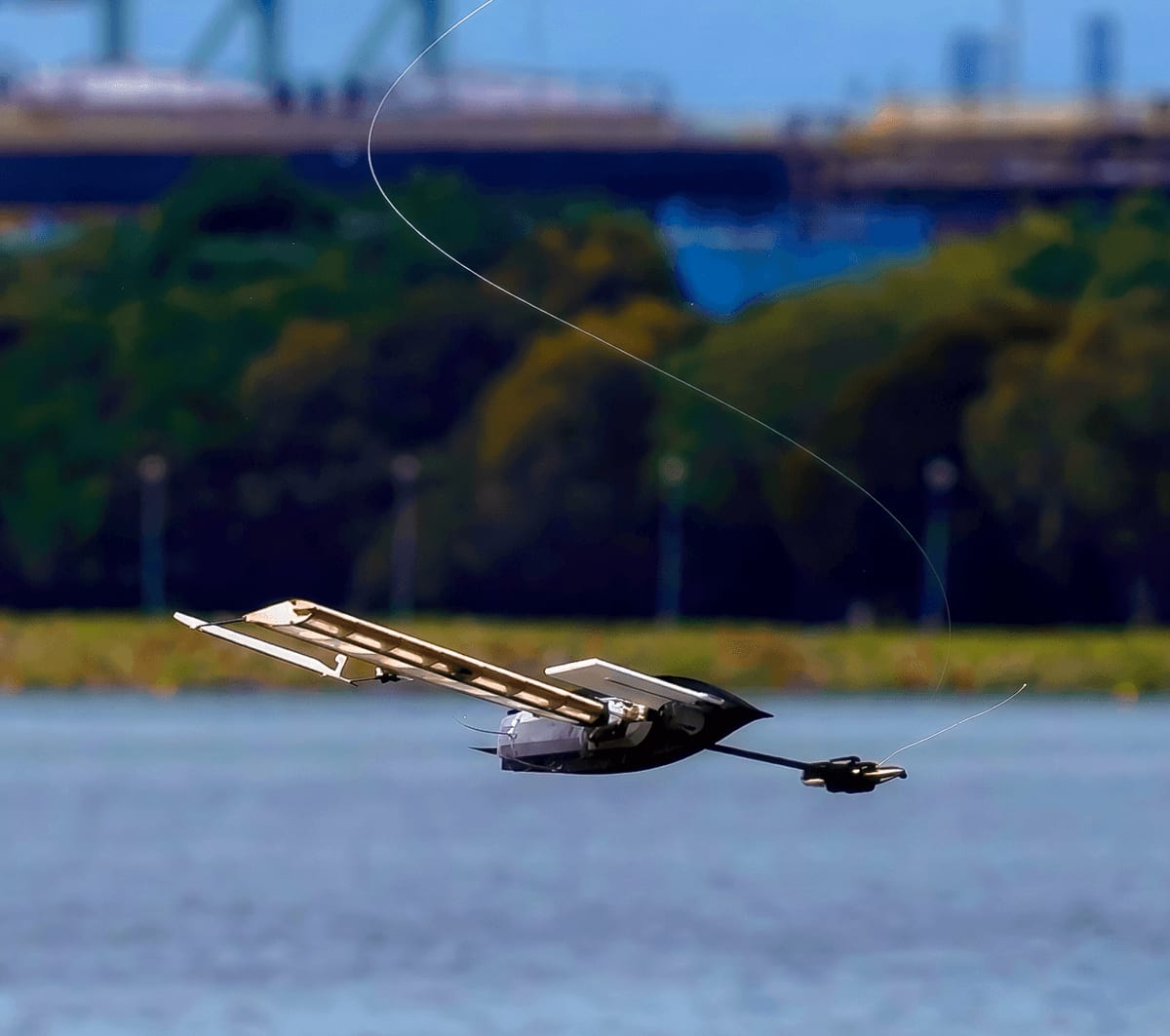
A robot named ALBATROSS can be released from the air, spin down to the water on its own wings without a parachute, right itself after landing, and then use those same wings as sails. The albatross robot comes from the AIR Lab at Singapore University of Technology and Design, and the work is described in a paper published in Science Robotics.
The name stands for Airborne Lander with Buoyant AuToROtating Sailing Sensor. The team calls it a hybrid aerial-marine robot. It is built to move from air to water and then travel across the surface under wind power, without a separate system for each stage.
Descent without a parachute
ALBATROSS is dropped from the air. As it falls, it autorotates, meaning its rigid wings spin as the robot descends and slow its fall. The team says this lets it reach the water without a parachute.
Skipping the parachute removes a component that would otherwise be carried for a single use. The wings do that job instead. The designers say the aim is to make the physical structure do as much of the work as possible.
After touchdown, the robot rights itself passively. The source describes this as self-righting after landing and does not describe any motor or active mechanism for it. The robot ends up in the correct orientation because of how it is built.
The same wings become sails
Once upright on the water, ALBATROSS reuses its rigid wings as sails. It then navigates autonomously, powered by wind. The wings therefore serve three purposes: slowing the descent, and then, after landing, catching the wind for propulsion.
The team states that this is done with minimal actuation. Rather than carrying one set of hardware for aerial descent, another for landing, and a third for marine propulsion, the robot uses a single set of wings throughout. Fewer separate systems means fewer parts to carry and, in principle, less energy spent after deployment.
What the researchers want to learn
The team frames the project as a question about a class of platforms. They are interested in whether robots like this could combine rapid aerial deployment with persistent, energy-efficient marine sensing. The name's reference to a sailing sensor points to the intended role: a device that arrives quickly from above and then stays on the water.
The description does not give the robot's size, weight, drop height, sailing speed, range, or the sensors it would carry. It does not say how long it can stay at sea or how it performed in open water. Those details would be needed to judge how practical the design is.
Other work in the same field
ALBATROSS is one of several reconfigurable and bioinspired designs that appeared in the same week. A lab at the University of Toronto has developed a lightweight, compliant footpad for a hopping robot. It pairs a planar foot on a compliant spherical joint, which lets the foot self-align, with embedded spines for grip on uneven or slippery ground.
The General Robotics Lab has presented HARP, a platform in which independently deployable aerial robots physically reconfigure to combine their capabilities for field operations. A high school student in Canada, Daniel Zhu, built a low-cost self-constructing arm for disaster response. It splits into three wheeled modules that travel separately and dock with a spring-lock mechanism, so the parts can fit through rubble gaps that a full arm could not.
Sharpa also unveiled three products at IROS: D01, a tactile-sensing robot for dexterous manipulation; W02, an ultracompact dexterous hand; and AE01, a haptic exoskeleton data glove.
Analysis: why this albatross robot matters, and what is unproven
The most useful idea in the albatross robot is consolidation. Most deployable sensing systems have to solve descent, landing, and movement separately, and each solution adds mass and failure points. ALBATROSS assigns all three jobs to one pair of wings. That is a design argument, and it is a reasonable one. A part that does several jobs avoids the extra mass of single-purpose hardware.
The comparison with the other designs from the same week is instructive. The modular arm and HARP also split one capability across physical modules that change configuration. ALBATROSS differs in that it changes the function of a single structure across phases of a mission. Both approaches address the same constraint, which is that a robot has to reach a site before it can be useful there.
The persistence claim is the part that remains unproven. Wind propulsion is energy-efficient in principle, since the robot does not need to carry fuel for movement. But the team presents long-duration marine sensing as a question it is interested in, not a result. The material available gives no endurance figures, no wind conditions under which the robot can navigate, and no data on how well it holds a course.
Two mechanisms also need more evidence than a description can provide. Passive self-righting has to work reliably in waves, not only in calm water. Autorotation has to produce a landing gentle enough for the sensor payload to survive. The source states that both happen, but it does not give success rates or conditions.
The paper's peer-reviewed venue is a point in its favour. The open items are quantitative: how far, how long, in what weather, and carrying what. Until those are published, ALBATROSS is best read as a working demonstration of a single-structure design, not yet a proven ocean-sensing platform.