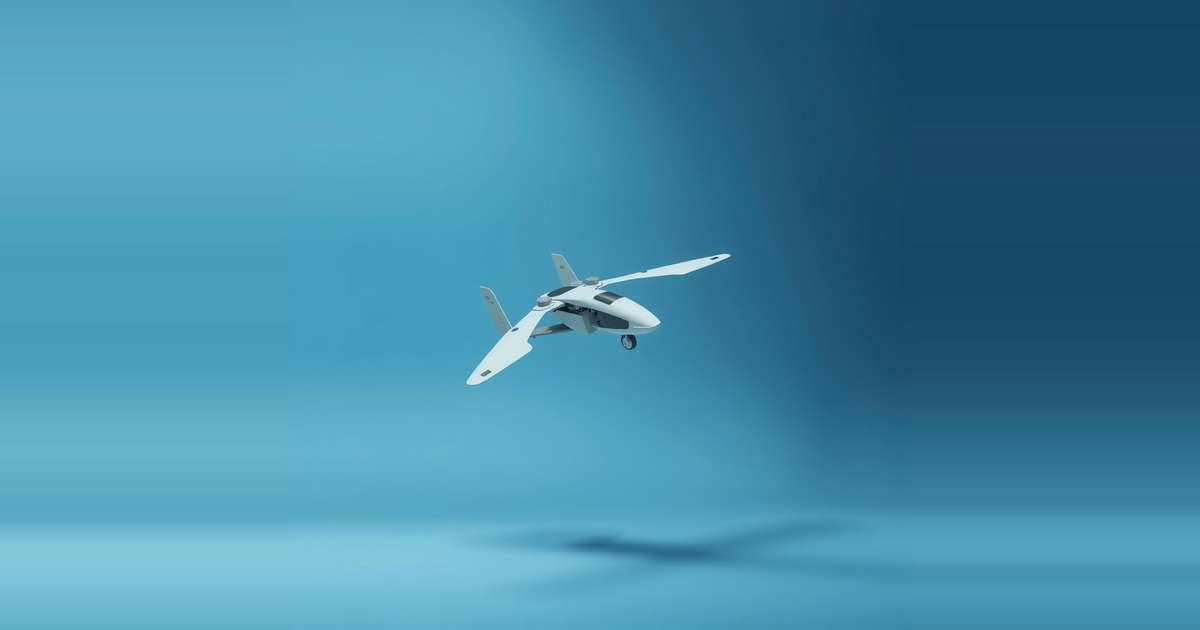
A flapping wing robot weighing less than 300 grams has swum underwater, broken through the surface and flown off without using feet, a step many diving birds need to take off. Engineers at EPFL and MIT built the vehicle, called the flapping-wing aerial-aquatic vehicle, or FAAV, and tested it in a water tank and in Lake Geneva.
The work was published in Science. It was led by Raphael Zufferey, a former EPFL researcher who is now an assistant professor of mechanical engineering at MIT.
What the robot is made of
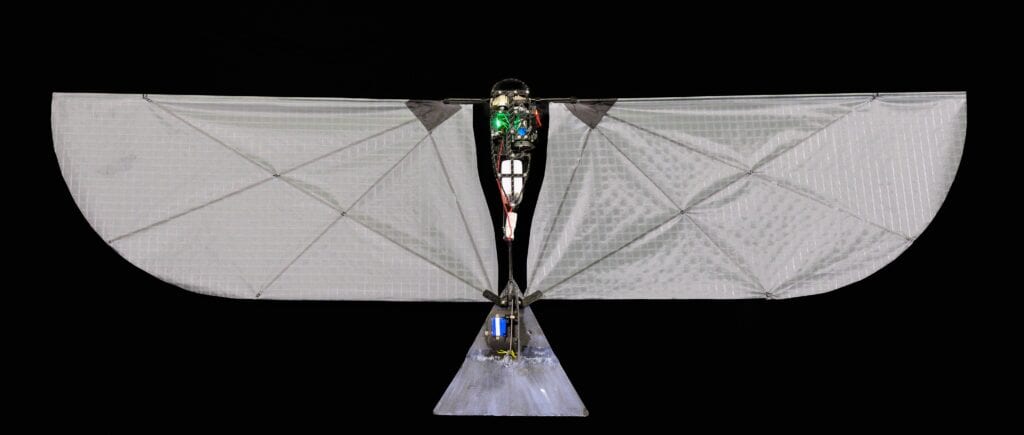
The FAAV has a central fuselage, two flexible flapping wings and a steerable tail. The wings and tail can be swapped for different sizes, which let the team compare configurations in the same airframe.
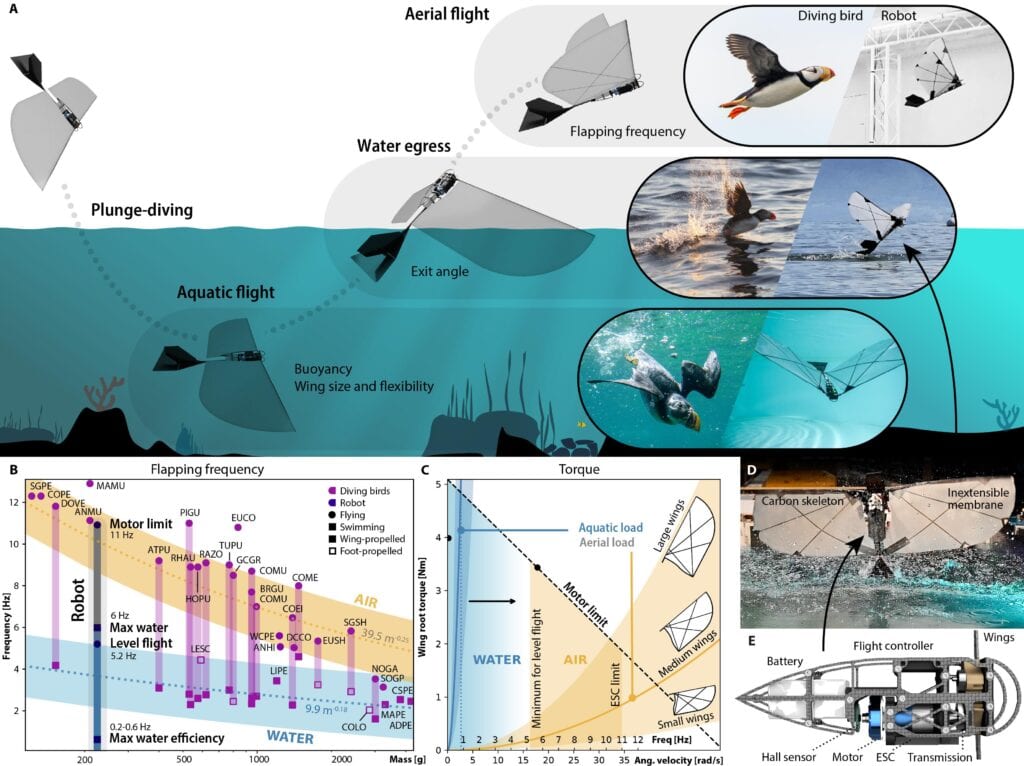
The wings are thin membranes coated with hydrophobic nanoparticles that help wick water away. Inside the body are a battery and a waterproof electric motor. The motor drives a crankshaft, which pumps the wings up and down at pre-set frequencies. The tail is motorized, so it can change angle to help the robot climb or dive.
The design is modeled on the roughly 100 bird species that can both fly and swim, including loons, gulls, puffins and petrels. These birds plunge into water to chase prey and then leap back into the air.

What the tests showed
Zufferey began the project as a postdoctoral fellow at EPFL, in the Laboratory of Intelligent Systems and the Biorobotics Lab. The lab heads, Dario Floreano and Auke Ijspeert, are co-authors. He finished the work at MIT, where he leads the AURA Lab, which builds bioinspired aerial and aquatic vehicles. The study also lists co-authors from Northwest Indian College in the United States.
The team ran experiments first in a small tank at EPFL and then in Lake Geneva. They looked for combinations of wing size, flapping frequency and tail angle that let the robot move through three phases: swimming, breaking the surface and flying.
Wing size and stiffness turned out to matter most. The wings that worked were 80 centimeters across. They had to be flexible enough to keep flapping amplitude small in water, yet firm enough to hold the robot up in air.
In the water the robot swam at almost one meter per second, flapping at about 5 hertz, or five flaps per second. In the air it flew at about 6 meters per second at a similar flapping frequency. The researchers say these speeds and frequencies resemble those of real diving birds.
Leaving the water required a steep launch. The robot had to be pitched at about 70 degrees so its wingtips did not touch the surface.
Flight without feet
Many diving birds paddle their feet at the surface to take off. The FAAV has no feet and does not need them. "If you look at birds, most birds need to paddle their feet at the surface to take off. And the question was, do we need the same for robots? And it turns out we don't," Zufferey says. "No one's been able to fly out of the water with wings."
The researchers say the results can help biologists understand how diving birds adjust their flight mechanics between two media with very different physical properties. They also see the design as the start of a class of aerial-aquatic drones.
Zufferey describes a use case in which oceanographers, marine biologists and coastal communities launch the robot from a boat or from shore. It would fly to an area of interest such as an iceberg, a port facility or a pod of whales, dive to take a measurement or collect a sample, and fly back to deliver the data. He says this would cost a fraction of traditional methods. The team says such robots could reach aquatic regions too dangerous for conventional ocean vessels.
What comes next
The team is redesigning the wings so they can turn as well as flap up and down. They also plan to test the robot in turbulent conditions, including swimming out of choppy water and flying through wind. After that they hope to deploy it on ocean science questions.
Why it matters, and what is unproven
The main result is narrow and specific: a flapping wing robot has left the water using wings alone. Most aerial-aquatic work has to solve the water-to-air transition with other hardware, and the source reports that no one had flown out of the water with wings before. Removing the need for feet or other launch aids keeps the airframe simple, which matters at a mass under 300 grams.
The result also works as a research tool. Because the wings and tail swap out, the same body can test how size, stiffness, frequency and tail angle trade off. The finding that the wing must be soft in water and stiff in air names a design tension that any follow-on vehicle will have to manage. The match to bird speeds and flapping rates gives biologists a physical model to compare against, though the source does not say how closely the robot's mechanics track those of real birds beyond those figures.
The field-use claims are further off. All reported testing took place in a tank and in a lake. Both are calmer than open ocean, and the team lists choppy water and wind as upcoming tests. The robot's steep 70-degree launch pitch also implies that surface conditions will affect whether a takeoff succeeds. Wings that cannot yet turn limit maneuvering, which the team is working to fix.
The source gives no figures for flight time, dive depth, payload, sample-collection hardware or cost. The sampling and data-delivery scenario Zufferey describes is therefore a goal, not a demonstrated capability. Whether the vehicle can carry useful sensors and still keep its wing-to-weight balance is an open question, and so is whether it can repeat takeoffs over many cycles. Those results will decide whether this stays a biomechanics platform or becomes a working ocean-sensing drone.