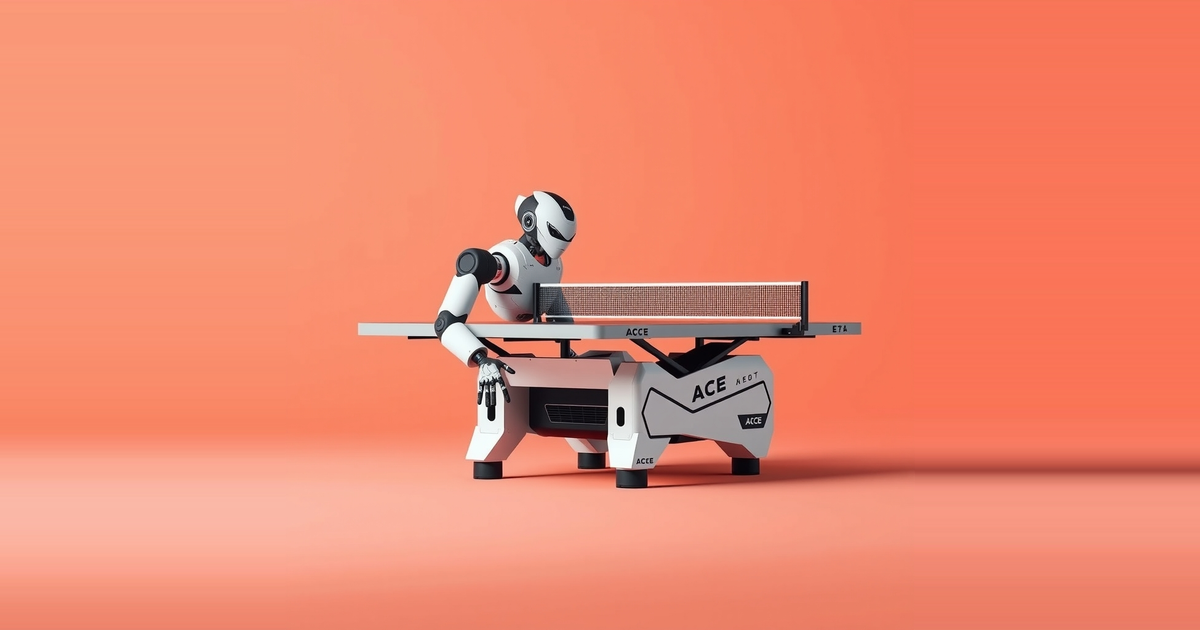
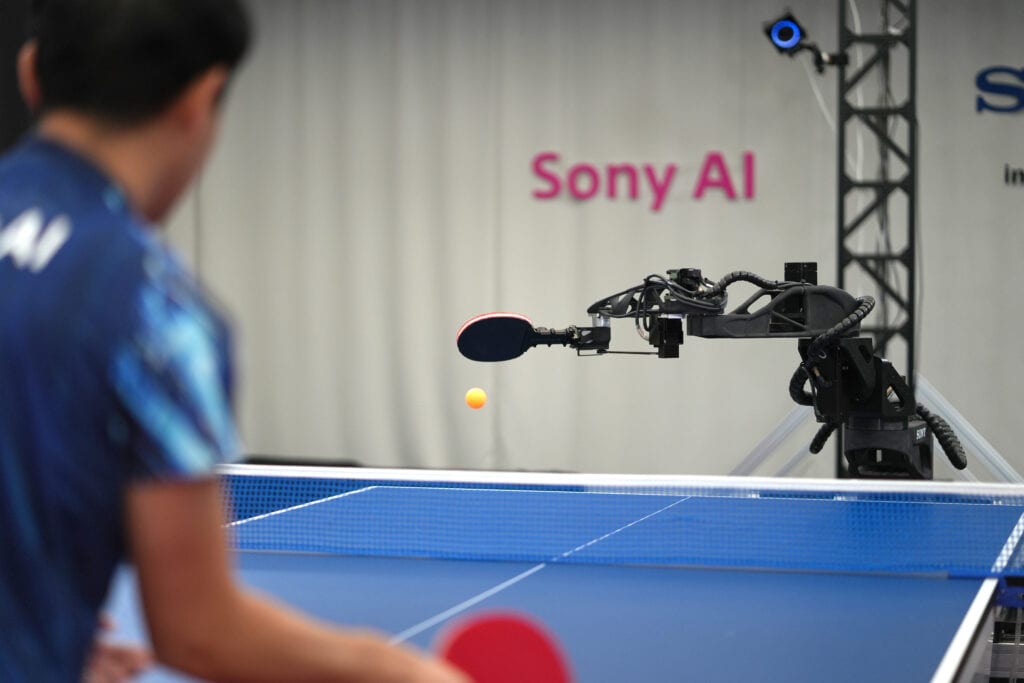
A table tennis robot called Ace won three of five matches against elite human players in recent evaluations. Developed by Sony AI, the autonomous system lost both of its matches against players from professional Japanese leagues, though it took one game off one of them. The work is described in a paper published in Nature.
The elite group in the tests were competitive athletes with more than ten years of experience, training an average of 20 hours a week. Ace played them with standard equipment on a regulation table. Its opponents were free to use the full range of shots, including heavy spin.
Why the sport is hard for machines
Table tennis leaves very little time to act. The ball can travel faster than 20 metres per second, which gives a player less than half a second to react. Spin adds to the difficulty. A ball rotating at extreme speed can curve in flight and rebound unpredictably off the table. Professional players can generate spin approaching 9,000 revolutions per minute.
Earlier systems dealt with this by narrowing the problem. Forpheus, built by the Japanese company Omron, used controlled ball launchers, limited movement or ignored spin altogether. Later systems aimed at more interaction but still ran under constrained conditions. Ace removes those restrictions.
How Ace sees the ball
Standard cameras blur fast motion or miss detail. Ace uses three event-based vision sensors, which register changes in light rather than capturing full frames at fixed intervals. Nine high-speed cameras add tracking of the environment, including the opponent and the opponent's racket.
Together the sensors support high-speed gaze control, which lets the robot point its sensors at what matters and follow the ball in real time. The system also tracks markings on the ball to estimate spin as it flies, a task that has long defeated robotic players.
How it decides and strikes
Ace's decisions come from deep reinforcement learning. The policy was trained in simulation over millions of virtual rallies, including self-play. It generates movement commands for a multi-jointed arm and recalculates trajectories every few tens of milliseconds, while avoiding collisions with the table and with itself.
The arm combines two prismatic (sliding) joints with six revolute (rotational) joints. The sliding joints give fast sideways motion, and the rotating joints give precise striking. The robot carries a racket and a ball-handling mechanism, which allows one-armed serves. Lightweight structures and optimised actuation let it return balls at speeds approaching 20 metres per second.
One rally shows the result of the simulation training. A ball clipped the net and its predicted path changed abruptly. Ace adjusted almost immediately, returned the shot and won the point. Many systems trained in simulation degrade when they meet real-world noise, and this exchange shows the gap can be narrowed.
Professional players still found weaknesses. They exploited limits in the robot's reach and speed, and its handling of extreme or highly deceptive shots.
What the result does and does not show
The result matters because the earlier landmark game-playing systems, Deep Blue and AlphaGo among them, worked in controlled digital settings. Ace works with a physical ball, a physical opponent and a deadline measured in fractions of a second. That moves the benchmark from perfect information on a screen to noisy sensing and mechanical limits.
It is not yet a superhuman result, which separates it from chess. The robot beat three of five elite opponents and lost to both professional-league players. The sample is small: five matches. The source does not say how many individual players took part, so the three wins should be read as a strong early indicator rather than a settled ranking.
The sensing setup also limits how far the result transfers. Ace relies on three event-based sensors and nine high-speed cameras, a much heavier sensor suite than a robot working in a home or hospital could be expected to carry. The playing area is also fixed: a regulation table, a known ball and a known set of rules. Those constraints are narrower than a construction site or a ward, where objects and layouts vary. The argument that the same prediction and control methods could support flexible automation in those places is plausible, but this work does not test it.
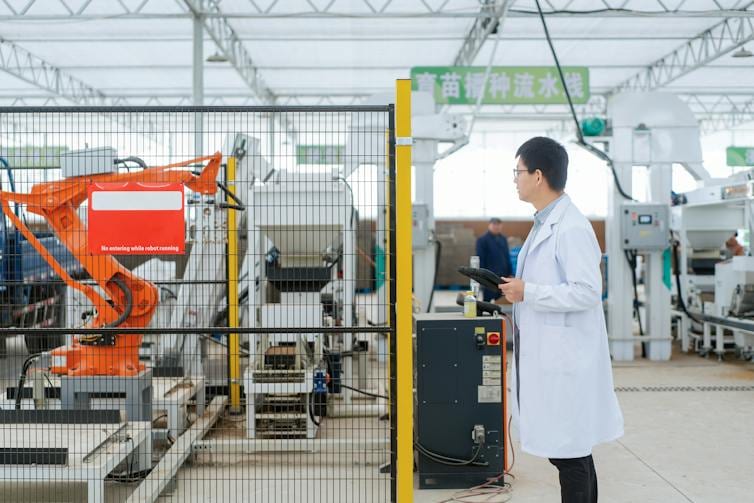
The claim about safe collaboration needs the same caution. Operating at the edge of human reaction time suggests robots could share space with people, since most industrial robots sit behind safety barriers because they cannot respond quickly enough to unexpected human behaviour. But Ace was evaluated as a competitor across a table, not as a co-worker handling tools or loads beside a person. Whether its collision avoidance and speed hold up in close shared work remains unshown.
The most useful signal is the reduced sim-to-real gap. Training on millions of virtual rallies and then winning against skilled humans suggests simulation-trained policies can handle contact-rich, high-speed tasks on real hardware. A table tennis robot is a demanding test of that approach, and the next test is whether it holds when the task, the sensors and the environment all change at once.