A soft robot gripper built at Cornell University can estimate whether a strawberry is ripe by measuring how stiff it feels, then twist the fruit off its branch or vine without damaging it. The soft robot gripper uses stretchable fiber-optic sensors in place of rigid force sensors, so the sensing material has the same mechanical properties as the finger itself.
The work comes from the Organic Robotics Lab of Rob Shepherd, the John F. Carr Professor of Mechanical Engineering in the Cornell Duffield College of Engineering. The team worked with Marvin Pritts, a professor of horticulture and global development in the College of Agriculture and Life Sciences who specializes in sustainable production methods for berry crops.
How the gripper senses fruit
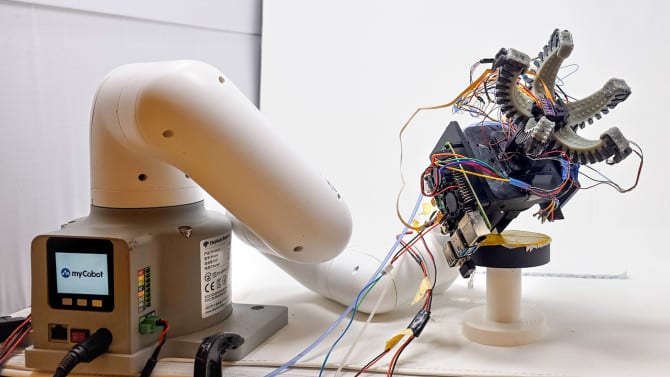
The gripper carries two different fiber-optic sensors. One measures the curvature of the finger. The other measures pressure at the fingertip. Together they let the robot estimate the shape of an object and adjust its grip, so it can hold ripe fruit without bruising it.
Shepherd described the design as one in which the sensing and the gripping are the same material. "The fiber-optic strain gauges have the same mechanical properties as the grippers that are using them," he said. "So it's kind of like the flesh feels the fruit, rather than having separate sensors."
The lab had already shown that stretchable fiber-optic sensors can give soft robots a sense of dynamic, tactile sensation. In recent years the team has moved into agriculture. One earlier project was a soft gripper that injects living plant leaves with sensors, which help it detect and communicate with its environment.
Why strawberries were the test case
The team needed a model fruit to train and test the gripper, and chose the strawberry. Ripe strawberries can be identified reliably by color. That gave the researchers an independent check on the touch-based model.
"So we could train our model to know if it's ripe based on touch, then validate our model by looking at the color," Shepherd said. He added that a team member named Anand was able to accurately estimate whether it was the right time to pick strawberries from the stiffness he measured.
Twisting instead of pulling
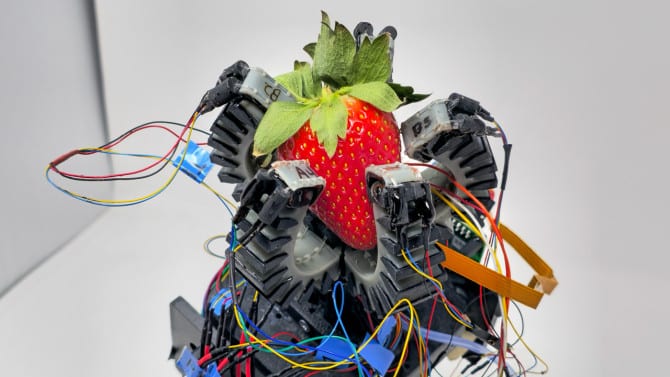
Once the gripper has a strawberry in hand, it does not pull or pluck. The researchers added a planetary gear mechanism so the robot wrist can rotate and twist the fruit off its vine. Pulling and plucking can strain and damage fruit, so the twisting motion is intended to protect it.
The gripper also has a camera in its palm. It is there for cases in which touch is not enough, such as fruit hidden behind leaves or other vegetation. Shepherd said the touch-based approach should be most useful when ripeness cannot be seen at all. He named avocados, pineapples and pawpaws as examples, and pawpaws are his favorite.
His reasoning on pawpaws is practical. "The problem with pawpaws is you can't see when they're ripe, and they ripen so fast that if you're not there at the right time, you just miss them," he said. They also do not survive shipping well, which he gave as one reason they are absent from grocery stores.
What it means for the field, and what is unproven
The most useful idea here is the sensor design, not the strawberry. Most robotic harvesting work leans on cameras to decide what is ready. Color works for strawberries, but it fails for fruit whose ripeness shows no outward sign. A gripper that reads stiffness through the same soft material that holds the fruit addresses that gap directly. The palm camera suggests the team sees the two senses as complementary rather than competing.
The validation method is also sound in principle. Because strawberry color is a dependable ripeness signal, it gives a ground truth against which a touch model can be checked. That is a sensible way to build confidence before moving to fruit where no such check exists.
That last step is where the open questions sit. The pawpaw, avocado and pineapple cases are the strongest argument for touch sensing, but the work as described was trained and validated on strawberries. Whether stiffness maps to ripeness in the same way for other fruit has not been shown. Each species would likely need its own model and its own reference measure of ripeness.
The description also leaves out the numbers that would let growers judge it. It gives no accuracy figure for the ripeness estimates, no picking speed, no damage rate compared with other grippers, and no cost. It reports no field trials. Everything described is a lab demonstration of a gripper, and a farm would need many of them working reliably in cluttered, variable conditions.
Shepherd's larger argument is about farming systems. He said row crops exist because they suit existing machines, and that larger numbers of smaller robots could make mixed cropping practical. He pointed to growing soy and corn together, or interspersing species that resist pests, which could reduce pesticide and fertilizer use. He acknowledged that a farm managed this way is very complicated and said robots could make it manageable.
That is a vision, not a result. A gentle, sensing gripper is one necessary piece. Navigation, coordination across many machines and economics would also have to work, and none of them is addressed in this research. The credible near-term claim is narrower: a soft sensor-integrated gripper can judge and harvest strawberries by feel in controlled testing.
The research was supported by the National Science Foundation Center for Research on Programmable Plant Systems and the Cornell Institute for Digital Agriculture.