
A robot 4.4 mm long can cut tissue, release drugs, grip and store tissue samples, and generate heat, and it switches between those functions in under a second. The seed-sized surgical robot was developed at Nanyang Technological University, Singapore (NTU Singapore), and is controlled wirelessly by weak magnetic fields.
The work was led by Associate Professor Lum Guo Zhan of NTU's School of Mechanical and Aerospace Engineering, and it appears in the journal Advanced Materials. The paper is titled Miniature Soft Robot With Magnetically Reprogrammable Surgical Functions. Its authors are Chelsea Shan Xian Ng, Yu Xuan Yeoh, Nicholas Yong Wei Foo, Keerthana Radhakrishnan and Lum.
Five functions in a few millimetres
In the laboratory, the team used magnetic coils to steer the robot and to select its tools. The robot can move, cut biological tissue with a small blade, release drugs, grip and store tissue samples, or emit heat to a targeted area. It performs one of these functions at a time.
Lum said most magnetic robots of this kind can perform only one or two functions. His stated long-term goal is for doctors to navigate such robots to a target location in the body and use them to carry out treatments.
The body of the robot is solid but flexible. The team contrasts this with slime-like miniature robots, saying the solid form makes the device sturdier and easier to retrieve after use.
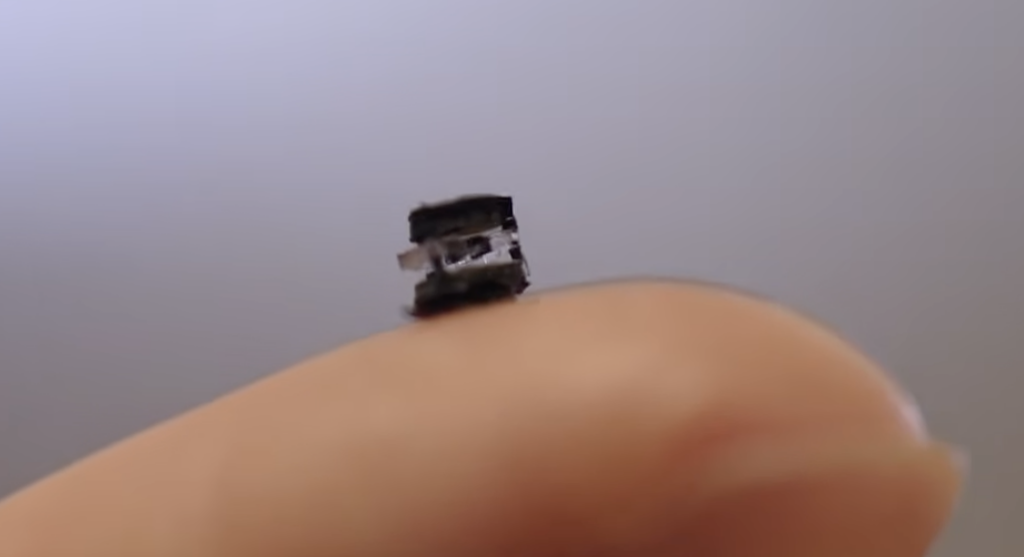
A magnetic module that can be reprogrammed
The robot is made from soft magnetic materials, including PDMS and Ecoflex. These are silicone-based materials common in soft robotics because they are flexible and can be shaped into small structures. They are embedded with magnetic microparticles, each 5 micrometres across, which let different parts of the robot respond to magnetic fields.
At the centre sits a magnetic module that can be magnetised, demagnetised and remagnetised in different directions. Each magnetic orientation activates a different function. The module can be reprogrammed in under a second, which is what allows the quick switching between tools.
The team also engineered separate regions of the robot so that only one part responds to a given magnetic field. That part changes shape to activate a tool, while the rest of the body stays still. This addresses a known limitation at small scales, where a magnetic field tends to act on the whole device at once and make it behave like a single magnet. That behaviour restricts how precisely the robot can move or activate individual tools.
The design also adds a sixth movement. Most miniature magnetic robots are limited to five degrees of freedom: movement along three axes and rotation in two directions. The NTU robot can also roll, spinning around its own long axis. The team says this gives finer control over positioning, which matters in narrow, soft and irregular spaces such as those inside the body.
What the tests showed
The researchers tested the surgical functions on biological tissue models, including chicken liver, and on gelatin-based materials that simulate soft tissue. The robot cut through tissue, dispensed particles that stood in for drug particles, gripped and stored tissue samples, and produced localised heat.
Heating required a different kind of field. The team exposed the robot to a high-frequency alternating magnetic field, which caused magnetic materials inside the device to generate heat. The approach is relevant to magnetic hyperthermia, a method being explored for cancer treatment.
The team also checked biocompatibility by exposing human skin cells to the robot's materials under laboratory conditions. More than 99 per cent of the cells remained viable, similar to the control group. The researchers say this suggests the materials are largely non-toxic under those experimental conditions.
Next steps
The team is now exploring how future versions could be combined with imaging technologies, sensing systems and clinically realistic artificial organ models that better mimic the physical behaviour of human tissues. Lum is also working with surgeons to understand how miniature robotic systems could fit into real clinical workflows.
He said that moving closer to practical use requires understanding how the robots could be guided, monitored and controlled in realistic medical settings, not only how they work in the lab.
Dr Yeo Leong Litt, Leonard, a senior consultant in the Division of Neurology at the National University Hospital, gave independent comments. He said he could envision the robots replacing many aspects of interventional radiological surgery and becoming a new mode of therapy. He described their ability to traverse complicated environments and deliver medication, perform biopsies and administer therapeutic heat as remarkable.
Why it matters, and what is unproven
The main contribution is in how the robot is built, not in any single tool. Cutting, drug release, sampling and heating have each been pursued separately in magnetic microrobots. Putting five functions in one 4.4 mm body, with regions that respond selectively to the same field, tackles the problem that magnetic fields at this scale usually act on a whole device at once. The added rolling movement is a second concrete gain, because it expands the control available for positioning in tight spaces.
The comparison the source supports is narrow but clear. Against robots that perform one or two functions, this device does five, and against slime-like designs it offers a body that is easier to retrieve. The source does not benchmark the robot against other multifunction designs, so claims of leadership beyond those points are not established.
Several things remain unproven. All reported tests were done in the laboratory, on chicken liver and gelatin-based tissue models, with coils outside the experiment. The source describes no tests inside a living body, and the team's own next steps, imaging, sensing and realistic artificial organ models, point to gaps in exactly those areas. A robot that cannot be seen or tracked inside the body cannot be guided to a target, so imaging integration is a precondition for the stated goal.
The heating function also depends on a high-frequency alternating field, separate from the weak fields used for movement and tool control. How a clinical system would deliver both field types around a patient is not addressed in the source. The cell-viability result is similarly limited: it covers human skin cells in the lab and supports the word largely non-toxic only under those conditions.
The independent comment from the hospital neurologist is an expert's view of potential, not evidence of clinical performance. For now, the seed-sized surgical robot is a validated laboratory platform for multifunction control at the millimetre scale. Whether it becomes a surgical tool depends on the next round of work with surgeons, imaging and organ models.