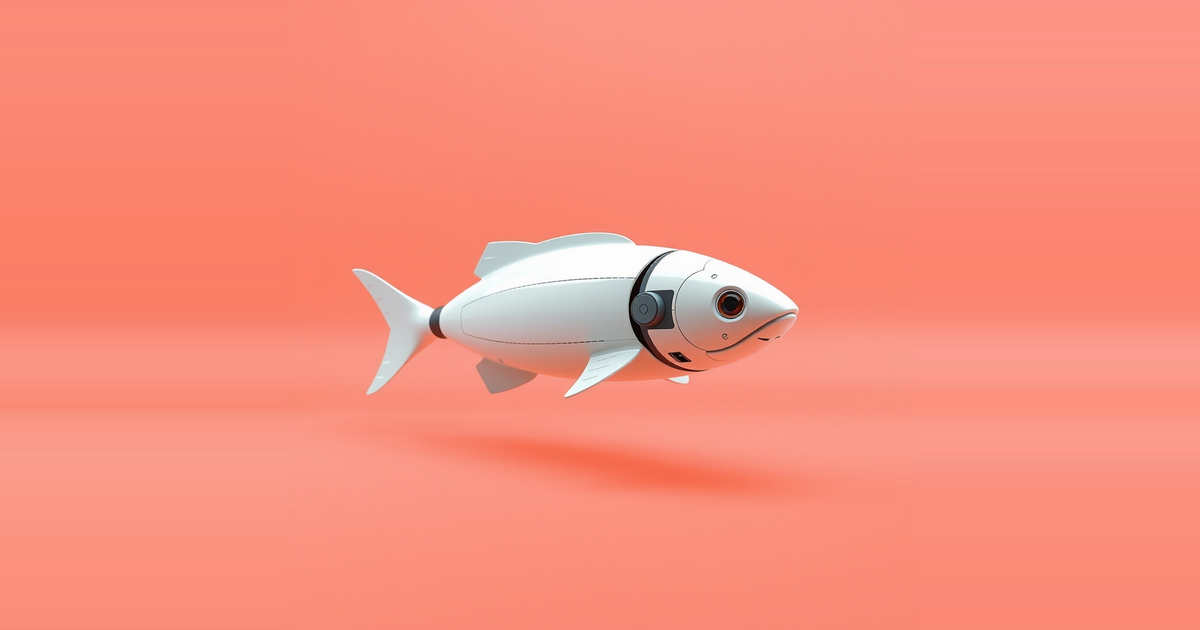
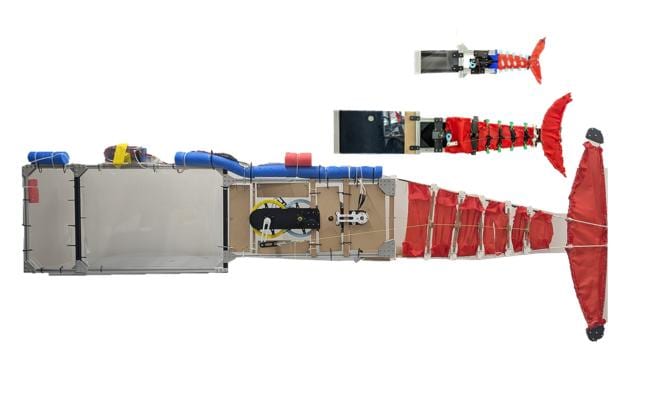
A single motor and two crossed tendons drive ScaFi, a robotic fish that engineers at EPFL and New York University have built at lengths of roughly 0.6, 1.1 and 2.9 meters. The team reports that the swimming motion stayed closely matched across all three sizes once adjusted for body length. Energy use did not scale as cleanly.
One design, three sizes
ScaFi, short for Scalable Fish, is modeled on fish such as cod and mackerel. These fish concentrate most of their body bending toward the tail, a swimming style found across an unusually wide range of body sizes in nature.
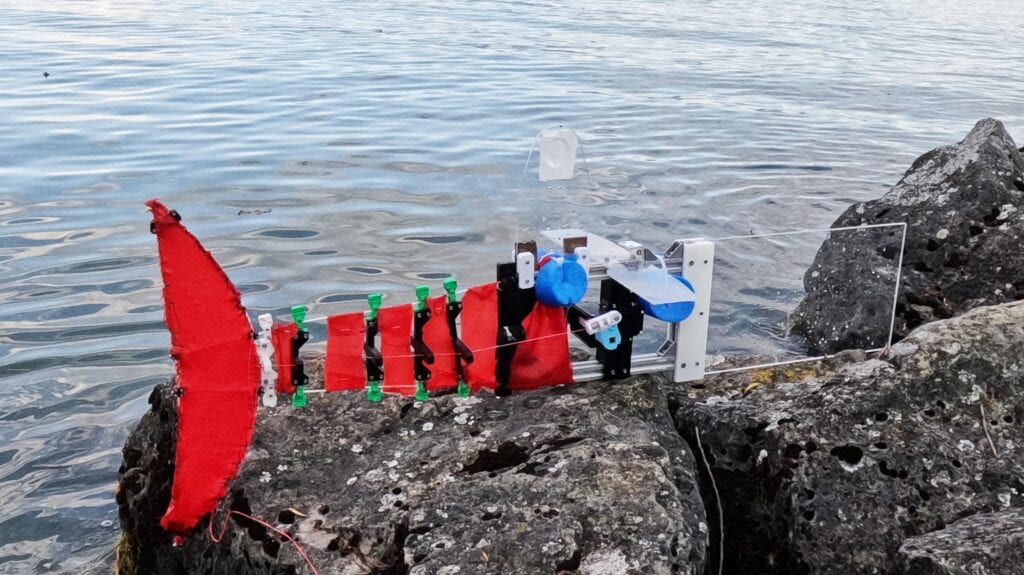
The robot has a rigid front section and a flexible tail made of fiberglass rods. One motor pulls two tendons that cross near the end of the tail. That crossing produces the S-shaped bend needed for fish-like swimming.
The diameter of the tail rods is the only part that has to change with the size of the robot. The rods become proportionally thicker as the robot grows, which preserves similar tail-bending behavior. The motor mechanism and the crossed-tendon system stay the same.
Nana Obayashi, first author of the paper in npj Robotics, led the work while completing her PhD in the Computational Robot Design and Fabrication Lab at EPFL, headed by Josie Hughes. She is now an assistant professor of mechanical and aerospace engineering at the NYU Center for Robotics and Embodied Intelligence. She describes the problem plainly: monitoring a creek and then a lake currently takes two different robots, each built and tested from the ground up.
Why propellers fall short
Propeller-powered underwater vehicles have long supported work in aquatic environments, but spinning blades can snag on vegetation, stir up sediment and startle wildlife. That makes them a poor fit for shallow creeks, dense weeds or close observation of fish.
Robots that bend their bodies to swim avoid the spinning blade. Most of them, however, are built for one size and one job. Scaling one up or down usually means starting over, which is the gap ScaFi is meant to close.
What the tests showed
In work with EPFL's Unsteady Flow Diagnostics Lab, led by Karen Mulleners, the researchers examined the water flow behind the robots. The smallest robot produced swirling patterns similar to those left by real fish. Across all three sizes, the swimming motion lined up closely once adjusted for body size. The robots grew nearly fivefold in length, and the fish-like gait held.
The team also took the robots into open water. The medium-sized robot swam in a Swiss stream, the largest ran on Lake Geneva, and the smallest worked in creeks only 15 to 30 centimeters deep. During the stream test, the robot kept swimming after a GPS dropout.
Efficiency was the weaker result. The two smaller robots performed similarly. The largest was consistently less efficient and needed a different, more powerful motor. The authors suggest drag and inertia may be responsible, but they have not resolved the cause.
Disturbance tests showed a tradeoff. The smallest robot was the most agile but recovered slowest after being knocked off course. The larger robots were less nimble and more stable.
The work was partially funded by the European Union's Horizon 2020 program under Marie Skłodowska-Curie grant agreement No. 945363.
What this means for the field
The main contribution is a method, not a single machine. Fixing the motor and tendon layout and changing only the rod diameter turns size into one controlled variable. That has two uses. It can lower the engineering cost of fitting a robotic fish to a new environment, and it gives researchers a way to study how swimming changes with scale, which the researchers note is hard to do with animals or custom-built robots.
The result is narrower than the idea of a single design for every job. The largest robot needed a different motor, so the claim that only the rods change holds for the swimming motion but not for the full power system. The authors say the same: the motion scaled more cleanly than the energy needed to produce it. A design that is not equally efficient at every size will matter to anyone planning long deployments, because efficiency governs endurance and the source reports no endurance figures.
The disturbance results point to a design choice. The smallest robot suits tight, shallow water where agility counts, while the larger ones trade maneuverability for stability. Users would still need to pick a size to match the task, even if the underlying platform is shared.
Several questions remain open. The field trials show the robots working in a stream, a lake and shallow creeks, but the source gives no data comparing them with propeller vehicles on efficiency, speed or disturbance to wildlife. The advantage over propellers in vegetation and sediment is a stated motivation, not something these tests measured. Only three sizes were built, so it is not known whether the approach holds well beyond them. The authors also say the idea of scaling around one key structural parameter could apply to other compliant robots, including ones outside water, but that has not been demonstrated.
The next test is the energy question. If the efficiency drop at the largest size can be traced to drag and inertia and then corrected, the case for one scalable robotic fish platform becomes much stronger. Until then, ScaFi shows that the gait can be scaled and leaves the power budget as the unfinished part.