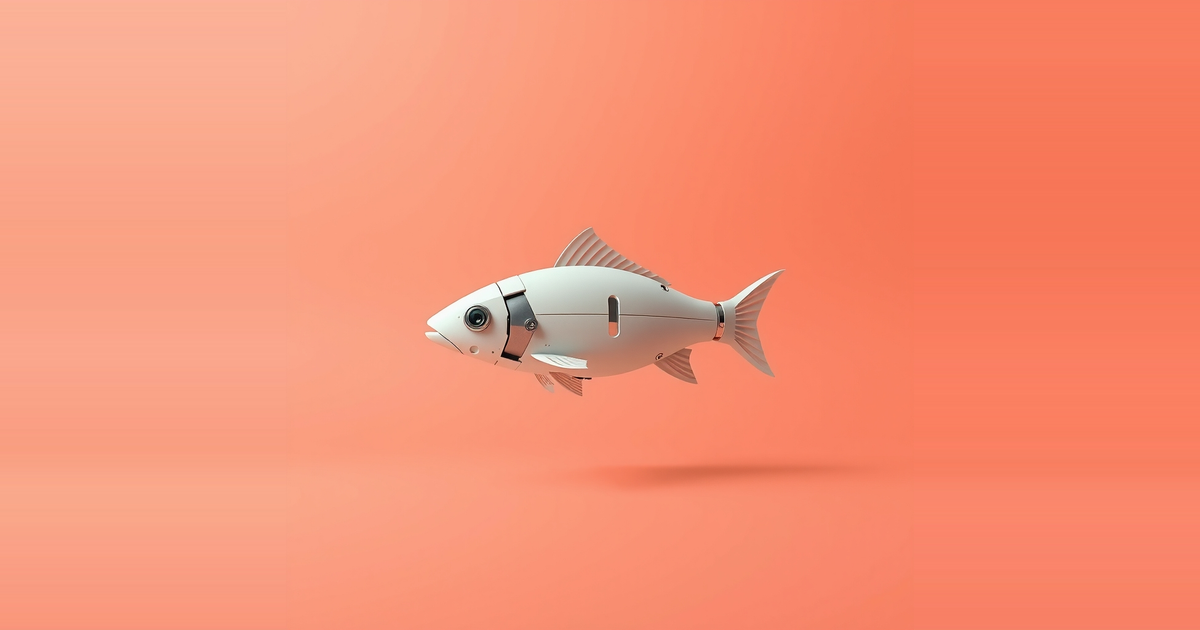
A robotic fish named ZBot, 80 centimeters long and weighing 2.7 kilograms, stayed in an aerial drone camera's view for 58 seconds in the Chamberonne river near Lausanne by using vision alone to counter the current. With its visual circuit switched off, it lasted roughly 37 seconds. With its motors off and drifting, it lasted 20 seconds. The work comes from EPFL in Switzerland, Duke University in the United States and the Instituto Superior Técnico in Portugal, and is published in Science Robotics.
What ZBot did in the river
ZBot carries two real cameras, six tail motors and a Raspberry Pi in a water-tight enclosed head. The Pi runs a neural network copied from the larval zebrafish optomotor response, the reflex that lets a fish hold position against flowing water. The river had rocks, dappled light and drifting leaves, and the water was sometimes muddy and turbulent.
The team compared three conditions: the full visual circuit, random bouting with the circuit blinded, and passive drifting with the motors off. The full circuit kept the robot in view longest. Intermittent burst-and-glide swimming appears to help in poor visibility, because the robot can gather useful visual information during glides, when its own motion does not degrade the image.
A circuit taken from live zebrafish
The wiring diagram came from the Naumann Lab at Duke. That group combined behavioral studies, whole-brain calcium imaging of larval zebrafish shown stimuli that mimic riverbed optic flow, and circuit modeling. In the fish, the retina picks up the direction of optic flow, pretectal neurons interpret it, and spinal nerves drive the muscles.
Xiangxiao Liu and Luca Zunino at EPFL turned that model into simZFish, a physics-based simulation built in the Webots simulator. It reproduces a six-day-old larva at 1:1 scale: a 4 mm body weighing 0.3 mg, with seven segments, six simulated motors, two sideways-facing cameras as eyes and realistic water dynamics. Its artificial retina feeds four types of direction-selective ganglion cells. These drive pretectal neurons that combine input from both eyes, and hindbrain command neurons that set how often the fish swims and which way it turns. A bout gate releases bursts of tail beats to produce burst-and-glide swimming.
Because every component is simulated, the researchers could change connection weights, delete or add neurons, or alter the lens and see the result at once. That let them identify the minimal set of elements the optomotor response needs.
The body is part of the computation
The side-mounted eyes produced a specific problem. Optic flow seen by laterally placed cameras creates conflicting swirls across the visual fields, a version of the aperture problem. When the full simulated retina fed the circuit, the signals cancelled and the behavior failed. When the team limited input to the lower posterior part of the visual field, the behavior returned.
That region matches the one that most strongly drives the response in real zebrafish, and it matches the large lower-posterior receptive fields recorded in the fish pretectum. The team's reading is that the geometry of the body and eyes dictates a wiring pattern that captures the most useful motion information with the fewest connections.
A mismatch sends the neuroscientists back to the microscope
The first version, simZFish1.0, turned far more than expected when each eye was shown motion in opposite directions, a shearing stimulus the model had never encountered. When Matthew Loring showed the same stimulus to real zebrafish, they barely turned.
The Duke group then used volumetric two-photon calcium imaging to record tens of thousands of neurons. They found that certain binocular pretectal neurons exist in previously overlooked subtypes, tuned to forward or backward motion, with responses to one eye suppressed when the other eye sees forward motion. Adding these subtypes and updating the connectivity produced simZFish 2.0, which matched the real fish's behavior far better, including the response to the shearing stimulus.
In a simulated flowing river with a realistic riverbed, simZFish eventually turned and swam upstream whatever direction it started in. Auke Ijspeert, who directs the Biorobotics Laboratory at EPFL, said the simulation narrows the search and the animal experiments verify the predictions.
What it means, and what is not yet shown
The strongest result is the loop between model and animal. A simulation made a prediction that failed against live fish, and that failure led to neurons that had been missed. That is a concrete case of a robot-style model producing new biology, not only illustrating old biology.
The robotics claim is narrower. The team says this is the first proof that effective rheotaxis can be achieved with visual circuits alone, which challenges the assumption that the lateral line is required. That claim concerns what is sufficient for a robot, not what real fish do. The study does not show that zebrafish rely on vision this way in a river.
The comparison with drones is practical. Most drones use dedicated downward-facing cameras for position stabilization, while this method uses the existing lateral cameras and adds no hardware. That points to savings in cost and computation, but the source gives no head-to-head test against a conventional stabilizer.
Several limits are stated. ZBot is roughly 200 times larger than the larva and swims in a different fluid regime, so it tests the circuit's logic, not the larva's exact mechanics. The simulated circuit holds position only against gentle flow. About half the river trials were discarded for collisions or signal dropouts, and the stripped-down circuit cannot avoid obstacles. The gap between 58 and 37 seconds is a clear but modest margin, and the source does not give the number of usable trials. A larger set of trials and a circuit that handles varied flow would make the case for this robotic fish stronger.
Both the simulator and the robot designs are open-source, so other groups can test new circuits on the same platform. That is likely the most useful route for checking the results independently.