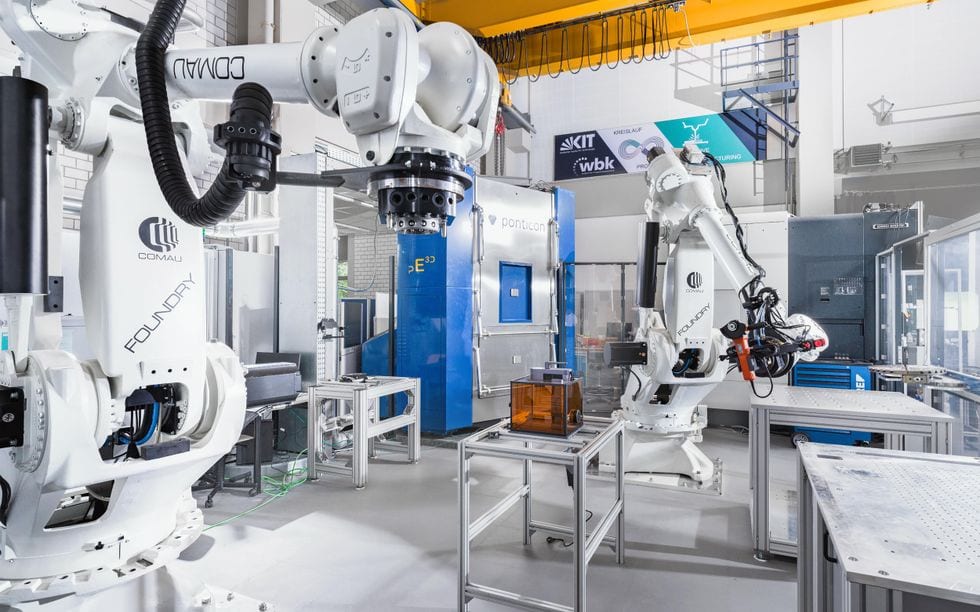
Researchers at the Karlsruhe Institute of Technology in Germany have built a robotic disassembly system that guesses how a product is broken, takes it apart, and changes course when the product does not behave as predicted. In a demonstration, the system started by unscrewing a component. A researcher then simulated a stuck screw by replacing the screw. The system saw that the screw was still in place and switched to milling away material to free the part.
The work was presented at the IEEE International Conference on Robotics and Automation (ICRA) 2026 in Vienna. It targets a problem the industry has not yet had to face at scale: what to do with machines and products once they fail.
Why Taking Things Apart Is Harder Than Building Them
The International Federation of Robotics counts more than 4 million industrial robots in use worldwide. Researchers predict the figure will pass 16 million by 2030 as manufacturing grows. Robots already help build cars, household appliances and smartphones, and each of those products will eventually break.
Jan Baumgärtner, one of the system's designers, says assembly is the easy direction. Each step is clearly outlined, and no deviations are expected. Disassembly of a broken product is unpredictable. "We can imagine 100 ways that something can go wrong," he says.
The cost of guessing wrong can be large. Baumgärtner gives the example of two parts held together by 100 screws. If the last screw is stuck, a robot that removed the other 99 first has wasted that work. A different removal method should have been chosen from the start. A robot that does not know how a product failed may have to undo part of its own work once it finds the problem.
How the Robotic Disassembly System Works
The system has two main components. A predictive algorithm estimates what is wrong with the product, and robotic manipulators carry out the work. At every stage, the system checks whether the results match its predictions and updates its methods if they do not.
It relies on a CAD model of the broken product and of each part. The models show the system how the parts should behave, so it can recognise when something is out of the ordinary. A mathematical model then predicts the damage to a broken part.
The process starts with the degrees of freedom of each part. These are the axes along which a part can move. A screw, for example, should rotate but not slide side to side. Given a broken device and its CAD model, the system first guesses how each part should move. It then nudges each part and compares the actual motion with the expected motion.
The difference points to the likely fault. A corroded part may move less than it should. A loose screw may move more. A deformed part may have different degrees of freedom than the model says it should have.
The system forms a plan at the start of disassembly and revises its guess about the fault as it removes each piece. A loose screw, for instance, may be hard to spot in an initial photograph. Once the system moves it and sees that it travels in more ways than a screw should, it accounts for that in the rest of the job. Operators can also specify which parts matter most to salvage intact, and the system adjusts its strategy to protect them.
Toward a Factory That Takes Products Apart
Baumgärtner's stated motivation is a circular economy in which old devices are repaired rather than thrown away. "The big future is saving our planet," he says.
He envisions scaling the current setup, which uses a few robotic arms, to many arms carrying different tools. Each arm would specialise in one part of the disassembly process, so a single factory could handle a wide range of products. He compares it to an industrial robot factory that builds cars but is set up to take them apart. In his words, it would be "a giant robot with 100 arms."
If the system works as intended, it would automate the full sequence of extracting a broken part, replacing it and rebuilding the device. Baumgärtner says the aim is to make that cheap enough that repair costs less than production. "That's why we need to think about scaling this," he says. "Because it means it becomes so cheap that it's cheaper to repair this [electronic device] than to produce it. That's the goal."
A later clarification from the project makes clear that the system is meant for products in general, not only for robots.
What This Means, and What Is Still Unproven
The main contribution is the loop between prediction and observation. Most automation assumes a known, clean starting state. A robotic disassembly system cannot assume that, because the defects are the unknown. Building the plan around a fault estimate that is corrected after every step addresses the 100-screws problem directly, since the system probes parts before committing to a method.
The salvage priority setting also matters for repair economics. A repair line only makes sense if the valuable parts come out undamaged. Letting an operator mark those parts gives the planner a goal beyond simply getting the product open.
The scale claims need to be separated from what has been shown. The demonstration described involved a simulated fault, a replaced screw, rather than a field failure. No success rates, cycle times, costs or range of tested products have been reported. The scenario of a factory with 100 arms is a stated ambition, not a result.
The design also has a built-in dependency. The system needs a CAD model of the broken product and of each part. That is plausible where a manufacturer supplies models, but it is a constraint for older or undocumented products. How the system behaves when the model does not match the unit in hand, because of a revision or a repair, is not stated.
The economic goal is the hardest test. Baumgärtner's target is repair that costs less than new production. Whether automated disassembly can reach that depends on throughput, tooling changes between product types and the value of the recovered parts. None of those figures are available yet. Until they are, the work is best read as a credible method for handling uncertainty in disassembly, with the commercial case still to be demonstrated.