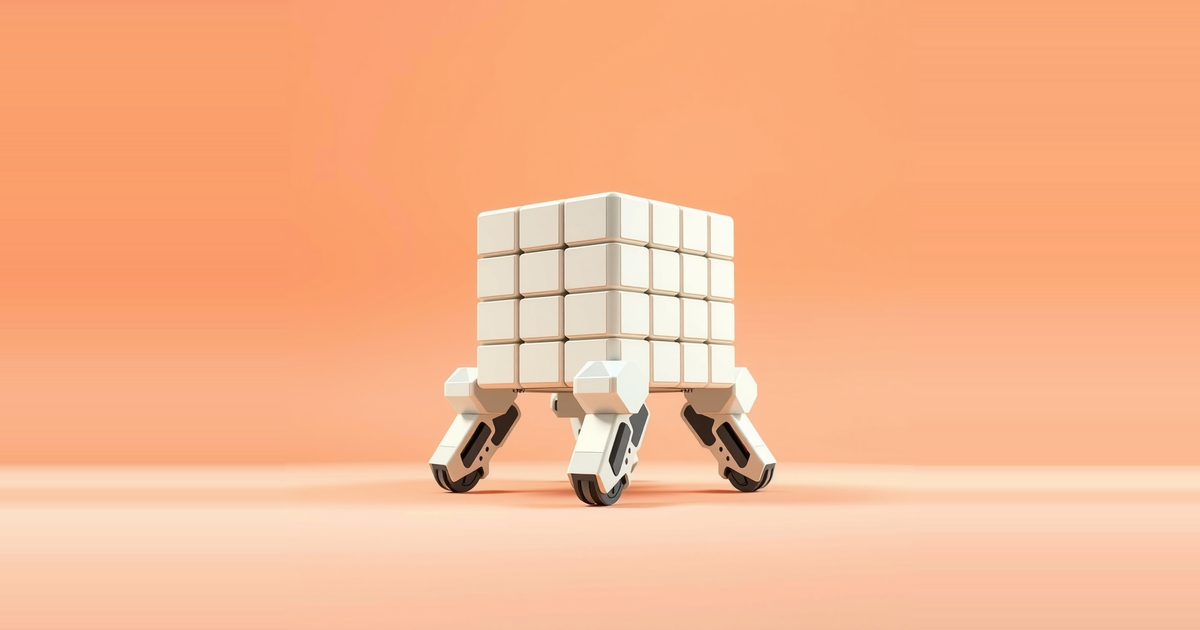
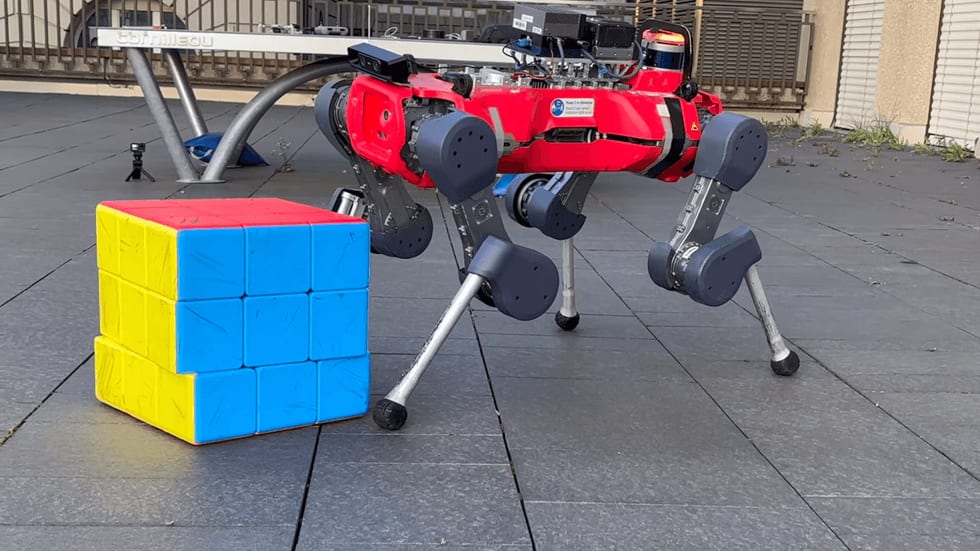
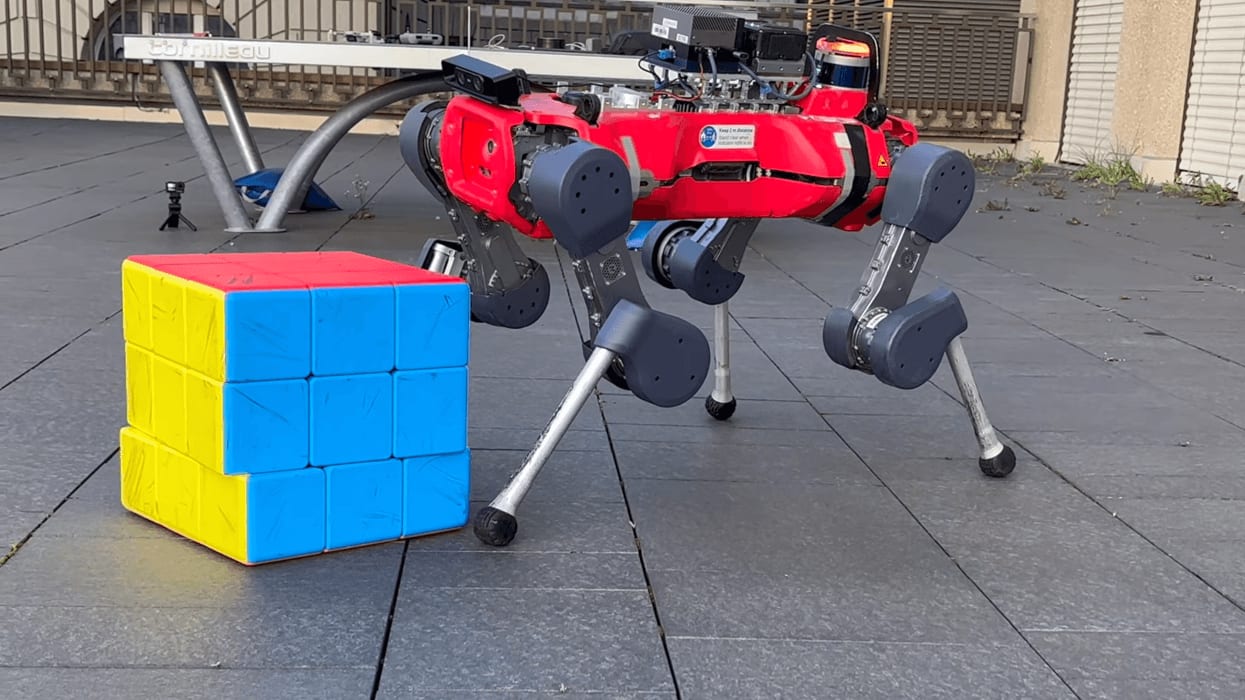
A quadruped robot from the ETH Zurich Robotics Systems Lab has solved a giant Rubik's Cube autonomously, using only its feet. The quadruped Rubik's Cube demonstration puts manipulation work on the limbs that a legged robot normally uses for walking. The lab has not published further details in the material available, including the cube's size, the solve time or the sensing used.
The demonstration was one of several legged and humanoid results shown in the same week, along with new hands, a biohybrid actuator and a training method that cuts compute sharply.
Whole-body control is the common thread
Several of the projects target the same problem: getting a robot to use its whole body for a task instead of treating locomotion and manipulation separately. A framework called Reflex addresses the reactive side of that problem. Its developers point to everyday human actions such as returning a tennis shot, catching a falling cup, stepping aside from a passing cart or passing a box tossed during truck unloading. Each requires anticipating a moving target and responding with the whole body within about a second. The team says visual reactive whole-body control remains difficult for humanoids.
Reflex is a three-stage framework. It learns these capabilities stage by stage and links the stages through a compact representation of object dynamics.
KAIST showed a different case. The KAIST Humanoid v0.9 was developed at the DRCD Lab, and RAILAB built the robot's arms. Using onboard visual feedback, the humanoid pushes objects weighing up to 35 kilograms and lifts objects up to 20 kg. It used that ability to arrange the letters "KAIST."
A separate result from Hybrid Robotics concerns how such motion controllers are trained. The method, called SuperMimic, was run for three hours on a single GPU. In that time it surpassed the return of a state-of-the-art motion tracker baseline that was trained for seven days on 128 GPUs. The team says this reduces GPU-hours by more than 1,000 times. SuperMimic failed on 25 of 129,514 benchmark motions, against 179 failures for the baseline. After 9.8 hours on two GPUs, it recorded zero failures.
Hands and muscle
The Robotics and AI Institute described AthenaZero, a robot with two three-fingered hands driven by tendons. The fingers interdigitate, which lets them hold objects of different sizes, such as an egg or a hammer. Each finger is powered by a motor in the robot's torso. That keeps the hand light, and force travels through flexible cables. The hand closes in about 80 milliseconds and is described as strong. With highly accurate barometric pressure sensors added, it can also be gentle.
At ETH Zurich's Soft Robotics Lab, researchers worked on biohybrid actuators, which pair lab-grown skeletal muscle with a soft, 3D-printed scaffold that turns contraction into movement. The usual approach grows the muscle and then builds a skeleton around it. This team instead adapted a soft-body simulation framework to co-optimize the muscle and the scaffold together. The resulting centimeter-scale bioactuators achieve up to 11 times more range of motion than previous systems with comparable tissue volume. The lab says they are strong enough to jump, swim, walk and grasp.
Field machines and infrastructure
Grain Weevil introduced a dual robot attachment that links two robots into one larger machine. One operator runs it, and the company says it does the work of up to three robots.
On the data side, Generative Bionics announced on 21 October 2026 at CES Unveiled Milan that it plans to build Europe's largest Physical AI Data Factory. AMD is its AI infrastructure partner.
NASA published a Moon Base update on the mobility vehicles that will support early work at the lunar South Pole region. Lunar terrain vehicles and robotic rovers will help investigate the area, support scientific research, test technologies and gather information for future missions.
Elsewhere, designer Joshua Bird released a single-motor drone and credited earlier research, including drones from the University of Pennsylvania that were covered in 2014. Parallel Systems, first covered in 2022, is still operating. At Humanoids Summit Seoul 2026, Michael Perry of Persona AI argued the business and engineering case for the humanoid form factor over wheeled, gantry and quadruped platforms.
What this means for the field
The quadruped Rubik's Cube result is best read as a test of capability, not a product. A cube puzzle needs sequenced, precise contact, and the robot has to do it with limbs built for locomotion. That is a harder constraint than giving the robot a gripper. What the available material does not show is how reliable the solve is, how long it takes, or how much of it depends on a controlled setup. Until those figures are public, the result is a proof of concept.
The Persona AI talk frames a real debate, and these items show why it is unresolved. The quadruped uses its feet for manipulation. The KAIST humanoid pushes 35 kg and lifts 20 kg. Grain Weevil gains capacity by joining two simple machines. Each supports a different answer to the form-factor question, and none of them settles it. A humanoid's value depends on tasks where its shape matters. A quadruped's value depends on whether foot manipulation can be made dependable enough for tasks beyond a puzzle.
The training result may matter more in the near term than any single robot. If SuperMimic's figures hold up outside its benchmark, a drop from 128 GPUs over seven days to one GPU in three hours would lower the cost of iterating on motion controllers. That would help smaller labs. The caveat is that the numbers describe a motion-tracking benchmark. They do not show how the policies behave on hardware in unstructured settings, and the available material does not say.
The hand and biohybrid work point to hardware limits that software alone will not remove. AthenaZero's torso-mounted motors and cable drive are a clear way to keep fingers light and fast. The biohybrid actuators show a large gain in range of motion from designing tissue and scaffold together. But the biohybrid devices are centimeter-scale, and no figures were given for force, lifespan or how long living muscle can be kept working. Those are the open questions to watch before such actuators can be considered outside the lab.