Imperial Robotics Summer School participants spent their group project on a problem most social robots are not built for: talking with several people at once. The team worked on multi-party human-robot interaction, in which a robot has to follow a group conversation instead of a single exchange.
The summer school ran from 20 to 24 July at Imperial College London. Umar Farooq attended the final week of the programme, which brought together emerging researchers, academics and industry professionals from across the robotics community. The format was intensive and hands-on.
A week of lectures and lab visits
The taught content covered the core of the field: robot kinematics, dynamics, sensing and control, and robot learning. Specialised sessions followed on aerial robotics, robot intelligence, surgical robot vision, bio-inspired sensing and control, and personal assistive robotics.
Participants also went into Imperial's robotics labs. They saw research in adaptive and intelligent robotics, aerial robotics, robotic surgery, manipulation and touch, and assistive robotics. Working with researchers from across the UK and beyond, they dug into practical challenges in quadruped locomotion, vision-based robot learning, tactile sensing and healthcare applications.
The range matters because the week did not treat these as separate specialties. A participant could move from a surgical vision session to a lab working on touch, then bring both perspectives to a project on social behaviour.
The group project: a robot that attends to the whole room
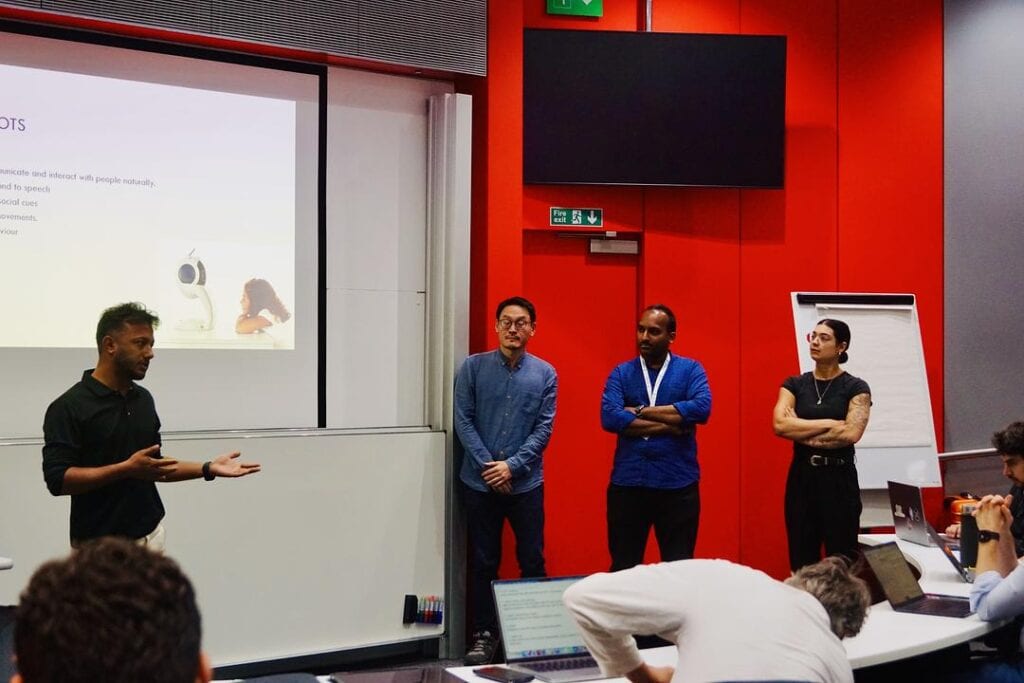
Most social robots are designed around one-to-one interaction. The group project set that assumption aside and asked how a robot could interact with several people at once.
The team split the problem into three parts. The first was detecting the active speaker in real time. The second was tracking each person's identity through the interaction, so the robot keeps track of who is who as the conversation moves. The third was generating natural gaze and head-turn behaviour, so the robot appears attentive to the whole group instead of fixed on one person.
These parts depend on one another. Gaze can only be directed well if the robot knows who is speaking. Knowing who is speaking is only useful if the robot can hold a stable identity for each person over time. The project treated them as one behaviour that has to work together.
From language to motion
The project also gave participants a view of the full pipeline from language to movement. A large language model translates natural intent into structured commands. Those commands are mapped to high-level robot functions. Inverse kinematics then turns those functions into joint trajectories. Finally, the trajectories reach the actuators through the robot's control stack.
Each stage hands a different kind of output to the next: text, structured commands, function calls, joint trajectories and actuator signals. Farooq described the exercise as a hands-on introduction to how difficult multi-party human-robot interaction is, and said it deepened his appreciation of the interdisciplinary side of robotics research.

How the places were funded
Farooq's place was funded by UK RAS STEPS, and he was one of five RTPs selected to attend. He said the programme has also run workshops that contributed to his development. He credited Marie Daniels for support and guidance through the application process, and thanked the Imperial College London team, the lecturers, the researchers and fellow participants.
Analysis: what this does and does not show
The project is a useful marker of where social robotics is difficult. One-to-one interaction lets a system assume that the person in front of it is the person speaking and the person it should look at. Remove that assumption and the robot needs perception, memory and motion control working together. The three tasks the team chose, speaker detection, identity tracking and gaze control, are a reasonable decomposition of that need.
The language-to-motion pipeline is also worth noting. It shows that a language model is one layer in a longer chain, not the whole system. The model's output only becomes behaviour after it passes through function mapping, inverse kinematics and low-level control. For group interaction, that means the quality of the robot's attentiveness depends as much on the perception and motion layers as on how well it handles language.
Several things remain unproven. The project was a week-long training exercise, and no results have been reported. The robot platform used has not been named. No measurements of speaker-detection accuracy, identity-tracking reliability or response latency have been given. Nothing indicates the system was tested with people outside the group, or that people judged the gaze behaviour natural. The stated aim, a robot that feels genuinely attentive to a group, is a perceptual judgement that needs user testing to confirm.
A comparison with other group-interaction systems also cannot be drawn from what has been reported, because none is cited. The only baseline available is the observation that typical social robots are built for one person at a time. Against that baseline, the project is a sensible direction rather than a demonstrated advance.
What it does show is how the field trains people for this problem. Bringing together students, academics and industry staff, and exposing them to quadruped locomotion, tactile sensing and surgical vision in the same week, encourages the cross-disciplinary thinking that multi-party interaction needs. Whether such projects lead to deployed systems will depend on follow-up work that reports measured performance.