A soft growing robot with an outer diameter of 1.8 mm and a wall thickness near 100 microns can now be steered by magnets, track its own shape in real time and extend without any internal air pressure. Researchers at the University of Leeds and the University of California San Diego built it. The work won the Best Paper Award at RoboSoft, the international conference on soft robotics research.
The paper is titled "Pressure-free Magnetic Soft Growing Robot with Real-Time Shape Control and Sensing for Biome Sampling." It appears in the proceedings of the 2026 IEEE 9th International Conference on Soft Robotics. Benjamin Calmé is the lead author.
How a growing robot moves
A growing robot behaves more like a climbing plant than a conventional catheter. It does not push or drag its whole body through a space. It extends at the tip, moving material from inside the robot outward so that it grows into the space ahead. Researchers often call these machines vine robots.
The body is soft and compliant. When it meets an obstacle, it deforms and follows the path of lower resistance. Calmé said this suits constrained, delicate anatomy.
Friction is the main clinical motivation. Flexible tools used today still rub against tissue as they are inserted and withdrawn, which can cause irritation or inflammation. In a growing robot, the sections already in place move far less because new material advances at the tip. Calmé said this can mean less discomfort and fewer side effects. He also said it could let clinicians attempt procedures in regions such as the brain, where the margin for error is small.
Removing the pressure
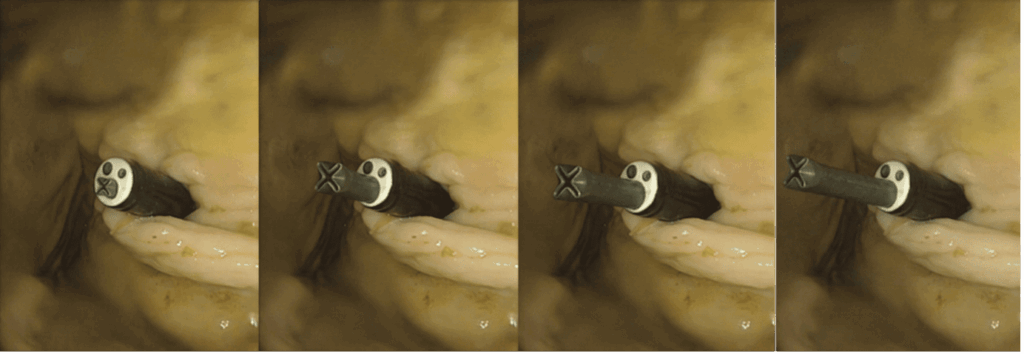
Many earlier growing robots relied on internal air pressure to extend. Calmé said that is a problem in fluid-filled spaces near the spine or inside blood vessels, because air entering through a leak is unacceptable. Without internal pressure, that risk is removed.
Control improves as well. In some earlier prototypes, the team used pressure to grow and magnetic fields to steer. That forced the system to alternate between growth steps and steering steps. The new design grows and steers at the same time, which Calmé said makes it faster and more usable.
Magnetic patterns for steering and sensing
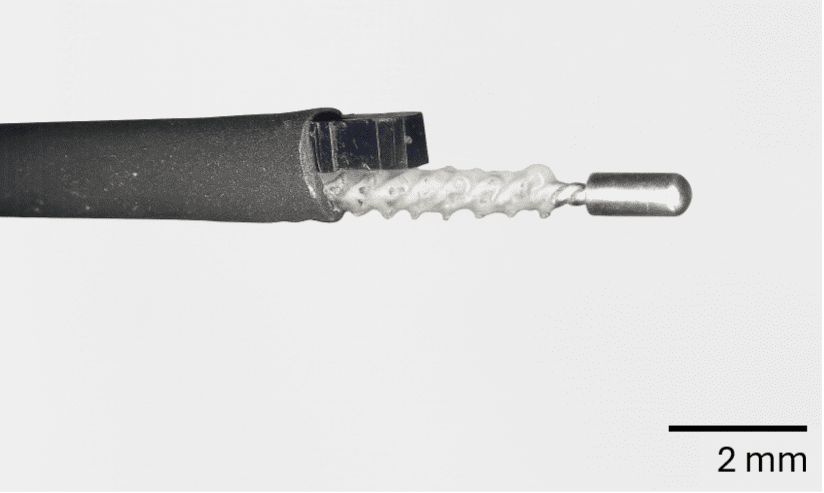
The team builds the actuation and the sensing into one structure. They mix magnetic particles into silicone, mold the material, and then magnetize regions in controlled directions. Calmé calls the resulting pattern the robot's magnetic DNA.
The part that magnetizes is the internal tail section of the robot. That tail later everts and becomes the outer body as the robot grows. Before this happens, the team places the material in a coil and applies a strong magnetic field. Orienting the material during magnetization assigns different magnetic directions along its length and cross-section.
Once the robot is deployed, moving an external magnet around it produces specific deformations. Because the magnetic pattern is known, tracking how the magnetized regions move lets the team estimate the robot's shape. Sensing updates arrive at up to 500 Hz.
Calmé said many earlier designs place separate actuators or sensors along the body, and those can become slow, bulky or hard to shrink to catheter scale. One design challenge in this work was unwanted attraction between the inner and outer layers, which would raise friction. Patterns that gave useful control without sticking took significant optimization.
Manufacturing was another hurdle. The work required careful control of injection molding, vacuum processes, particle distribution and defect prevention. Calmé said tiny bubbles or inconsistencies can affect both mechanical performance and magnetic behavior.
What was demonstrated and what comes next
The team tested the robot in an ex vivo stomach model. It performed retroflexion, a maneuver that bends the instrument back on itself, and it carried out biopsy sampling. Calmé said these show the robot can perform endoscopic maneuvers in realistic anatomy rather than only on a bench. He described them as a first demonstration that a pressure-free growing robot can do meaningful work in settings resembling real procedures.
The team's longer-term interest is neural and spinal applications, where precise electrode placement could help restore function after injury. Calmé described development as early. He named a realistic near-term target as robust pre-clinical performance, covering safety, biocompatibility and in-vivo demonstrations. He said clinical adoption will take much longer because regulation must be rigorous.
Calmé trained first in medicine and then in engineering in France, and worked in robotics labs in Paris and Strasbourg before joining Leeds. He describes part of his role as translating between surgeons and engineers.
Analysis: why it matters and what is unproven
The significance lies in combining three properties that earlier growing robots tended to trade against each other. Removing internal pressure addresses a specific hazard in fluid-filled anatomy. Simultaneous growth and steering removes the stop-and-start sequence of the earlier pressure-driven prototypes. Embedding both actuation and sensing in the magnetized silicone avoids adding separate parts along the body, which is what makes a 1.8 mm diameter plausible. A soft growing robot at this scale sits in the size range of catheters, which is where clinical relevance begins.
The comparison with existing tools is mostly about friction and safety margin, and those claims rest on mechanism. A tip-extending body should rub less than a pushed one, and Calmé says it can significantly reduce friction. No friction measurements or head-to-head comparisons with conventional scopes have been reported here, so the advantage is reasoned rather than quantified.
Several questions remain open. The only anatomical demonstration is in an ex vivo stomach, and in-vivo work has not been done. No accuracy figure has been given for the shape estimate, only an update rate of up to 500 Hz. Biocompatibility of the magnetic-particle silicone is listed by the team itself as a pre-clinical goal. The method also depends on an external magnet moved around the robot, and the practical hardware that implies in an operating room has not been described. The neural and spinal applications that motivate the work have not been tested.
The result is best read as a strong proof of concept for a manufacturing and control approach. The next evidence to watch is in-vivo performance and measured sensing accuracy. Regulatory progress will follow later, as Calmé himself says.