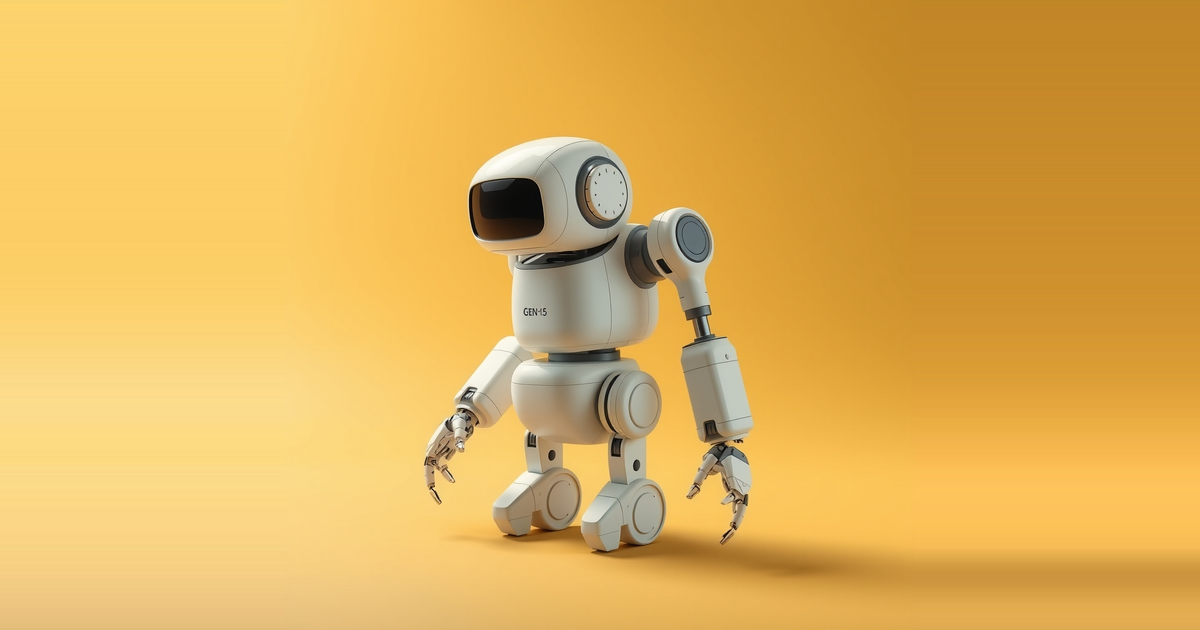
Generalist says its GEN-1.5 robot foundation model can learn a new physical task in seconds from a single example, with no gradient updates and no fine-tuning. The company describes this as one-shot robot learning, and says it is the first model it knows of in which one-shot and few-shot learning of physical skills have emerged at scale.
What Generalist claims
GEN-1.5 is the company's latest robot foundation model. Generalist frames the result around a human ability: people can pick up new physical skills from one or a few examples. The company says GEN-1.5 shows the beginnings of that same ability.
The model learns from demonstration. It shows broad capability across one-shot and few-shot learning, and it also shows zero-shot physical generalization, meaning it handles some situations without being shown any example. Generalist says the learning happens without gradient updates or fine-tuning, so the model's weights are not retrained for each new task.
The company is open about the limits. The tasks are simple and short-horizon. Generalist presents the work as a significant step toward its stated mission of building general intelligence for the physical world, not as a finished capability.
One caveat applies to the claim of novelty. For many tasks where the model appeared to work something out on its own, Generalist's blog post can only say that there was no relevant pretraining data "to the best of our knowledge." That is a statement of belief about the training set, not a verified exclusion.
Other work shown this week
GEN-1.5 was one of several research and product demonstrations in a weekly roundup of robotics video. The others were narrower in scope.
Unitree published a video of a robot performance that prompted a pointed question about commercial use. The guess offered was high-speed, high-risk package delivery to second-floor windows.
A team at the Italian Institute of Technology showed BeanBot, a robot inspired by Mexican jumping beans. AgileX Robotics showed a group of robot drummers.
The AIMS Group at the Hong Kong Polytechnic University and the DRAGON Lab at the University of Tokyo described a trajectory-optimization framework for aerial robots. They call it the first one based on sequential convex programming for generalized multirotors, covering both conventional and omnidirectional platforms. The goal is to move through a sequence of arbitrary poses quickly, precisely and continuously. The team chose a first-principles analytical model over learning a behavior from data.
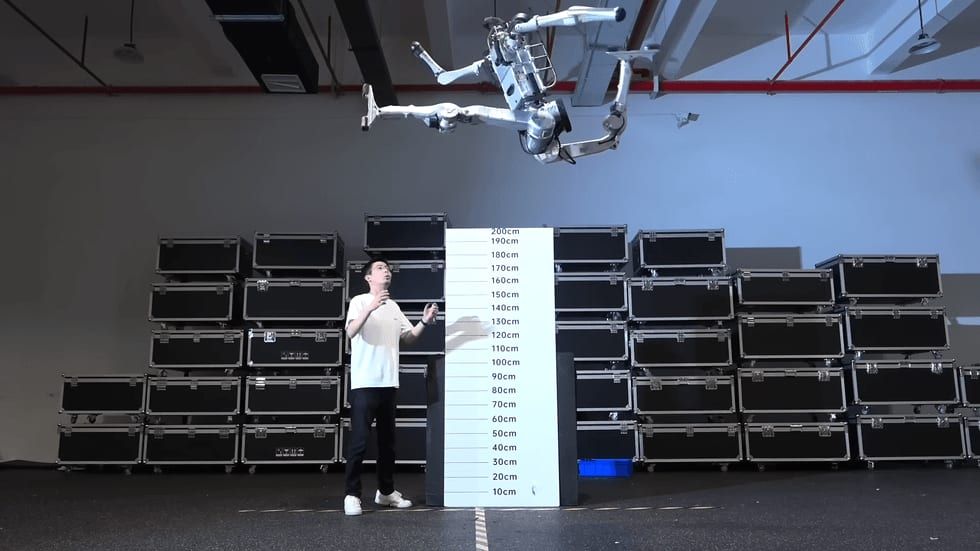
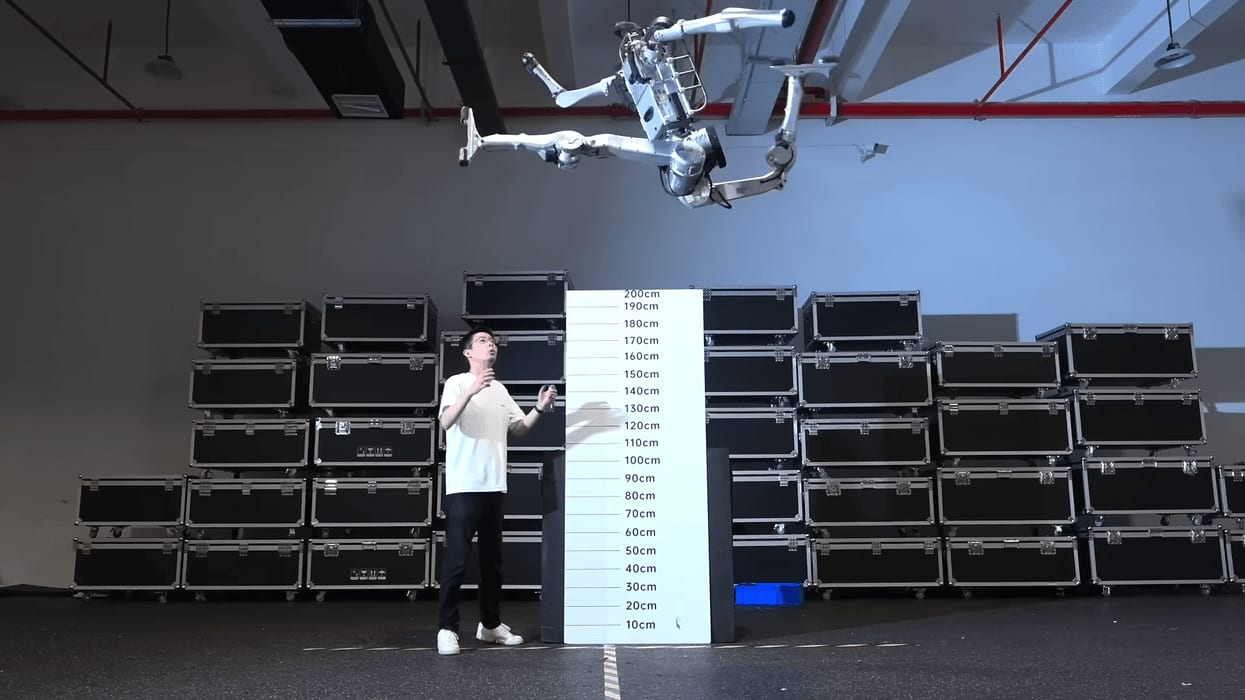
A separate group, EVARL, described a learning-based approach to brachiation, the swinging locomotion used by apes. Its method is called waypoint-guided reinforcement learning. It guides the end effector through waypoints while reinforcement learning explores whole-body motion. The learned policy handled courses with different bar heights, spacings and orientations in sim-to-sim experiments. In the real world, a life-size dual-arm robot traversed four consecutive bars.
Gravis Robotics promoted the Gravis Rack, a retrofit kit that turns off-the-shelf hydraulic machines into robots. It adds cameras, lidar and onboard compute, plus learning-based control meant to let a machine work close to its limits and move more dirt with full, fast cycles.
Kawasaki showed a different approach to robotic welding in shipyards. Flexiv showed an agricultural robot. PHYBOT showed a referee-themed clip. Zhejiang Humanoid showed home humanoids. SRI shared footage of Shakey the Robot.
TS-Robotics described a physical human-robot interaction method that uses the joint torque sensors of standard collaborative robots. A passive, uninstrumented plexiglass touchpad is mounted to the robot's flange, which turns the robot into a handwriting-based input interface. MIT showed an interface of a kind often used for robot training, adapted to train humans instead.
Upcoming events
Humanoids Summit Seoul runs 22–23 September 2026 in Seoul. IROS 2026 runs 27 September to 1 October 2026 in Pittsburgh. CoRL 2026 runs 9–12 November 2026 in Austin.
Why it matters and what is unproven
The most consequential item here is GEN-1.5, because it targets a cost that limits robot deployment. Most robot learning pipelines need data collection, training or fine-tuning for each new task. A model that adapts from one demonstration, without touching its weights, would move that work to the moment of use. That is the same property that made in-context learning useful in language models, and Generalist is claiming an early physical version of it.
The comparison with other items this week is instructive. The DRAGON Lab and PolyU work solves aerial pose-sequencing with an analytical model and no training data. The EVARL brachiation work uses reinforcement learning, and its hardest result is four real bars on a life-size robot. Both are specific, bounded and measured. GEN-1.5 is broader in ambition, but the evidence described is less quantified: the source gives no success rates, task counts or robot hardware.
Several points remain unproven. First, the tasks are simple and short-horizon, so it is unknown whether one-shot robot learning holds for long sequences where errors compound. Second, the pretraining-data caveat means that a claimed new skill may sit closer to the training distribution than it appears. Third, no independent evaluation has been described, and there is no stated comparison with fine-tuned baselines on the same tasks.
None of this undercuts the claim. It sets the standard for the next round of evidence: published success rates, clearly documented training data, and tests on tasks that take more than a few seconds. Until those appear, GEN-1.5 is best read as a credible early signal that one-shot robot learning can emerge at scale, not as proof that it generalizes to real work.