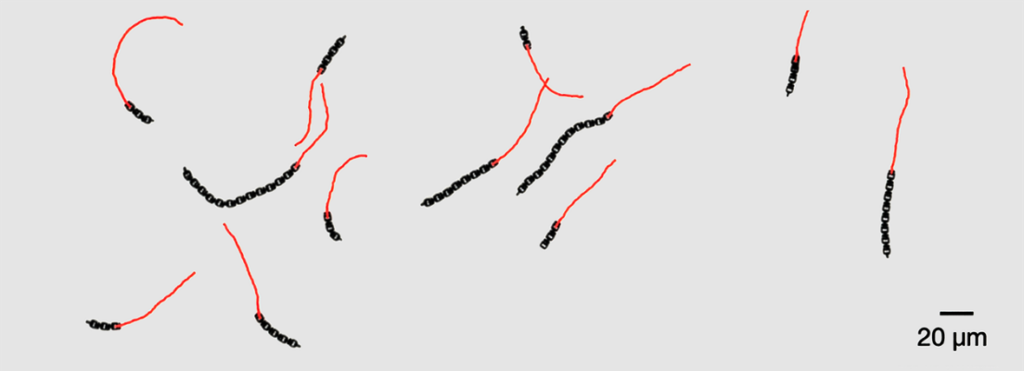
A chain of 5 µm elements joined by bars just 0.5 µm thick can swim at 7 µm per second, avoid obstacles and steer away from other chains, with no sensors, software or external control. The flexible microrobots were built by Professor Daniela Kraft and Mengshi Wei at Leiden University. Their behaviour comes from their shape and from how that shape interacts with the surroundings.
A chain built at the limit of 3D printing
The design is a soft, chain-like structure made of flexibly connected segments. The team printed it on a Nanoscribe 3D microprinter from synthetic material. Each element is 5 µm in size, and the bar-joints linking them measure 0.5 µm.
For scale, a human hair is around 70 to 100 µm thick. The researchers describe the work as 3D printing at the very edge of what is technically possible.
The elements are self-propelled, and the chain as a whole moves at about 7 µm per second. The motion starts when an electric field is switched on. Kraft and Wei did not expect that result. Once the chain begins to swim, its flexibility gives it a life-like appearance.
Shape and motion shape each other
Kraft says the team found continuous feedback between the robot's shape and its movement. The shape influences how the chain moves, and the movement in turn alters the shape. In her words, the microrobot senses how the environment changes its body and reacts to it.
This feedback replaces components that a robot of this size could not carry. Kraft says the approach means microscopic electronics are not needed to build in smart abilities.
Wei describes one effect seen when a chain is slowed or stopped. It starts to wave its tail as if trying to break free. The elements at the back still want to move, and their flexibility lets them do so.
Behaviour seen in the lab
Wei reports that when a microrobot meets an obstacle, it automatically searches for another route. When two robots meet, they steer away from each other without any instruction to do so.
The chains can also move through dense environments. They push aside objects that hinder their motion and keep going.
None of these behaviours is programmed. They emerge from the physical structure of the chain and its contact with what surrounds it.
Where the work goes next
The team points to biomedical uses for robots that can navigate complex environments on their own. The examples named are targeted drug delivery, minimally invasive medical procedures and diagnostics.
Kraft says the next step is to understand fully how such dynamic and functional behaviour arises. That knowledge, she says, should support more advanced microrobots and devices. It should also improve understanding of the physics of biological microswimmers and organisms. The work is described in a paper titled Life-like behavior emerging in active and flexible microstructures, by Wei and Kraft.
Analysis: what this changes and what is still open
The central claim is about design philosophy. Kraft notes that microrobots until now were either small and rigid, or large and flexible. A chain that is both small and flexible fills that gap. It also suggests that at this scale, mechanical structure can do work that electronics would otherwise be asked to do. Sensing, in this case, is the body deforming under load. Obstacle avoidance and robot-to-robot avoidance follow from that deformation rather than from a control loop.
That matters for the field because microscopic electronics are hard to add to a body this small. A 5 µm element leaves little room for a processor or sensor. A robot whose useful behaviour is built into its geometry avoids that problem. It also removes the need for a communication link to each unit, which is one of the harder parts of controlling many tiny machines.
The comparison with existing work should be made with care. The source states the small-and-rigid versus large-and-flexible split, but it gives no benchmark data against other microrobots. The 7 µm per second speed is about 1.4 element sizes per second. That figure is a useful reference, but the source does not report how it compares with other designs, so no ranking can be drawn from it.
Several points remain unproven. The source reports the behaviours as lab observations. It does not describe tests inside biological fluids, tissue or a living body. The motion starts when an electric field is switched on, and the source does not say how such a field would be applied in a medical setting. It also does not say whether the chains can carry or release a drug, or how many units could work together.
The biomedical applications are therefore stated aims, not demonstrated results. Kraft herself says the team still needs to fully understand how the behaviour emerges. Until that is clear, it is hard to predict how the design would respond to changes in size, stiffness or surroundings.
The strongest finding is a narrower one. Flexible microrobots at this scale can show adaptive, life-like behaviour with no onboard intelligence. If the feedback between shape and motion can be understood and tuned, it gives designers a new way to build capability into the structure itself.