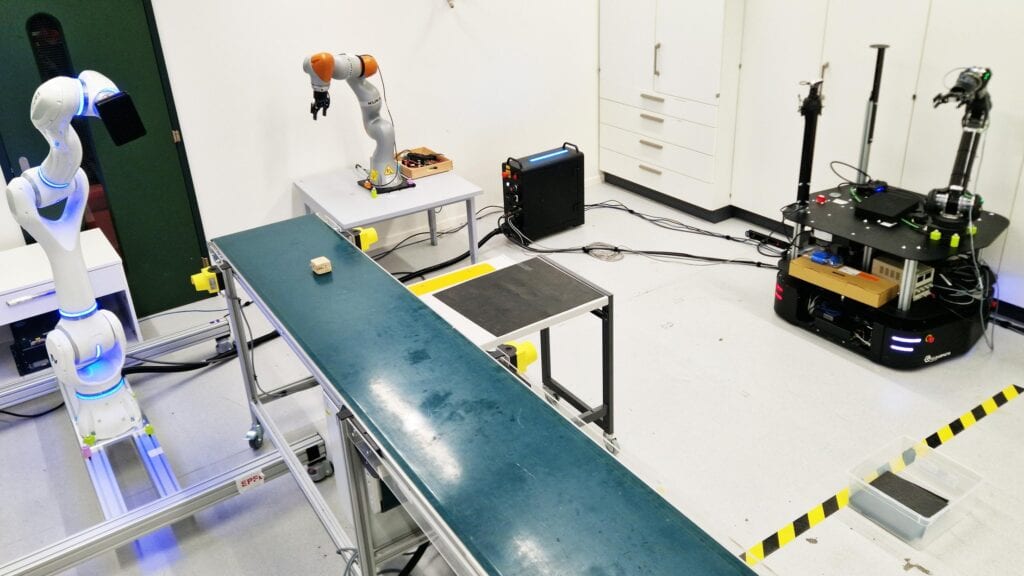
A human pushed a wooden block off a conveyor belt onto a workbench, placed it on a table, and threw it into a basket. Three commercial robots with different mechanical designs then reproduced that sequence safely and reliably from the same demonstrated skill. The experiment comes from the Learning Algorithms and Systems Laboratory (LASA) in EPFL's School of Engineering, where researchers built a control framework for cross-robot skill transfer called Kinematic Intelligence. The work is published in Science Robotics.
The problem with upgrading a robot fleet
In manufacturing, upgrading a fleet often means starting over. New hardware has to be installed, and the tasks have to be programmed again. Two robots built for similar jobs can still differ in how their joints are arranged and how far those joints can move. A task written for one robot therefore often cannot be used on another.
That repeated work is a cost. The researchers argue that letting skills move directly between robots would make these systems more sustainable and more cost-efficient. LASA head Aude Billard describes it as a long-standing challenge: transferring a learned skill across robots with different mechanical structures while guaranteeing safe and predictable behavior.
How Kinematic Intelligence works
The method starts with a person. The team recorded human demonstrations of object-manipulation tasks, including placing, pushing and throwing, using motion-capture technology. They then converted those recordings mathematically into general movement strategies. A strategy of this kind is not tied to any one robot body.
The second part is a systematic classification of the physical limits of different robot designs. It covers how far their joints can move and which positions they must avoid to remain stable. The framework uses this classification to tailor the general movement strategy automatically to each robot. The aim is that every robot can carry out the task within its own mechanical limits.
In short, the demonstration is converted once, and each robot's constraints are applied afterward. The person does not reprogram the task for each machine.
The assembly line experiment
The test used an assembly line setup. The human demonstration had three steps: pushing a wooden block off a conveyor belt onto a workbench, placing it on a table, and throwing it into a basket. Three completely different commercial robots reproduced the sequence using Kinematic Intelligence.
The robots did not all do the same thing. According to LASA PhD student and co-first author Sthithpragya Gupta, each robot handled different steps of the task. The system also worked when the allocation of steps was changed. "Each robot interprets the same skill in its own way, but always within safe and feasible limits," Gupta says.
The source does not name the three robots or report success rates, cycle times or the number of trials. Those details would be needed to judge how the framework performs outside a single demonstration.
What the team wants to do next
The researchers plan to extend the framework to human-robot collaboration and to natural language-based interaction. One example they give is a person instructing a robot at home with simple commands and no technical programming. LASA scientist and co-first author Durgesh Haribhau Salunkhe frames the goal this way: "The user brings the idea and the desired behavior, and the robot should take care of the rest."
The team also points to emerging robotic platforms, where rapid hardware evolution means today's machines may soon be replaced by newer versions. Skills that transfer across such platforms could make them more practical and scalable.
Analysis: why it matters and what is unproven
The central idea is a separation of concerns. The skill is stored in a form that does not depend on the robot, and the limits of each body are handled by a separate classification. That separation is what makes cross-robot skill transfer plausible as a maintenance strategy. If a fleet is replaced, the demonstrations and general strategies could in principle be kept, and only the robot-specific adaptation would change. This is an inference from the described design, not a result the researchers report.
The safety framing is also notable. The researchers stress that behavior stays within each robot's joint ranges and avoids unstable positions. Many transfer approaches treat the new robot as something to be fitted afterward. Here the physical limits are part of the method itself. The source does not compare Kinematic Intelligence with other transfer methods, so any claim that it outperforms them would go beyond the evidence.
Several things remain unproven. The reported demonstration involves one task with three steps, on three robots, with a lightweight wooden block. The source gives no information on heavier objects, cluttered workspaces, tasks requiring force control, or longer sequences. It does not say how much expertise is needed to build the classification of limits for a new robot, which bears directly on the claim that the approach reduces the expertise needed for deployment. The application to home use and natural language instruction is a stated goal, not a demonstrated capability.
The experiment does show that one demonstration can be adapted across three different commercial machines, including when the step allocation changes. For factories facing hardware turnover, that is the right problem to target. Whether the approach holds up across a wider range of tasks and robot types is the next test, and the planned work on collaboration and language interaction will be an early indicator.