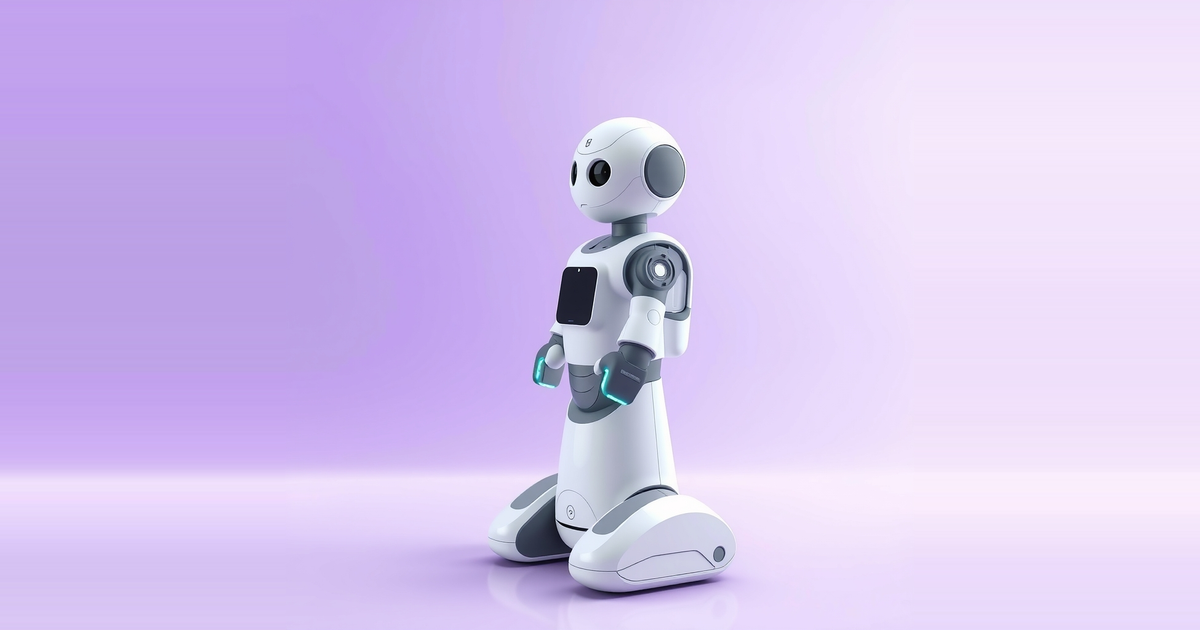
West Berkshire Council has been running a trial of robotic pets in its care homes, one of several UK experiments testing companion robots for older people. None of them resembles the android carer in the new sitcom Ann Droid, and none can do what that character does.
The comedy follows Sue, a recent widow played by Sue Johnston, and her son Michael. Linda, an assistive care robot played by Diane Morgan, is meant to provide daily support and companionship. The show exaggerates current capability. Some of the technology it draws on is already in use, though in much simpler forms.
What is being tested now
A social enterprise in south-west England has been piloting a service called Comfort Companions with Age UK South Gloucestershire. It offers AI-generated personas that hold conversations with, and give guidance to, older people who live alone and are at risk of loneliness.
The pilot runs alongside Age UK's volunteer programme. Human befrienders help older people learn to use the app. The AI companions are intended to supplement the waiting list for human befrienders, not replace them.
The West Berkshire trial uses physical robots, in the form of robotic pets. Current systems in this field tend to be AI avatars on a screen, robotic cats or dogs, or speakers that provide a voice in the room. They cannot help someone up after a fall, wash them or get them dressed.

Monitoring is ahead of companionship
The most mature capability is monitoring and prompting. Systems that detect a fall and alert another person are well developed. Other tools can encourage someone to contact friends, make a phone call or leave the house.
That gap matters when judging claims about companion robots for older people. Detecting an event and sending an alert is a narrower problem than holding up one side of a relationship.
Loneliness is not the same as being alone
Loneliness is a personal feeling that one's relationships are insufficient, together with a wish for more or better social contact. A robot is therefore unlikely to reduce it simply by being in the room. The quality of the interaction counts, as does whether the technology helps a person keep up relationships with people who matter to them.
The sitcom touches on this. Linda sometimes strengthens Sue's existing relationships, nudging her to meet friends and plan activities outside the home. Researchers in social care and human-centred robotics see this as the more useful model: a tool that keeps people connected to others, not an artificial friend that stands in for a human one.
Hardware and social limits
The physical barriers remain large. Most humanoid robots run between 90 minutes and five hours per charge when new. An overnight camping trip, as featured in the show, is a fair test of that fantasy.
Performance is uneven across tasks. A machine may play chess well, yet picking up an unfamiliar household object in a real home is still surprisingly hard.
The social barriers are harder still. Robots struggle with subtleties that people take for granted. Systems that learn by copying human behaviour can reproduce an action without grasping its intention. They also cannot reliably interpret facial expressions. A review of systems built to detect emotion from faces found they performed worst on older faces, with anger and neutral expressions among the least reliably identified.
Trust is a further issue. The sitcom plays on public worry about machines built to look after people, including an episode in which two robots joke together about killing their human companions. Research suggests older people can see value in companion robots, but acceptance depends partly on whether they feel in control. Appearance matters too. In 1970 the roboticist Masahiro Mori proposed the uncanny valley: people respond more warmly to machines as they become more human-like, until a near-human appearance turns that warmth into discomfort.
What the evidence does and does not support
The strongest point in the current picture is the way the UK pilots are framed. Comfort Companions is positioned as a supplement to a waiting list of human befrienders. That is a narrow, defensible claim. It does not require the software to match a person, only to offer something where there is currently nothing.
The weakest point is the lack of outcome evidence. The pilots described here are trials, and no results are stated. Whether an AI persona or a robotic pet reduces loneliness, as opposed to occupying time, is unproven. Because loneliness is defined by how a person feels about their relationships, the right measure is whether people end up more connected to others. Time spent with the device is not that measure.
The emotion-recognition finding is a specific risk for this field. Care is where reading a person's mood matters most, and the reviewed systems performed worst on older faces. A companion built for older users that misreads anger or neutral expressions may respond badly at the moments it is most needed. That argues for designs that prompt and connect people over designs that claim to read feelings.
Compared with the humanoid carer on screen, the practical products are modest. Fall detection is mature, screen avatars and robotic pets exist, and hands-on care tasks such as lifting, washing and dressing are out of reach. Battery life and object handling suggest that gap will not close quickly. Companion robots for older people will, for now, be judged as add-ons to human care.
The robots' advantages are real. They do not get bored, tired or impatient, and they are available at 3am. But they cannot offer a relationship in which both parties choose to be present. The field also faces a question that no hardware answers: why some older people have so little human contact to begin with. A device that treats the symptom while the cause goes unaddressed risks being an expensive answer to the wrong problem.