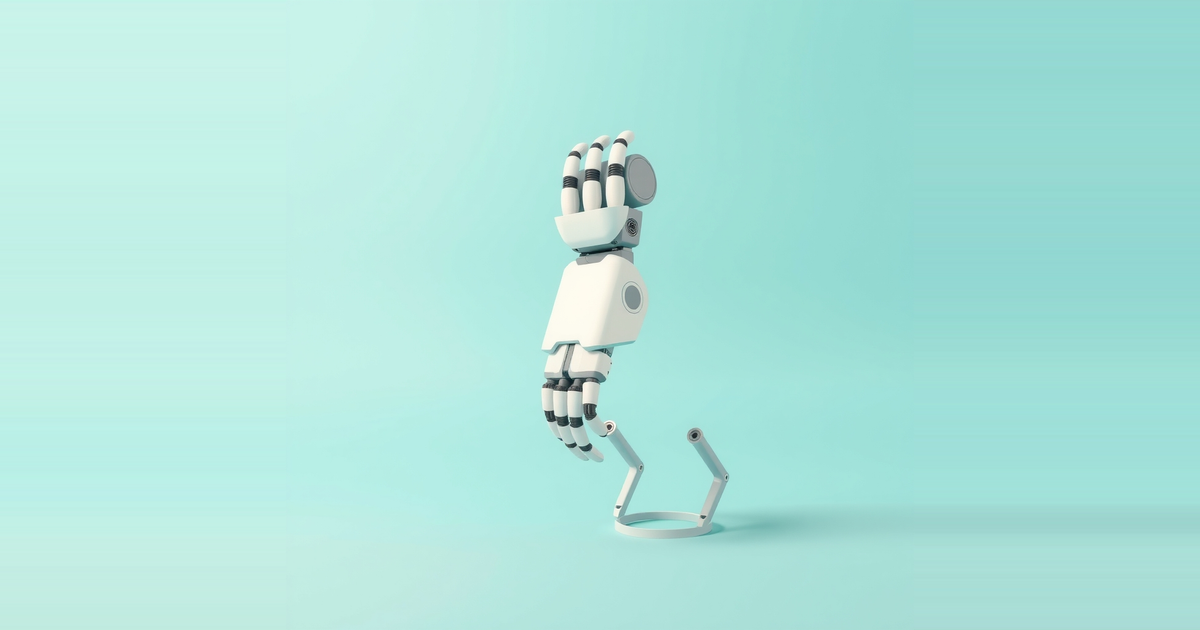
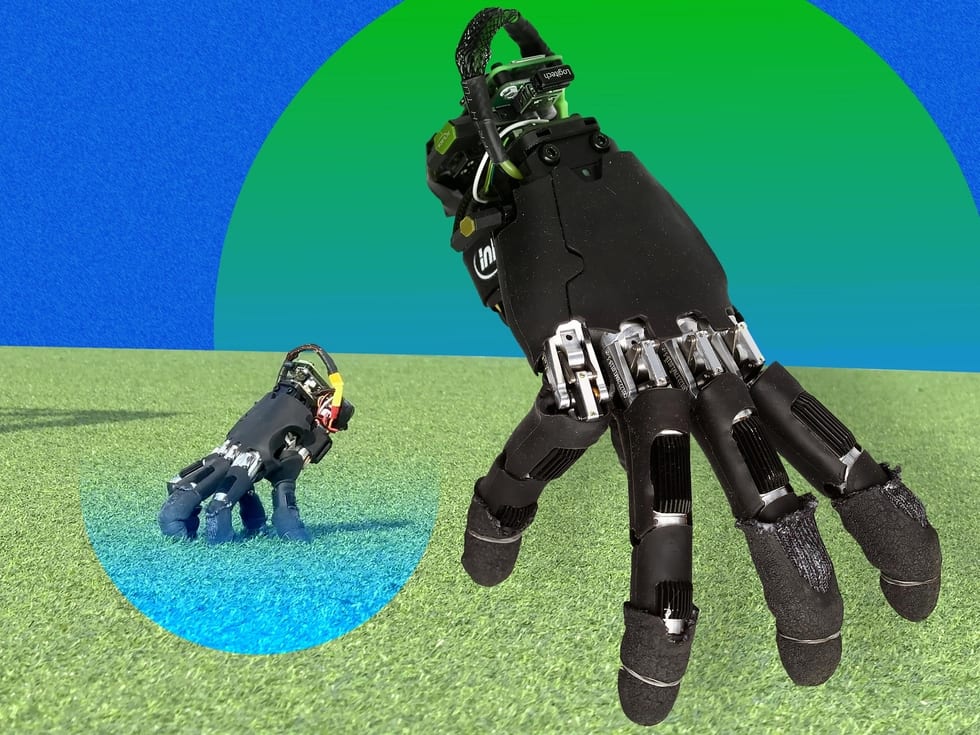
An off-the-shelf robotic hand fitted with an 80-gram backpack now crawls across floors, metal grates, grass and gravel on its fingertips, then uses the same fingers to press keys and push objects. Researchers in the Soft Robotics Lab at ETH Zurich built the walking robotic hand with no arm, no torso and no tether. Amirhossein Kazemipour, a Ph.D. candidate in the lab, led the project.
The hand comes from Wuji Technology. The ETH team added a battery, an inertial measurement unit (IMU) and a Raspberry Pi Zero, all housed in the backpack. Everything needed to move and act sits on the hand itself.
A commercial hand, not a custom walker
Earlier attempts to make a robot hand walk typically relied on hands designed for the purpose. The ETH team went the other way and chose commercial hardware. Kazemipour said they did not want to compromise the hand's manipulation capabilities. That choice made walking harder, he said, because a hand's shape is optimized for grasping rather than crawling.
The researchers see the hand reaching places a conventional robot arm cannot. Kazemipour points to fiddly maintenance tasks in industrial settings. He also points to search and rescue, where a robot could detach its hand to explore confined spaces too tight for the rest of its body. He described the aim in simple terms: "I wanted to see how much a robotic hand could do without the rest of the robot."
Training the fingers to be legs
The team trained its controllers in simulation using reinforcement learning. In this method a model learns through repeated trial and error, earning rewards as it approaches the desired behavior and penalties when it departs from it. Kazemipour said methods used for other legged robots could not simply be reused. Quadrupeds and bipeds tend to be symmetrical left to right, which simplifies walking and balance. A hand has fingers of different lengths and an opposable thumb.
The training rewarded moving at the right speed and in the right direction. It penalized wobbling and jerky motion. To keep the hand in a crawling stance, the team gave each finger its own target position relative to the palm, based on where that finger naturally sits when crawling. Fingers were penalized for straying from that reference, which the researchers describe as virtual springs pulling them back to the stance. The penalty for moving a finger forward or backward is significantly smaller than the penalty for moving it side to side. Stepping therefore costs the hand little compared with the reward for travelling.
The team also trained separate models for righting the hand after a fall, pressing keys on a keyboard, and pushing objects to a target. All four models fit on the onboard computer, and the controller switches between them as needed.
What the tests showed
In real-world trials the hand crawled across 14 different surfaces, including smooth floors, metal grates, grass and gravel. It made both right and left turns and reached an average speed of 9 centimeters per second. It righted itself after a fall in 21 of 25 trials.
For the pushing task, the hand was given a video feed from an overhead camera. It then autonomously pushed a 41-gram cube to targets up to 40 cm away, succeeding 15 times in a row.
Outside researchers responded with interest and caution. Masahiko Inami, a professor at the University of Tokyo whose group has developed hand-shaped walking robots, said the notable point is that the same fingers move the hand, support its weight and interact with its surroundings. He agreed a mobile hand could reach confined spaces and operate controls that a whole arm could not easily access. He added that practical deployment would require onboard perception and more robust navigation. Hideki Shimobayashi, a Ph.D. student in Inami's lab, noted that walking loads a hand very differently from grasping, so durability may be a challenge.
Matei Ciocarlie, an associate professor of mechanical engineering at Columbia University, called it a "cool result". He suggested it points to a class of mobile manipulators that are dexterous, able to cross complex terrain, and able to handle payloads comparable in size to themselves.
Analysis: what this does and does not establish
The main contribution is a method, not a finished machine. The virtual-spring penalty gives a way to train an asymmetrical, grasp-shaped hand to hold a crawling posture. That matters because the hand did not have to be redesigned around locomotion. If the approach holds up, existing dexterous hands could gain mobility through software and a small add-on package, rather than through new mechanical designs.
The comparison with earlier work is narrower than it might first appear. Walking hands already exist, including those from Inami's group. What sets this project apart, based on the reported details, is the combination of a commercial hand, a fully onboard battery and computer, and several trained skills that the controller switches between.
The limits are visible in the numbers. A speed of 9 cm/s is slow for any field task. A righting success rate of 21 in 25 means the hand failed to recover in roughly one trial in six. That is a meaningful gap for a robot meant to work alone in a tight space. The cube-pushing result relied on an overhead camera, so the perception behind it was not carried on the hand. Inami's remark that deployment would need onboard perception and sturdier navigation applies directly here. The 41-gram cube also says little about how heavy a load the hand could move, and the reported results do not state a payload figure.
Several claims remain untested in the reported work. The detach-and-explore scenario for search and rescue is a proposed use, not a demonstration. Durability under repeated walking loads is an open question that Shimobayashi raised. Kazemipour's longer-term idea, which he calls autonomous modular embodiments, would have body parts switch between serving as components of a larger robot and acting as independent agents. This hand shows only the second half of that idea: a part operating alone. Reattaching to a larger body and handing control back and forth would be the next thing to prove.