
Startups building agricultural robots will test their machines in Washington orchards, vineyards and berry fields, working alongside researchers and growers, under a new agricultural robotics incubator announced by Reservoir.
Reservoir is an agricultural innovation center and venture capital fund. It is running the program with Washington State University's Prosser Irrigated Agriculture Research and Extension Center (IAREC), the Washington Tree Fruit Research Commission (WTFRC) and the Tri-City Development Council (TRIDEC).
What the Washington program will do
The site is designed to put robotics startups to work in real production settings instead of leaving them in the lab or on a demonstration plot. Startups will operate in the state's orchards, vineyards and berry fields, with researchers and growers working beside them.
The announcement names the crops that matter most to the region: apples, cherries, pears, blueberries, wine grapes and hops. The partners describe these as some of the hardest crops in the world to automate. They also point to the conditions behind the program. Washington growers face rising labor costs, and the workforce for some of these crops is shrinking.
Each partner brings a different role to the effort. IAREC is a Washington State University research and extension center. WTFRC is a commission focused on tree fruit research. TRIDEC is a regional development council. The announcement does not give a site location, a start date, a funding amount or a list of participating startups.
Who Reservoir is
Reservoir describes its mission as helping agtech startups succeed where agriculture happens, in the field. It operates an innovation center and a venture capital arm. Reservoir VC backs startups working on problems in high-value crops and on what the company calls the rugged physical AI stack.
The company was founded in 2024. It started its innovation center in the Salinas Valley and says it hopes to expand to other key regions across California and the American West. Washington is the latest region to be added to that plan.
The model behind the incubator
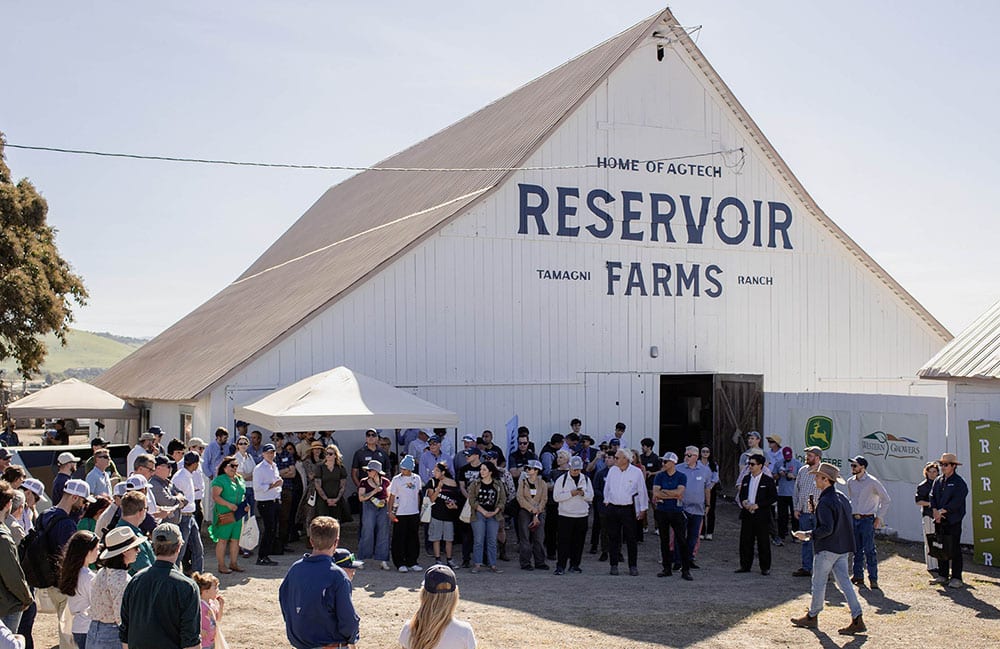
Earlier this year Reservoir opened Reservoir Farms – Salinas, its flagship on-farm innovation hub for specialty crops. The site has multiple innovation barns and 24 acres of dedicated commercial test fields. More than 300 growers, agricultural leaders, federal and state officials, community partners, investors and members of the media attended the grand opening.
Reservoir founder and CEO Danny Bernstein said the company built the hub after listening to partners about where agricultural innovation had stalled. "With the doors open, the focus turns to execution and impact – in the form of real-world solutions for growers, upskilled jobs for rural communities, and a more secure food supply for American consumers," he said.
Last summer, Reservoir announced plans to extend the on-farm model across California, Arizona and other major growing regions. Each hub is to be anchored by leading academic and research and development institutions. The Washington program follows that pattern, with a university research center as one of its partners.
The company has already tested the approach outside Salinas. It invited startups to run pilots over the winter at the University of Arizona's Yuma Agricultural Center, where they could test technologies in commercial desert vegetable production.
In August, Reservoir announced a $10 million, three-year R&D partnership with John Deere. The partnership is meant to speed real-world development and commercialization of rugged AI technologies for high-value crop agriculture. It builds on a relationship that began when Reservoir was founded. Deere said the partnership reflects its commitment to an innovation ecosystem that moves faster from prototype to grower impact.
Analysis: why the Washington hub matters and what is unproven
The most useful feature of this program is its crop mix. Salinas and Yuma are centered on vegetable and specialty crop production. Tree fruit, wine grapes, berries and hops are a different problem set. The partners themselves class them among the hardest crops to automate. Putting robotics startups in those fields tests whether the on-farm hub model can carry over from row crops to more difficult ones.
The partner list also points to a deliberate choice. The WTFRC is tied to the tree fruit industry, and Prosser IAREC is a research and extension center. Those organizations already work with growers on production questions. A startup in the program can therefore reach the people who decide whether a machine is worth buying, and the researchers who can judge whether it works. That pairing is the main way the program differs from a startup simply running a trial on a single farm.
The comparison with Reservoir's own sites is instructive. Salinas has barns and 24 acres of dedicated commercial test fields. Yuma was a winter pilot at a university center. The Washington announcement describes a site and a set of partners, but it does not state a facility size, acreage or schedule. It is not yet possible to say whether Washington will resemble Salinas with dedicated infrastructure, or Yuma with seasonal pilots hosted by a university.
Several things remain unproven. The announcement does not say how many startups will take part, how they will be selected or what growers will pay, if anything. It does not say whether the program has its own funding or draws on the Deere partnership. That partnership is described in terms of high-value crop agriculture generally, and no link to Washington is stated. There are also no results from Yuma or Salinas in the announcement, such as machines moved from pilot to commercial use.
The strongest argument for the program is the labor pressure it cites. The test of the incubator will be whether startups leave with machines that growers adopt on tree fruit, grapes, berries and hops. Until Reservoir and its partners publish participants, schedules and outcomes, the program is a credible structure and not yet a demonstrated result.