
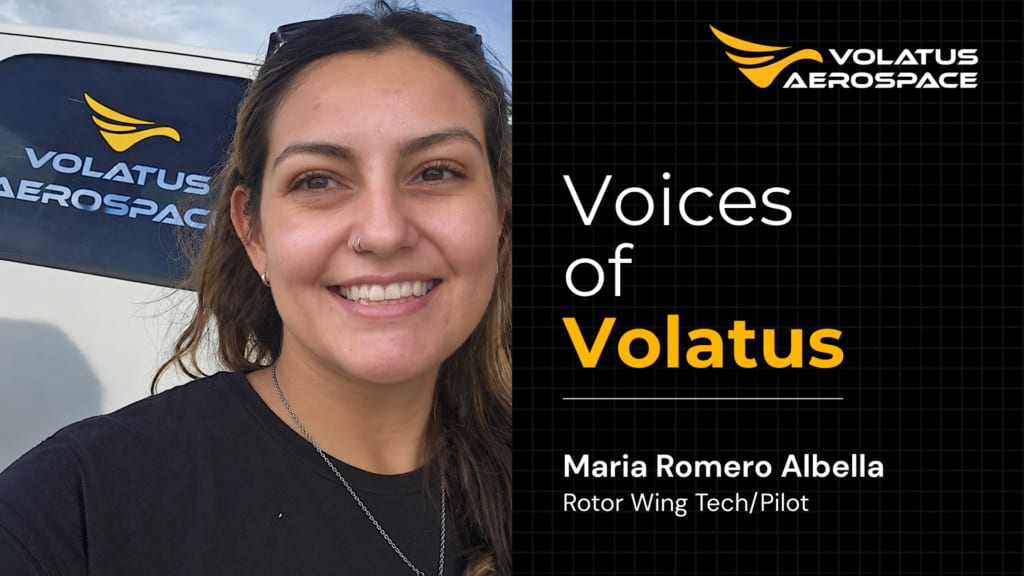
Maria Romero Abella joined Volatus Aerospace in March 2026 as a rotor wing technician pilot at its Villeneuve, Alberta, operations. She holds a dual role as Rotor Wing Technician and Pilot, and she has nearly a decade of aviation experience behind her.
Her job is to fly helicopters on operational work for the company. She describes the value of that work in one sentence: every flight has a purpose beyond simply building hours.
A decade in aviation, then the cockpit
Romero says she has spent about 10 years in aviation in different roles. Over that time, she says, the work developed naturally into flying and into helicopters. She names the versatility of the helicopter and its range of applications as what drew her to it.
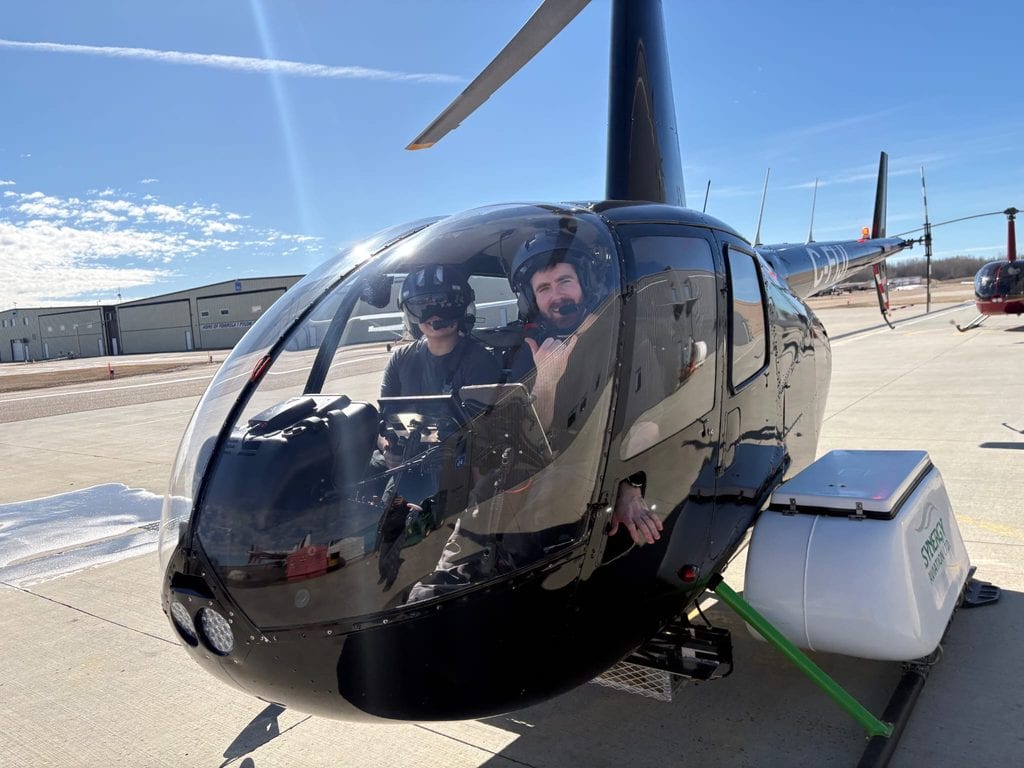
She works in Villeneuve with a team of aviation professionals that includes Brooke Standeven and Owen Drake. Their combined experience and technical expertise support the company's flight operations.
Her title combines two jobs. As a technician and a pilot, she is tied to both the aircraft and the missions it flies. The source material does not detail her maintenance duties or the specific missions she has flown, so those remain unstated here.
What the work involves day to day
Romero describes the job as one with constant problem-solving. Weather changes, operational requirements shift, and unexpected problems arise in the field. In her words, a pilot has to stay flexible, think on their feet and adjust the plan when conditions change.
She says that variety means no two days are exactly the same. She also says she enjoys an environment where she is constantly learning, making decisions and finding practical solutions as the day unfolds.
On what shaped her career most, she points to field work over classroom study. Training and studying give a foundation, she says. Real operations teach a pilot to prioritize, make decisions and adapt to what is happening in front of them. Conditions are not always perfect, so a pilot works with the resources, information and time available.
She credits that experience with building confidence, judgment and problem-solving skills that classroom learning alone cannot provide.
Team culture and career advice
Romero describes Volatus as an unusual mix of aviation and technology. Pilots, engineers, operations staff and data specialists can look at the same problem from completely different angles. She also says aviation attracts interesting people, and that colleagues usually have a story, a different perspective or something useful to teach.
Her best career advice is to take the job that will teach you something, not just the one that looks best on paper. It matches the way she describes her own path, which moved from varied aviation roles into flying.
Outside work, she paints, draws and does craft projects. She calls it a contrast to the technical and structured side of the job.
For readers who want to follow a similar route, the company points aspiring pilots to Transport Canada's resources on pilot training and licensing.
Context at Volatus and what the profile does not show
Volatus describes itself as a company that builds technology, flies missions and trains pilots. Its recent activity reflects that range. On Sept. 22, 2026, it reported a GPS-denied flight milestone for its V-Cortex autonomy platform, which it said navigated without GPS, external sensors or high-performance computing. On Sept. 29 it marked the official opening of a 53,000-square-foot facility in Mirabel, Québec, for production and system integration.
On Oct. 7 it said it had delivered an initial tranche of about C$4.5 million of ISR drones to a NATO partner under a contract valued at up to C$9 million, and that the customer had begun exercising a second-tranche option. On Oct. 28 it completed its acquisition of AISPECO, which adds sensor systems, mission software and European manufacturing capabilities.
Analysis: why a helicopter pilot profile matters to a drone company
The company's technology news and this profile sit side by side, and the pairing is informative. Volatus is a company with a crewed aviation operation and an uncrewed one. Romero's role is a small, concrete example of the first. The acquisition announcement describes the plan to combine sensor systems and mission software with the company's aviation operations. That plan depends on people who understand how flights are run in the field.
Her account of the work supports that reading. She says real operations teach prioritization and adaptation, and she describes pilots, engineers, operations staff and data specialists examining one problem from different angles. Those are the conditions in which autonomy and sensor products get tested against weather, shifting requirements and imperfect information. A platform that claims to work without GPS or external sensors will meet those same conditions outside the lab.
The comparison with other drone firms is limited by what is stated. Many companies in the field focus on either hardware or services. Volatus lists defence, manufacturing, services, equipment and training as separate lines. That breadth is a structural difference, but the source gives no revenue split, fleet size or headcount, so its effect on results cannot be measured from these facts.
Several points remain unproven. A single pilot's account does not show how much crewed flying will matter to the company's technology business. It does not show how Romero's duties divide between maintenance and flight, or whether the dual role is common at Volatus. The profile also does not say whether the V-Cortex milestone, the Mirabel facility or the AISPECO integration will change the work done in Villeneuve.
What the facts do support is narrower. Volatus is hiring pilots who learn through operational work, and it is simultaneously expanding its manufacturing and technology base. Whether those two halves reinforce each other is something the company's later results will have to show.