
Unproductive runtime fell by 50 percent at Recology's Recycle Central at Pier 96 in San Francisco after the facility deployed Glacier's DataMap, according to figures Glacier has released. The company also reports an increase of approximately 15 percent in throughput per shift and more than $1 million in projected annual labor savings. The numbers are the main evidence Glacier is bringing to a conversation about AI in recycling at the 2026 MRF Operations Forum in Chicago.
What DataMap does
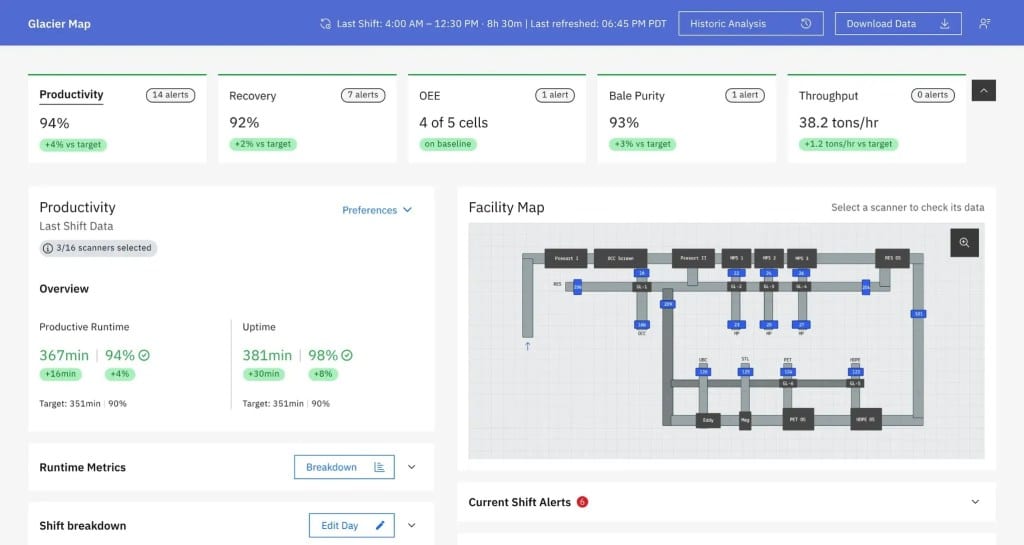
DataMap connects AI-powered vision systems across a materials recovery facility, or MRF. The software gives operators real-time visibility into material flow, equipment utilization, productive runtime and opportunities to improve recovery. Glacier says the goal is to help teams turn those observations into operational decisions.
The product addresses a long-standing gap in how MRFs are managed. Operators have traditionally built a picture of facility performance from manual observation, equipment reports and experience. A MRF is a complex and changing environment, and each of those inputs captures only part of it.
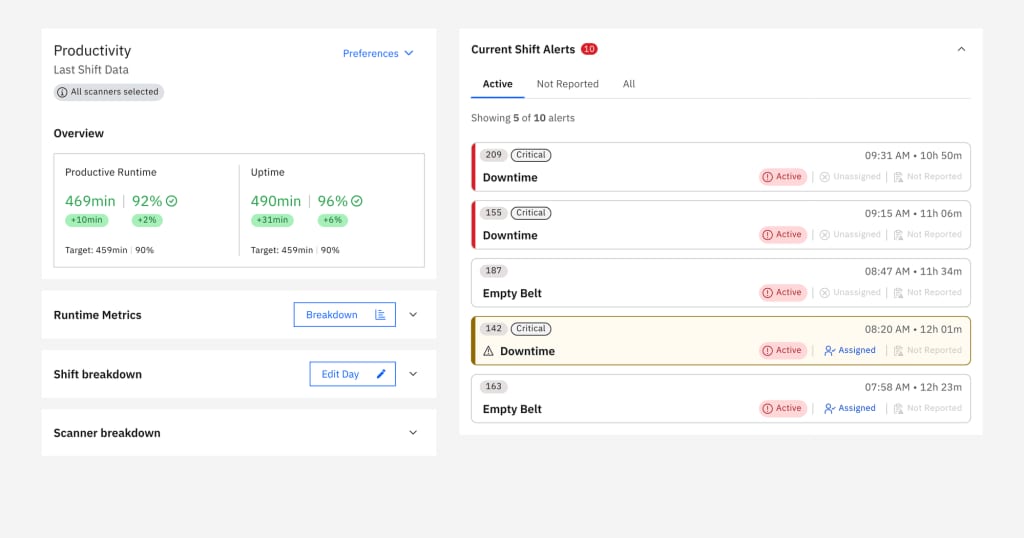
At Pier 96, Glacier says the DataMap deployment helped operators find hidden inefficiencies. It also helped them separate equipment runtime from productive processing time, and it let them measure the effect of operational changes. The distinction matters because a machine can be running without moving useful material. A runtime figure alone would not show that, and the reported 50 percent cut in unproductive runtime depends on drawing that line.

The panel and the people behind it
Anisa Nuanes, Glacier's Head of Product, leads development of DataMap. She was scheduled to speak on a panel titled "AI in the MRF: Practical Applications for Smarter Operations" on Tuesday, October 27, from 4:15 to 5:15 p.m. CT. The session was part of the MRF Operations Forum at the Marriott Marquis Chicago. The forum runs alongside the Paper & Plastics Recycling Conference.
Glacier described the panel's aim as a discussion of where AI delivers measurable value today, what operators should expect from these systems, and what comes next. The company framed the operator's standard for new technology plainly: whether it works and whether it makes the facility more profitable.
Nuanes's account of the work centers on problems that are not specific to sorting. Glacier lists collecting useful data in demanding environments, telling meaningful signals from noise, delivering information to the right people at the right time, and fitting new tools into how MRF teams already work. Glacier's own summary is that a dashboard does not recover another ton of material, and that the value lies in what operators do with the information.
Glacier's wider presence in Chicago
Glacier's team planned to attend both the MRF Operations Forum and the plastics and paper conference throughout the week. The company said it would meet customers, partners and operators to discuss robotics, material recovery and facility-wide intelligence. Glacier builds a two-armed sorting robot as well as DataMap, so the company sits on both sides of the automation question: individual sorting tasks and whole-facility measurement.
On the evening of the panel, Glacier planned a get-together at SPIN Chicago, at 344 N State Street, from 5:30 to 7:30 p.m. Attendance required an RSVP and space was limited. Some staff were expected to wear shirts featuring Gemothy, a LEGO-style character modeled on the company's sorting robot. Glacier said a very small number of collectible Gemothy kits might appear.
Analysis: what the Pier 96 numbers do and do not show
The framing Glacier chose is worth noting for the field. Most attention to robotics in recycling has gone to picking systems that remove specific items from a belt. Glacier's account moves the unit of analysis from the pick to the plant. If a facility cannot tell productive processing from idle running, adding sorting capacity may not fix the underlying loss. Measurement tools like DataMap address that earlier step, and the reported results suggest the gap can be large.
That claim still needs caution. The figures come from one facility and were released by the vendor. The source does not state the baseline period, how unproductive runtime was defined or measured, or how long the system had been running before the results were tallied. The labor savings are described as projected, not realized. A 15 percent throughput gain per shift is meaningful if it holds, but a single-site result says little about how it would transfer to a MRF with different equipment, material mix or staffing.
It is also unclear how much of the improvement came from the software and how much from the operational changes operators made after seeing the data. Glacier's own description credits the system with surfacing problems and measuring adjustments, which implies that the gains depended on operator action. That is a reasonable model, but it means results will vary with how well a facility acts on what it sees.
Comparison with other approaches is limited by what the source provides. It names no competing products and gives no cost for DataMap, so claims about relative value cannot be tested here. What can be said is that the pitch rests on a testable standard: whether the system raises throughput and lowers cost at a given plant.
Several things would settle the question. These include independent verification of the Pier 96 results, results from additional facilities, a clear definition of the metrics, and realized labor savings in place of projections. Until then, the Recology figures are a promising data point for facility-level AI in recycling, not proof that it works across the industry.