A manifesto in Nature Machine Intelligence defines a new discipline called Sustainability Robotics and asks that robots be judged by their overall contribution to sustainability goals, not by technical performance alone. Authors Sophie Song, Barbara Mazzolai and Mirko Kovač call on academia, industry and governments to adopt the framework. Kovač heads the joint Laboratory of Sustainability Robotics at Empa and EPFL's School of Architecture, Civil and Environmental Engineering.
The authors say the term should not be confused with sustainable robotics. Their aim is larger than making robots greener. In Kovač's words, "Our ambition is not to simply make robots more sustainable; they must actively contribute to solving sustainability challenges."
The tension the field has to face
The manifesto follows a 2025 paper in Science by Aude Billard, head of the Learning Algorithms and Systems Lab at EPFL's School of Engineering and Academic director of the Robotics Center. Billard gives a pointed example. A robot installs solar panels faster and more precisely than a human can. It is built from expensive materials and runs on a heavy battery that needs recharging every few hours. If the costs of building and running it outweigh the benefit of the clean energy it helps produce, she asks whether it can be called sustainable.
Billard argues that roboticists can no longer ignore that robots rely on energy-intensive power systems and on electronic components made from finite resources. She also notes that robots can help with pressing problems, including environmental and biodiversity monitoring, precision agriculture, and maintenance of bridges, buildings and power grids.
Current work, the manifesto says, follows two paths. One develops robots that allow more sustainable use of resources. The other develops robots that are themselves more sustainable, through better energy efficiency, biodegradability or recyclability. Sustainability Robotics would extend and integrate both within one framework.
Three principles and a wider scorecard
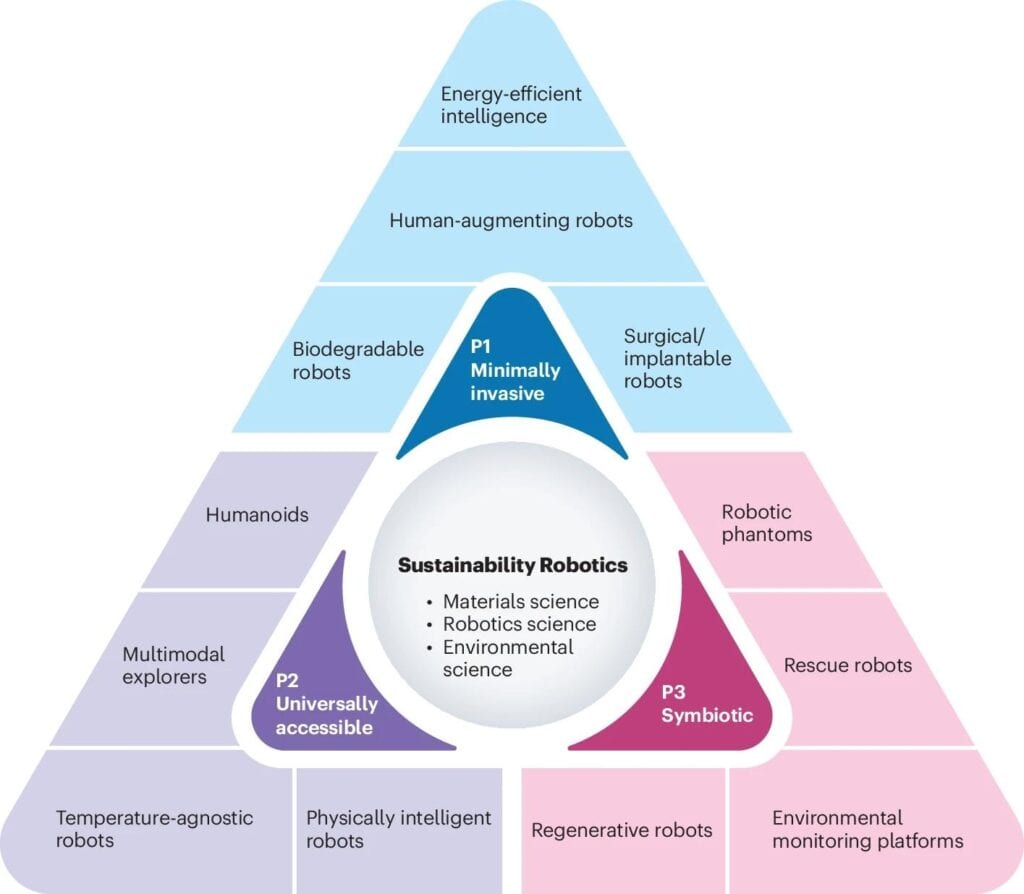
The authors argue that environmental, social and economic impacts should become part of how robots are evaluated. They propose three core principles. Robotic systems should be minimally invasive, universally accessible, and symbiotic, meaning they create value for people as well as for economies and ecosystems.
They also argue that climate change, biodiversity loss and resource scarcity need not be treated only as constraints on innovation. These pressures can instead prompt new engineering solutions. Both Billard and Kovač accept that the approach has limits. Robots designed with sustainability in mind will still need energy and materials to build and operate, and their use will still carry risks. Kovač puts it this way: "the challenge is not to eliminate these trade-offs, but to make them visible, and account for them when evaluating a robot's overall impact."
Projects already in the lab
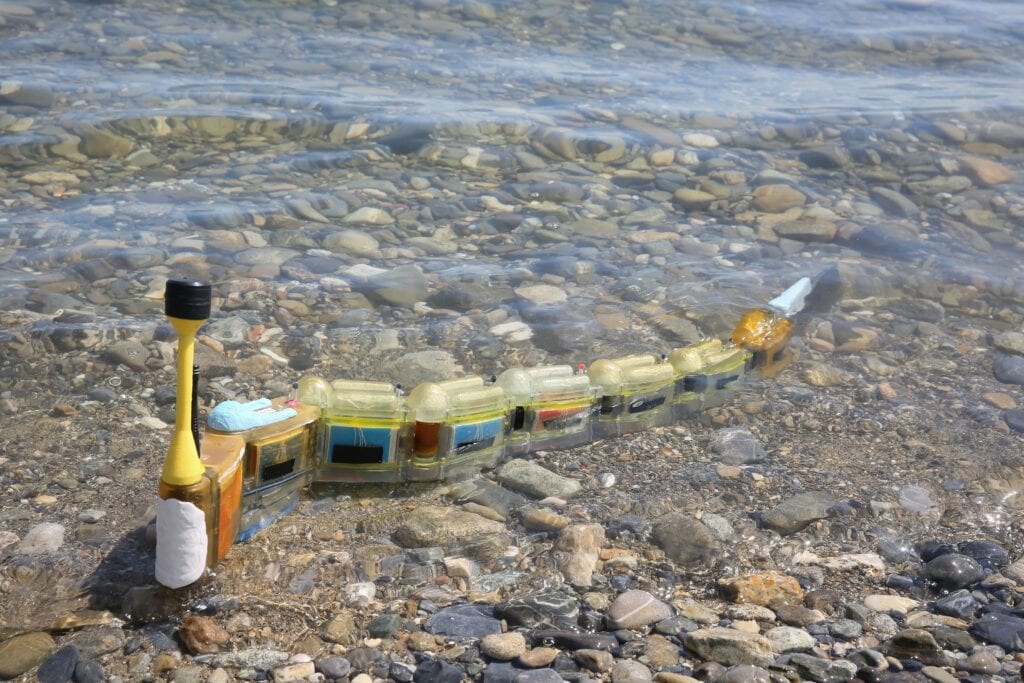
Several EPFL laboratories are working on what this could look like. The eel-inspired Envirobot, from Auke Ijspeert's Biorobotics Lab, targets autonomous monitoring of water quality. It fits the lab's wider effort to take cues from animals so that robots can work in complex natural environments.
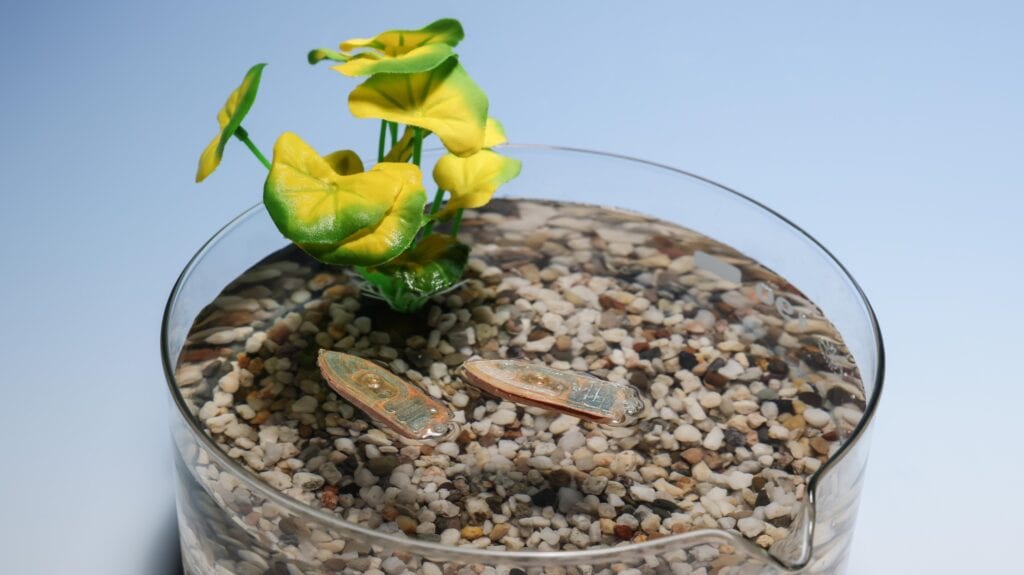
Dario Floreano's Laboratory of Intelligent Systems has built an aquatic robot made from fish food. It is also meant for environmental monitoring and can carry biodegradable sensors for pH, temperature and the presence of pollutants. At the end of its life it can feed aquatic organisms instead of becoming electronic waste. Floreano also coordinates RoboFood, an initiative on edible robots and roboticized food systems. He says such devices could deliver food to endangered areas, deliver medicine to people or animals who have difficulty swallowing, and monitor food freshness with sensors that can be eaten.
In the Lab for Creative Computation, Stefana Parascho studies how robotic workflows, which usually depend on uniform components and fixed plans, can be adapted to irregular and reclaimed construction materials. This could cut waste and let architects work with available materials instead of only standardized products.
Josie Hughes's CREATE Lab builds sustainability into robot design from the start. Its quadruped PAWS is canine-inspired and, once set in motion, can run by itself using compliant materials and synergistic joints, without activating any motors. The design relies on mechanical structure rather than increasingly complex control.
What this means, and what is unproven
The main contribution of the manifesto is a change in the unit of measurement. Robotics papers typically report speed, precision, payload or autonomy. Billard's solar-panel example shows why those figures can mislead: a robot can win on every one and still lose once its materials and power demands are counted. Asking for trade-offs to be made visible is a modest, workable demand, because it asks for reporting before it asks for any particular design.
The projects named so far also share a pattern. Envirobot, the fish-food robot and PAWS each reduce complexity, power draw or electronic waste at the design stage. That is a different approach from improving a conventional robot's battery or recycling its parts afterward. The two paths the authors describe, sustainable resource use and sustainable machines, are both present in the EPFL examples, but the manifesto's claim is that they need to be evaluated together.
Several things remain unproven. The material provided gives no scoring method for the three principles, no threshold at which a robot counts as sustainable, and no measured comparison of any of these robots against conventional alternatives. Terms such as minimally invasive and symbiotic are directional, not yet quantitative. The edible and biodegradable devices are presented as alternatives to electronic monitoring tools, but no performance or cost data accompanies that comparison. PAWS shows that motor-free running is possible, and the work does not show how far the approach extends to tasks beyond locomotion.
Adoption is the larger open question. The manifesto addresses academia, industry and governments, yet it is a call to act and not a standard. Whether Sustainability Robotics becomes a recognised discipline will depend on whether others agree on how to measure impact and then report it. Until they do, the framework offers a vocabulary and a set of EPFL case studies, not a benchmark the field can be held to.