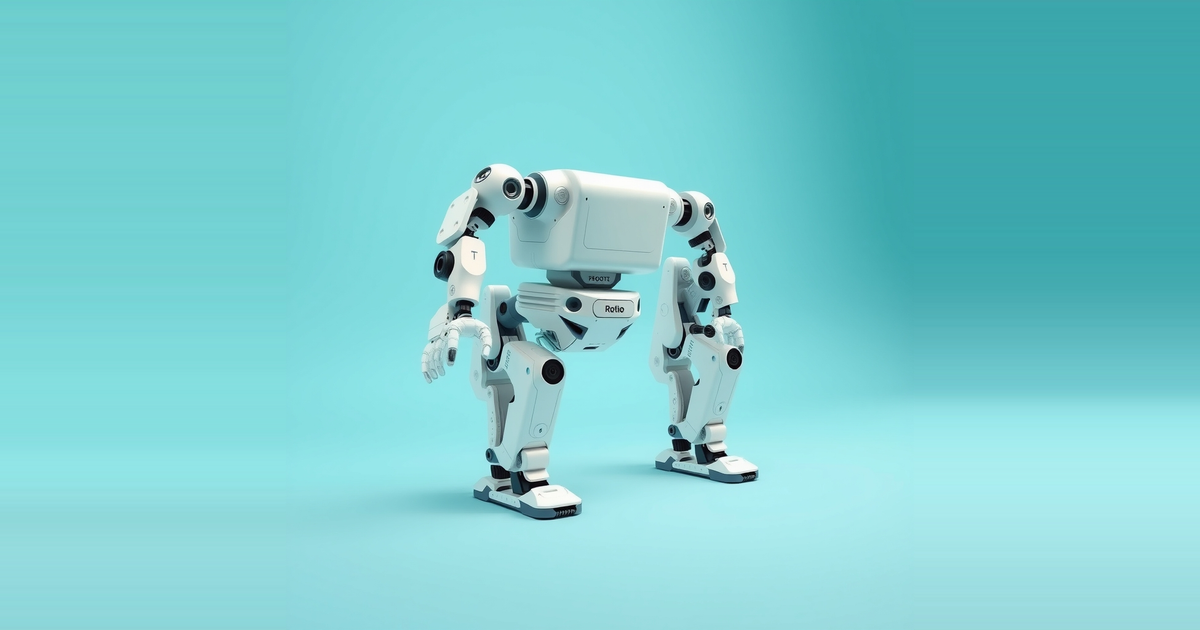
The global robotics market reached $53.2B in 2024 and is on a trajectory to $178.7B by 2033. That projection sits at the head of a new robotics technology roadmap from Henrik I Christensen, professor of computer science and engineering at the University of California San Diego. The 52-page position paper covers Asia, Europe and America. It sets out the current state of the art and the main opportunities for the decade 2025–2035.
Scope and method
The roadmap combines several kinds of evidence. Christensen drew on robotics research from leading conferences, including ICRA, IROS, RSS and CoRL. He added machine-learning venues such as NeurIPS and ICML, along with journal publications. That academic base is paired with market intelligence from trade organizations and with regional government strategies. The paper also rests on his visits to research labs across three continents.
The intended readers are policymakers, technology strategists, research agencies, and industrial research and development leaders. The document is organized to serve them. It opens with scope and methodology, then a global market baseline, then a survey of the academic research landscape. That survey spans embodied AI, foundation models, reinforcement learning, navigation, manipulation and sensing, bio-inspired locomotion, multi-robot systems, and human-robot collaboration.
Later sections cover enabling technologies, regional strategies for Europe, Asia and the USA, and the 2025–2035 roadmap itself. The roadmap is split into algorithms and AI, hardware and actuation, materials and manufacturing, and systems, safety and deployment. Sector analysis follows for manufacturing, logistics, healthcare, agriculture, mining, construction and service robots. The paper closes with cross-cutting themes and recommended research priorities for each of the three regions.

A market divided by region
The paper assigns each region a different strength. Asia dominates industrial deployment, with 74% of global installations in 2024. China alone accounted for 54%. Europe leads in safety-critical regulation and in collaborative robots, known as cobots. The United States leads in AI-powered autonomy and in defense robotics.
These divisions shape the regional research priorities the paper recommends. Deployment volume, regulatory leadership and autonomy research are concentrated in different places, and the roadmap treats that spread as a defining feature of the field.
Technology findings
The roadmap names Vision-Language-Action (VLA) models as the most consequential algorithmic development of the current period. It says they enable cross-embodiment generalization for the first time. In practical terms, that means one model can be applied across different robot bodies rather than being tied to a single machine.
On the hardware and materials side, the paper points to soft robotics and compliant mechanisms. These rely on liquid crystal elastomers (LCEs), electroactive polymers (EAPs) and self-healing hydrogels. The roadmap says they are bridging the gap between rigid industrial systems and bio-compatible medical devices.
Humanoids and regulation
The humanoid robot segment is valued at $370M in 2025. The roadmap projects it will reach $6.5B by 2030. It describes Chinese original equipment manufacturers (OEMs) and US technology companies as racing to scale production. The paper lists a humanoid convergence race among its cross-cutting strategic themes.
Regulation is the other variable the paper stresses. It calls regulatory asymmetry a critical geopolitical factor. The EU AI Act is the first comprehensive legal framework for high-risk AI systems, and the roadmap says it is reshaping humanoid robot design globally. Its framing is that rules written in one region are already influencing how machines are built for every region.
Analysis: what the roadmap does and does not settle
The main value of this robotics technology roadmap is its breadth. Much robotics forecasting is organized around one technology or one market. This paper puts research venues, market data and regional policy in a single frame, and it ends with region-specific priorities. That makes it a useful reference for funding and planning decisions that cross borders.
The regional split also carries a point about dependence. If Asia holds 74% of installations while the United States leads in autonomy and Europe in safety rules, no single region holds all three strengths. The paper's emphasis on geopolitical technology risk follows from that. Each region's strength depends on the others, and the roadmap's regional priority lists suggest the gaps will be addressed differently in each.
The numbers need careful reading. The market projection runs from $53.2B in 2024 to $178.7B by 2033, more than a threefold rise. The humanoid projection runs from $370M in 2025 to $6.5B by 2030, roughly a 17-fold rise in five years. Both are forecasts, and the humanoid figure starts from a small base that is a fraction of the overall market. The source does not state the assumptions behind either figure, so readers cannot yet test how sensitive they are to production scaling or demand.
Several claims also remain unproven in practice. The statement that VLA models enable cross-embodiment generalization for the first time is a judgment about the current period, not a benchmarked result in the summary of the paper. Whether that generalization holds across the range of hardware in real factories and hospitals is a question for deployment data. The same applies to the soft-robotics materials. LCEs, EAPs and self-healing hydrogels are described as bridging industrial and medical use, but the summary gives no timeline or evidence of commercial readiness.
The roadmap is also a position paper from a single author. It is built on published research, industry statistics and lab visits, which gives it range, but it reflects one expert's synthesis rather than a consensus process. Its strongest use is as a structured starting point. Readers who plan around it should check the market figures and regional shares against their own sources, and watch whether the EU AI Act's influence on humanoid design shows up in products as production scales.