
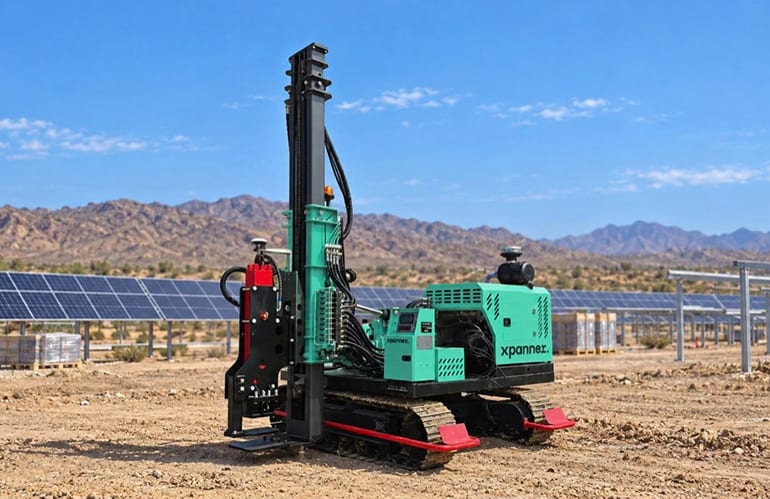
The Xpanner X1 Piling R6 drives solar and battery storage posts with a 97 kW (130 hp) engine and a hydraulic hammer rated for up to 1,260 J (929 ft.-lb.) of impact energy, and a single operator supervises the work. Xpanner, based in Santa Fe Springs, Calif., describes the machine as a fully automated pile-driving robot for utility-scale solar and battery energy storage (BESS) sites. The autonomous pile driver uses high-precision GNSS and onboard sensors to place each pile.
How the machine works
The base of the robot is Xpanner's Everstar R6 crawler machine. Xpanner fits it with its own automation stack, which combines onboard sensors, controls and a controller the company developed. Together they carry out the pile-driving process for each post without manual steering of the mast.
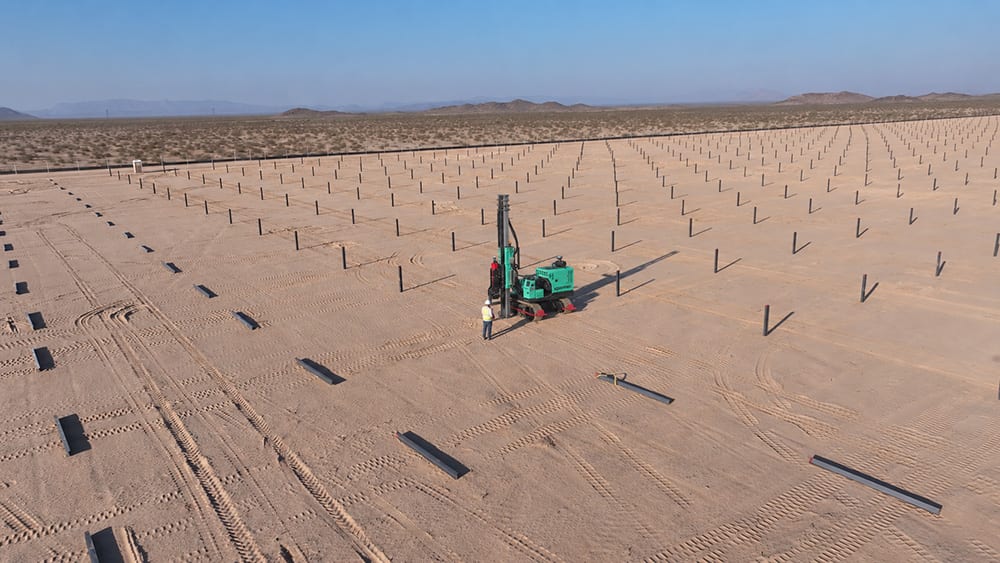
Setup begins with the operator uploading a plan. The operator then walks the machine to the row using a remote control interface and supervises as it drives each pile. From there the R6 navigates on its own to the following pile locations, relying on GNSS antennas and receivers, precision sensors and the automation controller. One operator can manage the installation remotely.
Henri Lee, co-founder and CEO of Xpanner, said builders are racing to bring new power online for the grid and for AI data centers and cannot find enough skilled crews. In his words, the X1 lets one operator drive every pile plumb with a single touch, keeps people away from the mast and logs each pile as it goes in. He said it takes the automation that EPC firms (engineering, procurement, and construction) already trust on the company's PD10 and puts it on a more powerful, more versatile machine.
Hardware built for hard ground and varied piles
The hammer is a high-frequency hydraulic unit with three energy settings, so crews can match impact energy to soil conditions. The guide rail slides 11.8 in. (300 mm) forward and back and 19.7 in. (500 mm) left and right. The upper body rotates 180 degrees. Xpanner says this puts the hammer on target from a single setup, without repositioning the tracks.
The X1 can drive piles up to 23 ft. (7.0 m) long, with a maximum driving depth of 15.7 ft. (4.8 m). The hammer lowers close to the ground and piles can be driven flush to grade. As a result, one machine handles standard tracker piles, short motor piles and BESS foundation piles without an adapter.
Field-oriented features include a mast that does not need disassembly for transport, a large fuel tank for long shifts, engine auto-idle, a large-capacity cooler, manual override and an e-stop. The multi-function mast is also listed with potential capabilities: DTH drilling, auger drilling and ground screwing on the same carrier, so one machine could pre-drill and then drive.
Project data and the business model
The X1 connects to Xpanner Connect, the company's web-based project dashboard. Project teams load the pile schedule and coordinates, assign machines and set up a site in minutes. While the robot works, it records each pile's position, depth and plumb and posts the data to a live project map. Xpanner says this replaces manual counts, phone calls, spreadsheets and end-of-day reports. Managers can also watch machine state, cycle counts and alerts across a fleet without visiting the site.
Xpanner uses a mixed capex and software-as-a-service model. Customers buy or rent the robot, then license the automation software on a monthly subscription for each active technology. The subscription is not tied to a project, a site or a number of piles driven. The customer pays while the technology is in use, and once piling is finished the equipment and software can move to another project and be activated again. Xpanner handles initial installation, calibration, operator training and technical support. The contractor supplies the equipment operators on site. The company did not state a price for the machine or the subscription.
The X1 Piling R6 is designed to work with the X1 panel lift, which Xpanner released earlier this year, for autonomous solar panel installation.
What this means, and what is still unproven
The announcement points to a clear division of labor in construction automation. Xpanner is not building a new vehicle from scratch. It is placing an automation layer on a crawler base machine, and it says the same approach already runs on its PD10. That lowers one kind of risk, since the carrier is a known type of equipment, but it also means the claim to evaluate is the software and sensing, not the chassis.
The pairing with the X1 panel lift is the more notable strategic detail. Piling and panel setting are consecutive stages of a solar build. A single vendor offering robots for both, tied to one project dashboard, could let a contractor carry pile data into later steps. That is an inference from the product lineup, not something Xpanner has demonstrated, and the source does not describe any data handoff between the two machines.
The subscription terms are also worth watching. Because the fee is tied to active use rather than to a site or pile count, the software cost follows machine utilization. For contractors with uneven schedules, that is a different cost structure from a flat license. Whether it pencils out depends on prices that Xpanner has not disclosed.
Several points remain unproven in public information. The company gives no productivity figures, such as piles per hour or comparison against a conventional crew. It gives no accuracy tolerances for placement beyond saying piles are driven accurately and plumb. It names no customers or deployed sites for the X1 Piling R6. The claim that one operator can supervise installation is stated, but the source does not say how often that operator must intervene in rough terrain or poor GNSS conditions. The manual override and e-stop suggest human control stays available when needed.
Until Xpanner or its customers publish field results, the autonomous pile driver is best read as a credible product aimed at a real labor constraint, with its performance claims still to be tested on live solar and BESS sites.